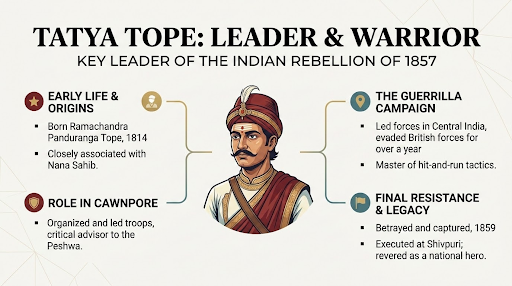
Tatya Tope, born Ramachandra Panduranga, was a brilliant military strategist and Commander-in-Chief for Nana Saheb during the 1857 Indian Rebellion. Renowned for his masterful guerrilla tactics against British forces, he was betrayed and executed in 1859.
Madhya Pradesh Archives discovered an 1857 "Hukumnama" signed by Tatya Tope.
Early Life and Background
Real Name and Birth: He was born Ramachandra Panduranga (sometimes recorded as Ramchandra Panduranga Yewalkar) in 1814, in Yeola (or Gola), near Nashik in Maharashtra.
Family: He belonged to a Marathi Deshastha Brahmin family. His father, Pandurang Rao Tope, was a respected nobleman in the court of Peshwa Baji Rao II, and his mother was Rukhmabai.
Origin of his Name: Impressed by his brilliance, Peshwa Baji Rao II gifted the young boy a jewel-studded topi (cap), which became his lifelong companion and earned him the lasting title "Tatya Tope".
Childhood Companions: After the Peshwa was exiled to Brahmavarta (near Kanpur), Tatya Tope grew up alongside Nana Saheb (the Peshwa's adopted son) and a young girl named Manu, who would later become Rani Lakshmibai of Jhansi.
Role in the 1857 Rebellion
Commander for Nana Saheb: After Nana Saheb was proclaimed Peshwa by the rebels, Tope served as his military advisor. He played a primary role in the liberation of Kanpur from British forces in June 1857.
The Battle for Gwalior: Tope and Rani Lakshmibai captured the Gwalior Fort in June 1858 after being driven out of Jhansi. This was a massive psychological blow to the British, as the Scindia of Gwalior was a British ally.
Relief of Jhansi: When Jhansi was besieged by Sir Hugh Rose, Tatya Tope led an army of 20,000 men to assist the Rani. Though he was defeated at the Battle of Betwa, his attempt showcased his commitment to the united front of the rebels.
Guerrilla Warfare: The Final Phase
Following the fall of Gwalior and the martyrdom of Rani Lakshmibai, Tope did not surrender. For nearly a year, he led guerrilla campaigns across Central India and the Deccan.
Capture and Execution
Betrayal: Tatya Tope betrayed by a former friend and trusted ally, Raja Man Singh of Narwar, who handed him over to the British in exchange for a Jagir (land grant) and amnesty.
Execution: He was captured while asleep on April 7, 1859, by Major Meade. Following a brief military trial, he was hanged on April 18, 1859, at General Meade's camp in Sipri (modern-day Shivpuri, Madhya Pradesh).
Legacy
Tatya Tope remains a supreme symbol of Indian nationalism and the struggle for independence. The Tatya Tope Memorial was erected at his execution site in Shivpuri, Madhya Pradesh.
Source: ETVBHARAT
|
PRACTICE QUESTION Q. Consider the following statements regarding the 1857 freedom fighter Tatya Tope:
Which of the statements given above are correct? A) 1 and 2 only B) 2 and 3 only C) 1 and 3 only D) 1, 2, and 3 Answer: D Explanation: Statement 1 is correct: Tatya Tope was born as Ramachandra Panduranga Yawalkar (often spelled Yewalkar) in 1814 in Yeola, Maharashtra. Statement 2 is correct: He was a loyal follower of the Peshwa family and acted as the Commander-in-Chief (Senapati) of the forces of Nana Saheb during the rebellion in Kanpur. Statement 3 is correct: After evading the British for nearly a year through guerrilla warfare, he was betrayed by his trusted friend Raja Man Singh of Narwar and captured by Major Meade’s troops in the Paron jungles. |
Tatya Tope's real name was Ramachandra Panduranga Yawalkar. He was born in 1814 into a Marathi Brahmin family in Yeola, Maharashtra.
The title 'Tope' translates to commanding officer or cannon. Historians believe he received this moniker either due to his exceptional command over artillery or from a prized, jewel-encrusted hat (Tope) gifted to him by the Peshwa.
He served as the chief military advisor to Nana Saheb and became the strategic backbone of the revolt. He led the liberation of Kanpur, attempted the relief of Jhansi, captured Gwalior, and spearheaded a highly effective guerrilla campaign against the British across Central India.


© 2026 iasgyan. All right reserved