Dr. B.R. Ambedkar (1891–1956) was the "Father of the Indian Constitution" and a pioneering social reformer. He championed Dalit rights, served as India’s first Law Minister, and founded the Bahishkrit Hitakarini Sabha, ultimately embracing Buddhism to escape the caste system.
Why In News?
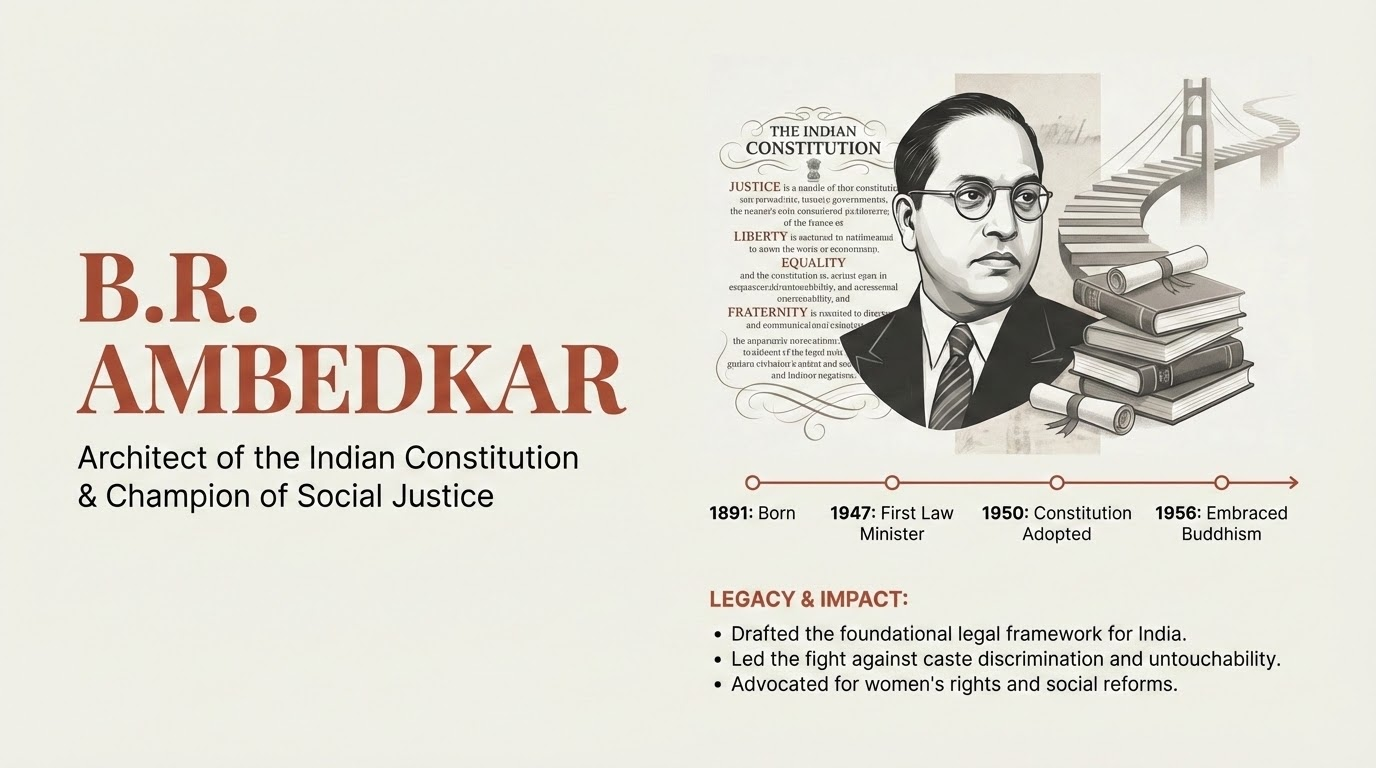
April 14th is celebrated as Ambedkar Jayanti, the birth anniversary of Dr. B.R. Ambedkar, who was the chief architect of the Constitution of India.
Who was B.R. Ambedkar?
Dr. B.R. Ambedkar (1891–1956) was a world-class jurist, economist, and social reformer who served as the Chairman of the Drafting Committee of the Indian Constitution and independent India’s first Law Minister.
What were the socio-historical conditions that shaped Ambedkar’s thought?
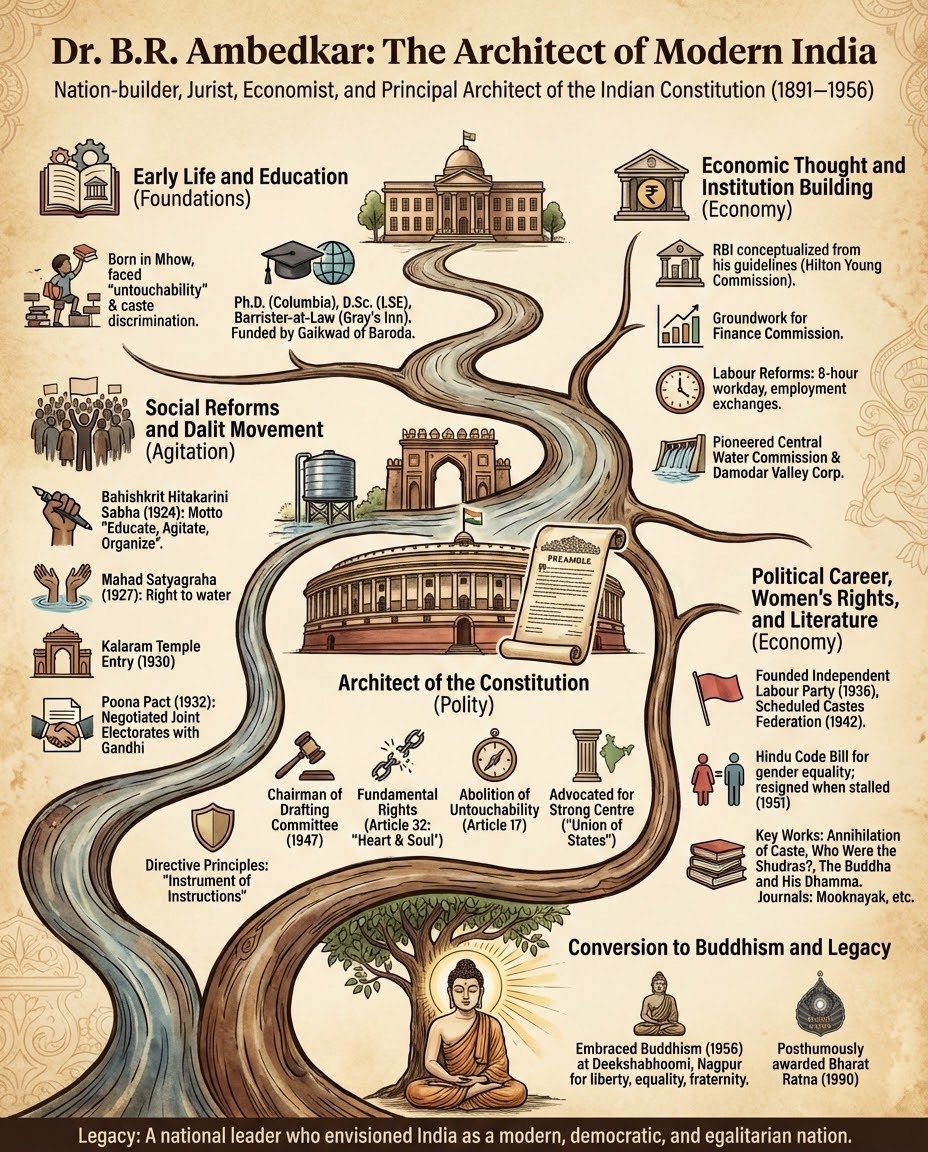
Experience of "Untouchability": Born into the Mahar caste, his childhood was marked by systemic humiliation. He was forced to sit on a gunny bag in school and was denied access to common water sources.
Influence of Western Liberalism: At Columbia University (USA) and the London School of Economics (UK), he was influenced by John Dewey’s pragmatism, which viewed democracy not just as a government, but as a "mode of associated living"
Satyashodhak Tradition: Deeply inspired by Jyotirao Phule, who earlier in the 19th century had challenged Brahminical hegemony and advocated for the education of women and Shudras.
Colonial Political Space: British willingness to categorize "Depressed Classes" as a distinct political minority (separate from Hindus) allowed Ambedkar to negotiate for specific legal and political safeguards.
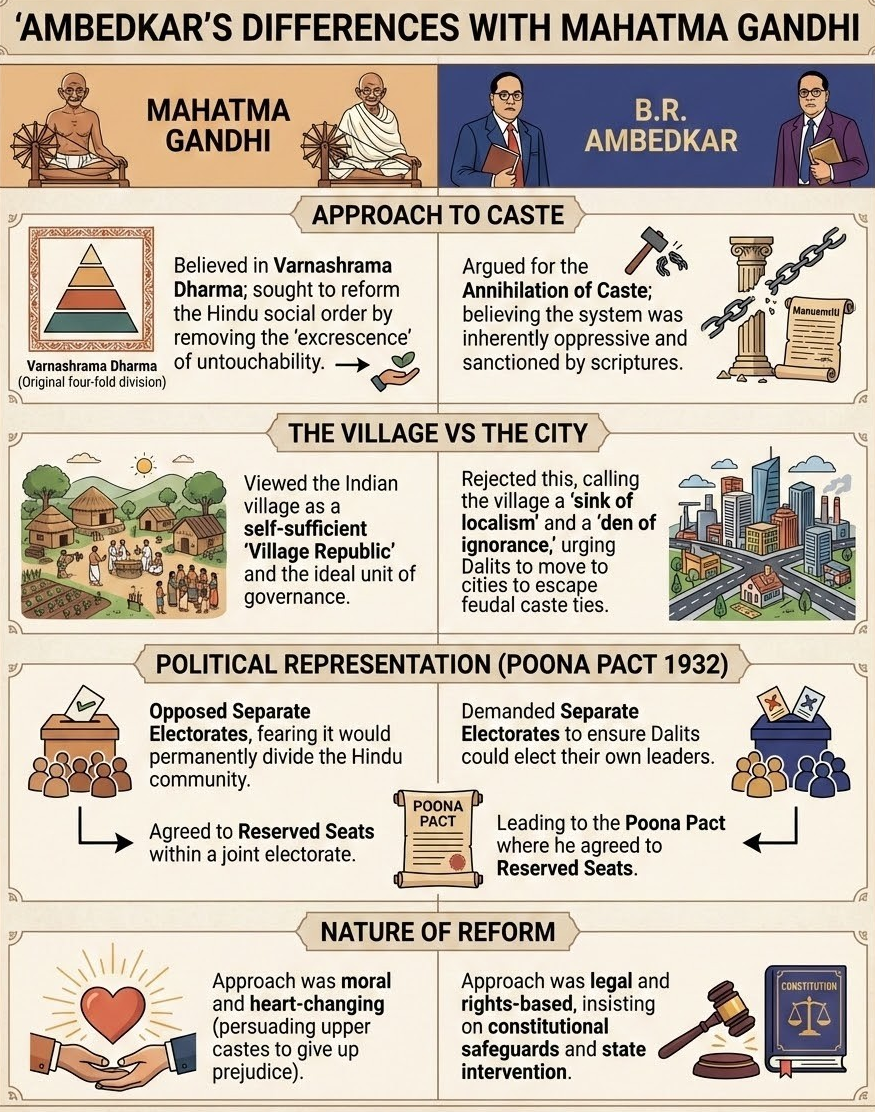
Challenging the Caste System and Social Inequality
Ideological Challenge
Direct Action and Civil Rights
Ambedkar’s Role in Shaping the Indian Constitution
As the Chairman of the Drafting Committee, Ambedkar was the primary author of the constitutional text, ensuring it functioned as a tool for social revolution.
Ambedkar’s Idea of Democracy
For Ambedkar, democracy was not merely a political arrangement but a way of life rooted in "Liberty, Equality, and Fraternity."
Contribution as an Economist and Policymaker
Reserve Bank of India (RBI): The RBI was conceptualized based on the recommendations Ambedkar presented to the Hilton Young Commission in his book, The Problem of the Rupee
Labour Reforms: As the Labour Member in the Viceroy's Council (1942–46), he introduced the 8-hour workday, maternity benefits, and the Tripartite Labour Conference to protect worker rights..
Water and Power Policy: He played a key role in establishing the Central Water Commission and the Damodar Valley Corporation, advocating for multipurpose river valley projects to prevent floods and generate power.
Finance Commission: His doctoral thesis, The Evolution of Provincial Finance in British India, provided the foundational logic for the creation of the Finance Commission to manage center-state financial relations.
Literary Contributions
Relevance of Ambedkar’s Ideas in Contemporary India
Social Justice and Affirmative Action: His policy of Reservations (Article 15 and 16) continues to be the primary tool for the socio-economic upliftment of Scheduled Castes (SCs), Scheduled Tribes (STs), and Other Backward Classes (OBCs).
Constitutional Morality: Amidst political polarization, Ambedkar’s concept of Constitutional Morality—placing the spirit of the Constitution above personal or populist whims—is frequently cited by the Supreme Court to protect democratic institutions.
Gender Equality: His work on the Hindu Code Bill paved the way for modern laws regarding women’s right to property, divorce, and inheritance, which remain central to debates on the Uniform Civil Code (UCC).
Financial Infrastructure: His economic theories on the "Problem of the Rupee" and "Provincial Finance" continue to influence the Reserve Bank of India (RBI) and the Finance Commission’s role in managing fiscal federalism.
Water and Energy Security: His role in the Damodar Valley Corporation and the Central Water Commission laid the foundation for current integrated water resource management and power grid systems.
Conclusion
Dr. Ambedkar’s legacy is not limited to being a Dalit leader; he was a national leader who envisioned India as a modern, democratic, and egalitarian nation. He was posthumously awarded the Bharat Ratna in 1990.
Source: INDIANEXPRESS
|
PRACTICE QUESTION Q. "Dr. B.R. Ambedkar’s contribution to the making of modern India goes beyond the drafting of the Constitution." Discuss. 150 words |
Constitutional Morality refers to the adherence to core democratic principles by both citizens and the administration. Dr. Ambedkar warned that the Constitution is merely a skeleton, and its success relies heavily on this moral framework. The Supreme Court notably used this doctrine in 2018 to decriminalize homosexuality.
The Mahad Satyagraha was a civil rights movement launched by Dr. Ambedkar in 1927. Its primary goal was to secure the fundamental right of untouchables to draw water from a public tank in Mahad, Maharashtra, challenging deeply entrenched caste discrimination and untouchability.
Dr. Ambedkar resigned from the Union Cabinet in 1951 in protest after conservative elements in parliament stalled the Hindu Code Bill. He had introduced this revolutionary bill to reform Hindu personal law, aiming to grant women property rights, legalize divorce, and outlaw polygamy.



© 2026 iasgyan. All right reserved