In a hung assembly, the Governor uses constitutional discretion to appoint a Chief Minister. They sequentially invite pre-poll alliances, the largest party, or post-poll coalitions to prove their majority on the assembly floor.
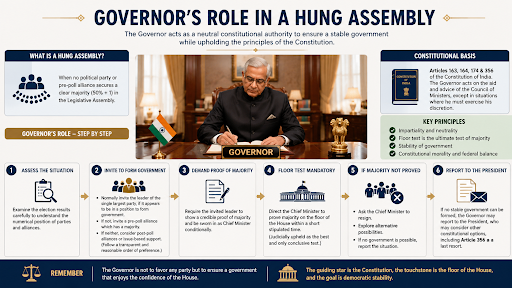
Following a hung assembly in the May 2026 elections, the Tamil Nadu Governor has postponed inviting Vijay's Tamilaga Vettri Kazhagam (TVK)—the single-largest party—to form a government, requesting majority proof first.
A hung assembly is a situation where no single political party or pre-poll alliance gains an absolute majority of seats in the house of parliament or state legislature following an election.
In such a scenario, the Governor must utilize their discretionary powers to invite a political party or alliance that they believe can prove its majority on the floor of the house to win a vote of confidence and form a stable government.
Article 164(1): Mandates that the Chief Minister shall be appointed by the Governor, which turns into a circumstantial discretionary power for the Governor during a hung assembly.
Article 163(1) & (2): The Governor possesses discretionary powers as the sole judge of their functions. Their actions cannot be questioned regarding the validity of exercising such discretion.
Article 361: Provides absolute immunity to the Governor from court proceedings for official acts, though the Supreme Court has ruled that this immunity does not shield actions that are mala fide from judicial review.
Official expert commissions have laid down a specific order of precedence for the Governor to follow when no party holds a clear majority:
|
Supreme Court on Governor’s Discretion In S.R. Bommai vs Union of India, the Court established that the floor of the Legislative Assembly is the sole legitimate forum for testing a government's majority. In Rameshwar Prasad vs Union of India, the Court ruled that if a post-poll alliance satisfies the Governor of its majority, the Governor cannot refuse the formation of the government. In the Nabam Rebia case, a Constitutional Bench unanimously established that the Governor does not enjoy absolute discretionary powers, and their actions are within the scope of judicial review if found to be arbitrary or mala fide. |
Constitutional Silence: The Constitution lacks a specific order for inviting parties during a hung assembly, creating a "constitutional silence" on how discretionary power should be used.
Arbitrary Discretion: Lacking binding rules, Governors have occasionally misused power (e.g., Maharashtra 2019), resulting in arbitrariness and violations of natural justice.
Political Instability: Subjective Governor decisions or delays enable horse-trading and "bandaged arrangements," undermining the public mandate.
Central Influence: A lack of constitutional conventions allows the ruling party at the Centre to maintain an upper hand in States through partisan Governor appointments.
Prioritize Floor Tests: The floor test must remain the primary method for proving a stable government.
Constitutional Reform: Amendment to curb arbitrary discretion by Governors to protect constitutional principles.
Formalize Conventions: Sarkaria Commission guidelines for Chief Minister appointments in hung assemblies should become binding conventions.
Time-bound Confidence Votes: The National Commission to Review the Working of the Constitution recommends a confidence vote within 30 days of the Chief Minister’s appointment.
Strengthening Anti-Defection Laws: Implementing constitutional amendments to curb horse-trading and unprincipled political alliances.
Independent Application of Mind: The Governor must exercise discretionary powers impartially, prioritizing public welfare over political bias to uphold the rule of law.
Respecting the Democratic Mandate: Ensuring a stable government that reflects the electorate’s aspirations and maintains the Assembly’s confidence remains paramount.
The Governor must exercise their discretionary powers in a hung assembly with utmost care, impartiality, and precision, ensuring that their decision leads to a stable government that serves the public welfare and respects the greater good of the citizens.
Source: INDIANEXPRESS
|
PRACTICE QUESTION Q. Discuss the concept of 'Constitutional Silence' with reference to the appointment of a Chief Minister by the Governor in a hung assembly. 150 words |
A hung assembly is a situation where no single political party or pre-poll alliance gains an absolute majority of seats in the house of parliament or state legislature following an election.
While Article 361 grants immunity for official acts, the Supreme Court ruled in Rameshwar Prasad v. Union of India that this immunity does not shield actions that are mala fide or ultra vires from judicial review.
The Supreme Court has ruled that the refusal of a Chief Minister to undergo a floor test is considered as the government losing the faith of its own legislature.




© 2026 iasgyan. All right reserved