Compounding climate disasters threaten 36% of vertebrate habitats by 2085. To protect vulnerable regions like Similipal, India must leverage its Supreme Court-recognized climate rights, pursuing urgent net-zero targets and nature-based strategies like Mission LiFE to build essential ecological resilience.
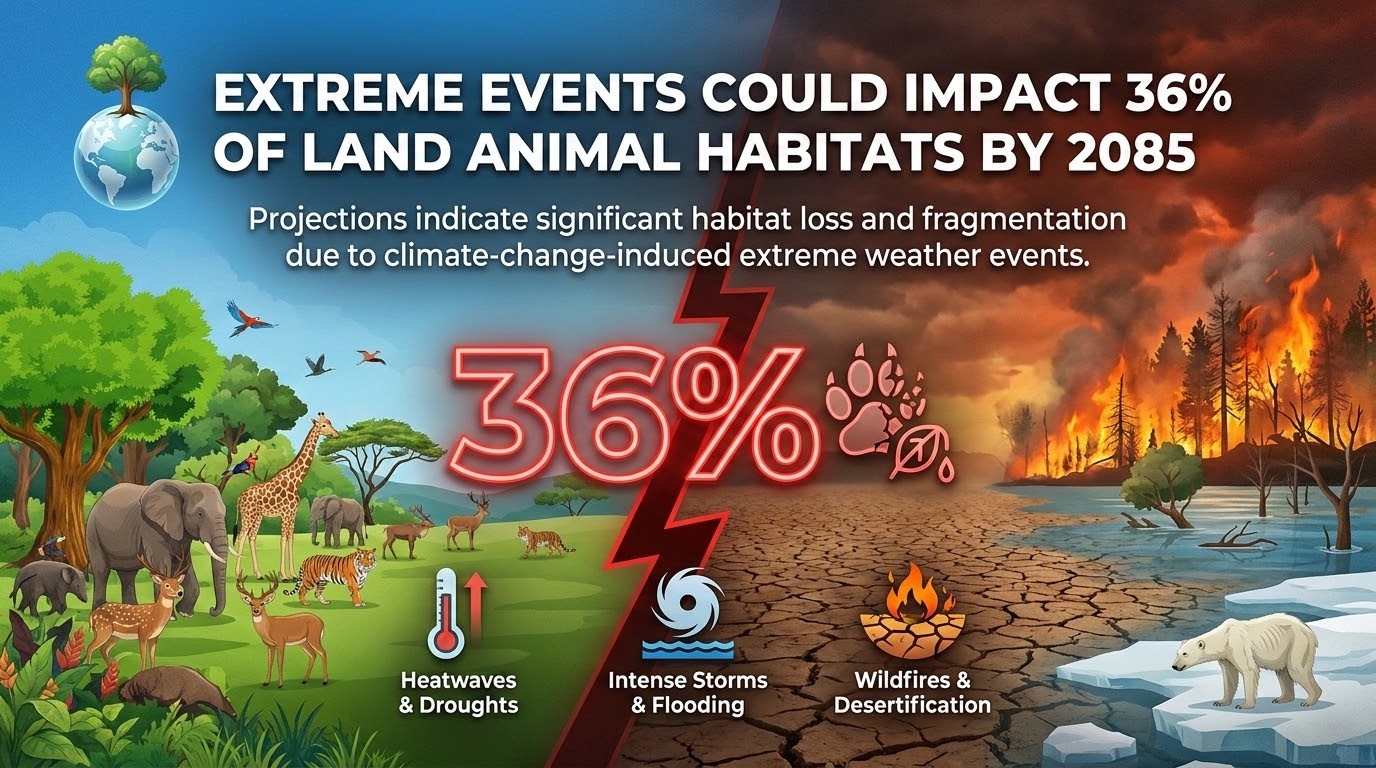
A Nature Climate Change study reveals that intensifying extreme climate events—including floods, droughts, and heatwaves—are set to shift the geographical ranges of terrestrial wildlife.
The 36% Threshold: Under a high-emission scenario, nearly 36% of global land animal habitats will experience extreme climate events that exceed their historical tolerance limits by the year 2085.
The Speed of Change: The study emphasizes that it is not just the rise in average temperature, but the abruptness of extreme events that prevents species from adapting or migrating in time.
Geographical Vulnerability: The impact is not distributed uniformly across the globe. Certain regions face a much higher risk of "Ecological Assemblage" collapse.
Abrupt Climate Displacement: Unlike gradual warming, extreme events cause sudden mass die-offs. This leads to a "Trophic Cascade"—where the loss of one predator or prey disrupts the entire food chain.
Zoonotic Risks: As animals lose 36% of their habitats, they move closer to human settlements. This increased "human-wildlife interface" raises the risk of Spillover Events (future pandemics).
Ecosystem Services at Risk: The loss of land animals impacts pollination, seed dispersal, and natural pest control, directly threatening global food security.
Dynamic Protected Areas: Instead of fixed boundaries, need to build "Climate Corridors" that allow species to move across latitudes and altitudes.
Assisted Migration: In extreme cases, humans may need to physically relocate vulnerable species to "Climate Refugia"—areas less likely to be hit by extreme events.
Strict Emission Control: The difference between a 1.5°C and a 3°C world is the difference between 15% and 36% habitat loss. Adhering to the Paris Agreement is the only long-term solution.
The 2085 projection is a "Final Warning" for biodiversity. It moves the conversation from "Saving the Tiger" to "Saving the System." For a country like India, protecting habitats is no longer just an ethical choice but a necessity for climate resilience.
Source: INDIAN EXPRESS
|
PRACTICE QUESTION Q. With reference to the constitutional provisions regarding environmental protection in India, consider the following statements: 1. The Right to be free from the adverse effects of climate change has been explicitly recognized as a fundamental right flowing from Articles 14 and 21. 2. Article 48A of the Constitution mandates the State to endeavor to protect and improve the environment and safeguard the forests and wildlife. Which of the statements given above is/are correct? a) 1 only b) 2 only c) Both 1 and 2 d) Neither 1 nor 2 Answer: c Explanation: Statement 1 is correct: In 2024, in the case of M.K. Ranjitsinh & Ors. vs Union of India & Ors., the Supreme Court of India recognized for the first time that the "right to be free from the adverse effects of climate change" is a distinct fundamental right emanating from Articles 14 (right to equality) and 21 (right to life) of the Constitution. Statement 2 is correct: Article 48A was inserted into the Directive Principles of State Policy (Part IV) by the 42nd Amendment Act of 1976. It explicitly mandates that "The State shall endeavour to protect and improve the environment and to safeguard the forests and wild life of the country" |
Compounding climate disasters refer to extreme weather events that occur simultaneously or in rapid succession, such as a severe drought followed immediately by a wildfire. This overlapping effect prevents ecosystems from recovering and exponentially amplifies the destruction of local biodiversity.
A study led by the Potsdam Institute for Climate Impact Research (PIK) projects that by 2085, over 36% of terrestrial vertebrate habitats globally will be devastated by overlapping, multiple climate-driven extreme weather events if current emission trajectories continue.
Extreme climate shocks selectively decimate highly vulnerable native and endemic species, clearing out the natural competition. This creates an ecological vacuum that highly resilient, invasive non-native species exploit, allowing them to rapidly take over and degrade native habitat quality.



© 2026 iasgyan. All right reserved