Elephant–train collisions in India are a major anthropogenic cause of wildlife mortality, primarily driven by railway lines cutting across elephant corridors, high-speed night-time operations, and habitat fragmentation. Recognising this risk, Indian Railways has implemented measures such as speed restrictions in vulnerable stretches, AI-based elephant detection systems, coordinated patrolling with forest departments, and the creation of elephant-friendly crossings. While challenges remain in scaling these interventions nationwide, a combination of technology, ecological planning, and institutional coordination offers a viable pathway to significantly reduce such incidents and balance development with conservation.
Copyright infringement not intended
Picture Courtesy: Indian Express
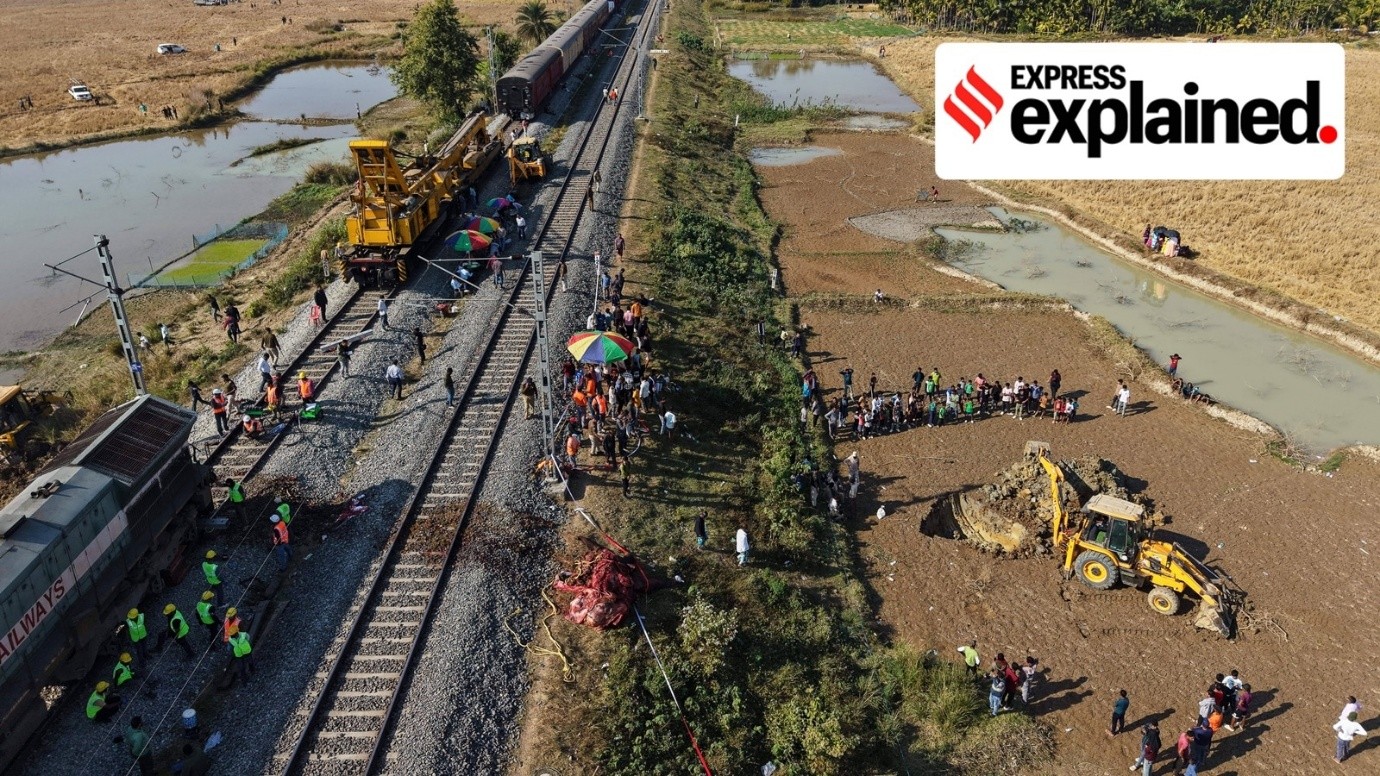
The recent collision between the Rajdhani Express and a herd of elephants in Assam’s Hojai district, killing seven elephants and derailing multiple coaches has once again highlighted a persistent conservation and infrastructure challenge in India.
|
Must Read: RAILWAY ACCIDENTS | Gajraj Software | HUMAN ANIMAL CONFLICT | |
Railway lines passing through elephant corridors: A primary cause of elephant deaths on railway tracks is the alignment of railway lines across traditional elephant migration corridors, forcing elephants to cross tracks while moving between forests, water sources, and feeding grounds. India hosts over 27,000 Asian elephants, more than half of the global population of the endangered Asian elephant, many of which depend on long-established corridors in states like Assam, West Bengal, Odisha, and Kerala.
High-speed train operations and long braking distance: Elephants are often killed because trains travel at high speeds and require long distances to stop, making collisions unavoidable once animals appear on the tracks. Data from the Ministry of Environment, Forest and Climate Change shows that 186 elephants died due to train hits between 2010 and 2020, making rail accidents the second-largest anthropogenic cause of elephant mortality after electrocution.
Poor visibility during night-time operations: Most elephant–train collisions occur at night, when visibility is severely reduced due to darkness, fog, rain, or forest cover. A 2017 study on North Bengal railways found that a majority of collisions happened during night hours, as loco pilots had insufficient time to spot elephants on curved or forested tracks.
Absence or poor design of wildlife crossings: The lack of well-designed wildlife underpasses and overpasses significantly contributes to elephant deaths. Where crossings exist, they are often too narrow or enclosed, discouraging elephant use. Conservation studies indicate that properly designed crossings combined with fencing can reduce wildlife mortality by up to 90–98%, yet many high-risk railway stretches in India still lack such infrastructure.
Limited deployment of early-warning technology: Although technology exists to detect elephants in advance, its limited coverage increases fatalities. AI-based thermal cameras and sensor systems can detect elephants up to 700–750 metres ahead, but these systems are currently deployed only in select stretches, such as parts of Northeast India and the Kerala–Tamil Nadu border.
Avoidance through corridor-sensitive planning: The most effective way to prevent elephant deaths is to avoid laying new railway lines through elephant habitats and migration corridors, as recommended by the International Union for Conservation of Nature (IUCN). Studies show that rerouting infrastructure away from high-use corridors eliminates collision risk entirely, which is why conservation planning now emphasises early-stage environmental screening before project approval.
Construction of scientifically designed wildlife crossings: Where avoidance is not possible, wildlife underpasses and overpasses must be constructed at known elephant movement points to allow safe crossings. The IUCN’s 2023 guidelines state that well-designed crossings combined with fencing can reduce wildlife mortality by up to 90–98%, provided they are open, wide, and at least 6–7 metres high for elephants.
Strategic fencing to guide elephants: Continuous and well-maintained fencing along railway tracks prevents elephants from wandering onto rails and channels them toward designated crossing structures. Evidence from forest–railway interfaces in Assam shows that collision hotspots often coincide with unfenced stretches, indicating that fencing is a simple but critical intervention when used alongside crossings.
Regulation of train speed in vulnerable stretches: Speed restrictions significantly reduce collision severity and improve reaction time for loco pilots. On high-risk forest sections, reducing train speed to 30–40 km/h at night has been shown to lower fatal encounters, as pilots gain additional seconds to brake or alert control rooms.
Deployment of AI-based early warning systems: Technology-driven solutions are emerging as powerful preventive tools, especially where structural changes are still pending. AI-enabled thermal cameras and sensor-based detection systems can identify elephants on or near tracks from 700–750 metres away and send real-time alerts to drivers.
AI-based thermal and infrared detection systems: One of the most effective technological interventions is the use of AI-enabled thermal and infrared cameras that can detect elephants on or near railway tracks even in darkness, fog, or rain. These systems can identify large animals from a distance of 700–750 metres, giving loco pilots crucial extra time to slow down or stop. In 2023, the Northeast Frontier Railway deployed such AI-based elephant detection systems in Assam and North Bengal, and early assessments showed a reduction in close-call incidents on identified hotspot sections.
Ground-based sensor networks along railway tracks: Ground-mounted sensor systems combining seismic, acoustic, and motion sensors are increasingly being used at known elephant crossing points. These sensors detect vibrations and low-frequency sounds produced by elephant movement and automatically trigger alerts to nearby signal stations and control rooms.
Integrated real-time alert systems for loco pilots: Technology now allows direct transmission of wildlife alerts to loco pilot cabins, station masters, and railway control rooms through digital dashboards and mobile-based interfaces. Once elephants are detected, automated alerts prompt immediate speed reduction or temporary halts.
Geofencing of elephant corridors
Elephants fitted with GPS radio collars provide real-time movement data that can be integrated with railway signalling systems. Through geofencing, alerts are generated automatically when collared elephants approach railway tracks, enabling pre-emptive speed restrictions on approaching trains.
Elephant–train collisions are a preventable consequence of infrastructure intersecting wildlife habitats rather than unavoidable accidents. Indian Railways’ initiatives—such as speed regulation in elephant corridors, AI-based early warning systems, coordinated patrolling with forest departments, and the creation of elephant-friendly crossings—demonstrate that a technology-enabled and ecologically sensitive approach can significantly reduce fatalities. Strengthening and scaling these measures nationwide is essential to balance railway safety, development needs, and long-term wildlife conservation.
Source: Indian Express
|
Practice Question Q. Elephant–train collisions have emerged as a major anthropogenic cause of wildlife mortality in India. In this context, examine the causes of such incidents and critically evaluate. (250 words) |
Elephant–train collisions are frequent because many railway lines pass through traditional elephant corridors, forests, and feeding routes, combined with high train speeds, poor night-time visibility, and habitat fragmentation.
Most collisions involve the endangered Asian elephant, which constitutes more than half of the world’s elephant population and depends on long-distance seasonal movement across forest landscapes.
Most elephant–train collisions occur at night or early morning hours when visibility is low and elephants are more likely to move across tracks, especially during crop-harvest seasons.




© 2026 iasgyan. All right reserved