China’s Hukou system is an internal passport mechanism classifying citizens as rural or urban, tying welfare access to registered localities.
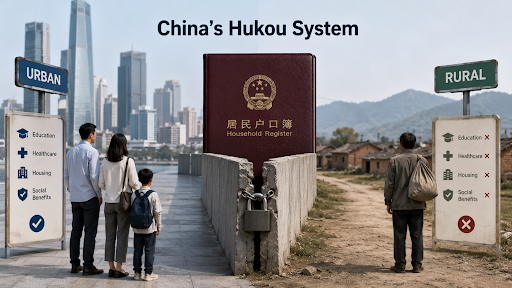
China recently updated guidelines to allocate benefits like healthcare and education based on residency, reforming its traditional hukou registration status system.
The Hukou functions as an internal passport system within China. It acts as an internal residence registration mechanism that regulates population mobility and dictates state resource allocation.
This System officially classifies every citizen as either a rural or urban resident. It strictly links a person's eligibility for government welfare and public services to their registered locality.
Establishment in 1958
The government established the core framework of the hukou system in the 1950s. Authorities designed it to exert strict control over internal migration patterns across the country.
Rural–Urban Segregation
The policy enforces segregation by permanently classifying populations as either rural or urban residents. This binary classification determines all subsequent state interactions with the citizen.
State Planning Objectives
State planners utilize the hukou system to manage resource distribution effectively. The government relies on registered population data to plan infrastructure, employment, and public expenditure.
Rural Hukou
Citizens holding a rural hukou possess registrations tied to rural localities, limiting their access to the extensive welfare networks and social insurance programs concentrated in urban centers.
Urban Hukou
Citizens with an urban hukou hold official registrations in cities, granting them seamless access to urban government welfare programs, public services, and infrastructure.
Access to Welfare Benefits
The system tightly binds access to services—including schools, healthcare, social insurance, and housing subsidies—to the individual's officially registered locality.
Internal Migration
The post-1978 economic reforms drove massive internal migration for industrialization, but the system left migrant workers stranded without official city registrations.
Urban Labour Markets
Migrants fuel urban labour markets but consistently face extreme difficulties in accessing local benefits in the cities where they live and work.
Educational Access
Due to strict locality registrations, migrant families face severe barriers when attempting to access urban educational facilities for their children.
Healthcare Access
The registration system denies or heavily restricts access to subsidized healthcare for millions of out-of-hukou migrant workers.
China's Hukou reforms aim to dismantle discriminatory internal migration barriers, fostering inclusive, people-centered urbanization to drive long-term, consumption-led economic growth.
Source: THEHIND
|
PRACTICE QUESTION Q. Consider the following statements regarding China's Hukou System:
Which of the statements given above are correct? (a) 1 and 2 only (b) 2 and 3 only (c) 1 and 3 only (d) 1, 2, and 3 Answer: (c) Explanation: Statement 1 is correct: The Hukou (household registration) system is China's internal residence registration mechanism that officially classifies citizens as rural or urban residents. It was formalized in the 1950s by the Chinese government to control internal migration and allocate state resources. Statement 2 is incorrect: Recent reforms have not completely abolished the Hukou system, nor have they replaced it with a universal basic income (UBI) model. Instead, recent policies (such as the State Council guidelines) aim to expand access to basic public services in the places where migrants actually live and work, moving toward "inclusion without abolition" while retaining the registration structure. Statement 3 is correct: Historically, Hukou has operated as an institutional carrier for the differential distribution of public goods. Access to crucial social welfare, subsidized housing, public education, and healthcare is intimately tied to a citizen's officially registered locality. |
The Hukou system is a mandatory governmental household registration mechanism that legally ties a citizen’s social welfare benefits, healthcare, education, and housing eligibility directly to their officially assigned birth location.
The system was established in 1958 to strictly control mass internal migration, prevent the overcrowding of major cities, and strategically direct rural labor to maximize agricultural output for the state.
The framework faces intense criticism for institutionalizing structural social inequality, as it deprives millions of rural-to-urban migrant workers of basic public services, turning them into second-class citizens within cities.
The Chinese government is reforming the system by completely scrapping household registration restrictions in small and medium-sized cities while transitioning to a merit-based points accumulation model in megacities like Shanghai and Beijing.


© 2026 iasgyan. All right reserved