The Chauri Chaura incident of February 1922 was a significant turning point in India’s freedom struggle. During a protest linked to the Non-Cooperation Movement, a clash between demonstrators and police escalated into violence, resulting in the burning of a police station and the death of 22 policemen. The episode shocked Mahatma Gandhi, who believed that the national movement must remain firmly rooted in non-violence. As a result, he called off the Non-Cooperation Movement, despite its growing momentum across the country.
Although the incident led to a temporary halt in mass political action, it had lasting consequences. It reinforced non-violence as the core principle of India’s struggle for independence, highlighted the difficulties of controlling large-scale popular movements, and prompted a phase of organisational rebuilding and constructive work. In the long run, Chauri Chaura shaped the strategy, discipline, and moral direction of future Gandhian movements.
Copyright infringement not intended
Picture Courtesy: Dainik Bhaskar
Context:
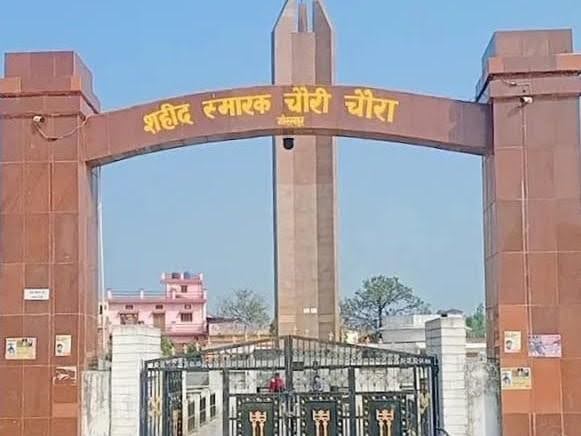
Tributes were paid to the martyrs of the Chauri Chaura incident on their 104th anniversary in Chauri Chaura, Gorakhpur, by several dignitaries, including MLA and MP.
|
Must Read: CHAURI CHAURA INCIDENT | |
Background:
The Chauri Chaura incident occurred on 4 February 1922 in Chauri Chaura, a town in the Gorakhpur district of present-day Uttar Pradesh. It took place during a period of intense nationalist mobilisation under the Non-Cooperation Movement.
Incident:
A large procession of protesters, including local volunteers associated with the nationalist cause and the Khilafat agitation, marched through the area as part of a demonstration. Police attempted to disperse the crowd and reportedly opened fire, resulting in casualties among the demonstrators.
Angered by the firing, a section of the crowd turned violent. The protesters chased the policemen to the local police station, set the building on fire, and killed 22 police personnel trapped inside. In the violence, three civilians also lost their lives
Immediate consequences:
The incident deeply disturbed Mahatma Gandhi, who believed that the national struggle must remain strictly non-violent. Convinced that the movement was drifting away from its moral foundations, he called off the Non-Cooperation Movement on 12 February 1922.
The colonial administration responded with severe repression. Hundreds of people were arrested and tried, and many received harsh sentences. The episode marked a turning point in India’s freedom struggle by highlighting the challenges of maintaining mass non-violent discipline.
Non-Cooperation Movement (1920–1922):
Objectives
The Non-Cooperation Movement was launched on 4 September 1920 under the leadership of Mahatma Gandhi and endorsed by the Indian National Congress. Its central aim was to persuade Indians to withdraw cooperation from British rule in order to achieve self-government and eventually full independence.
Immediate causes
The movement arose from widespread anger over repressive colonial policies and brutal events. The Jallianwala Bagh massacre of 1919 and the controversial Rowlatt legislation, which allowed detention without trial, convinced many Indians that constitutional methods alone were insufficient.
At the same time, Gandhi supported the Khilafat Movement, which sought to protect the Ottoman Caliphate after World War I. This created a rare moment of Hindu–Muslim political unity within the national movement.
Methods of protest
The movement relied on non-violent resistance (ahimsa) and mass participation. Its main strategies included:
Through these actions, Gandhi aimed to weaken the economic and administrative foundations of British rule without resorting to violence.
Movement end:
The outbreak of violence at Chauri Chaura convinced Gandhi that the country was not yet ready for disciplined non-violent struggle on such a large scale. His decision to suspend the movement disappointed many nationalists but reinforced his commitment to moral methods in politics.
Importance of the Chauri Chaura Incident (1922):
Impact on the freedom struggle:
Conclusion:
The Chauri Chaura incident marked a crucial turning point in India’s freedom struggle. The outbreak of violence during a mass protest shocked Mahatma Gandhi and led to the suspension of the Non-Cooperation Movement, reinforcing the principle that India’s path to independence must rest on strict non-violence. Though it caused a temporary pause in the national movement, the episode ultimately strengthened the moral foundations, discipline, and long-term strategy of the struggle against British rule.
Source: Dainik Bhaskar
|
Practice Question Which of the following statements regarding the Non-Cooperation Movement is/are correct?
Select the correct answer using the code below: Answer: (a) Explanation: Statement 1 is correct: The Non-Cooperation Movement urged Indians to withdraw support from British rule through peaceful means. This included:
The idea was that British authority in India depended on Indian cooperation, and withdrawing it would weaken colonial control. Statement 2 is correct: The movement worked in close alignment with the Khilafat Movement, which aimed to protect the Ottoman Caliph after World War I. Statement 3 is correct: In February 1922, violence at Chauri Chaura led to the killing of policemen by an angry crowd. Shocked by the departure from non-violence, Gandhi suspended the movement, believing that the nation was not yet ready for disciplined mass satyagraha. Statement 4 is incorrect: At the time of its launch in 1920, the movement sought self-government within the British Empire, not immediate complete independence. The formal demand for Purna Swaraj (complete independence) was adopted later in 1929 at the Lahore Session of the Indian National Congress. |
The Chauri Chaura incident refers to a violent clash on 4 February 1922 in Chauri Chaura, where protesters set a police station on fire, leading to the death of 22 policemen. It occurred during the Non-Cooperation Movement.
Mahatma Gandhi believed the movement must remain strictly non-violent. The violence at Chauri Chaura convinced him that people were not yet ready for disciplined mass struggle, so he suspended the movement in February 1922.
The goal was to peacefully withdraw Indian cooperation from British rule in order to achieve self-government (Swaraj). It aimed to weaken British authority without using violence.



© 2026 iasgyan. All right reserved