Bioterrorism remains a major security risk, worsened by the BWC’s lack of verification. India’s dense population, climate, and open borders heighten vulnerability. Despite existing frameworks, rapid biotech advances outpace oversight. India needs a National Biosecurity Act, stronger One Health systems, and active advocacy for global BWC reforms.
Copyright infringement not intended
Picture Courtesy: THEHINDU
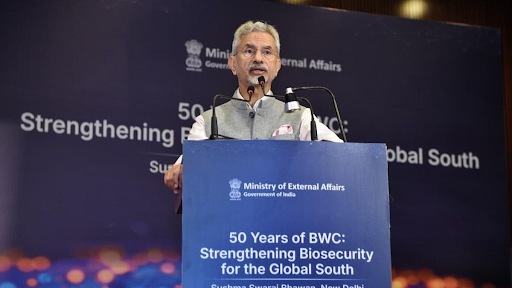
Indian External Affairs Minister underlined the increasing danger of bioterrorism and the use of biological weapons by non-state entities, advocating for a robust international framework to combat these challenges.
Bioterrorism is the deliberate release of biological agents like viruses, bacteria, or toxins to cause illness, death, and widespread fear in people, animals, or plants.
Unlike conventional attacks using explosives, bioterrorism is invisible, spreads silently, and can be hard to distinguish from natural disease outbreaks.
Its relevance has intensified due to globalization, advanced biotechnology, the recent COVID-19 pandemic, and rising geopolitical tensions.

Historically, biological warfare has been used for centuries, from poisoning wells in ancient times to catapulting plague-infected bodies into cities during the Middle Ages.
The modern era has seen more sophisticated attacks, such as the 1984 Salmonella poisoning by the Rajneeshee cult in the US and the 2001 Anthrax letter attacks.
CRISPR/Gene Editing and Synthetic Biology advancements are accelerating biological weapons potential, simplifying and cheapening the modification or creation of dangerous pathogens.
Easier access to knowledge and dual-use equipment lowers the barrier, shifting the main biological weapon threat from large state programs to smaller, more agile groups or individuals.
Biological agents are considered more dangerous than conventional weapons for several reasons:
India faces a heightened risk of bioterrorism due to a unique combination of factors:
India has a multi-layered framework to manage biological threats, integrating disaster management, public health, and security agencies.
Disaster Management and Public Health Legislation
Disease Surveillance and Control
Biosafety and Genetic Engineering Regulation:
The Biological Weapons Convention (BWC), which India ratified in 1974, prohibits the development, production, acquisition, and stockpiling of biological weapons.
Stealth Agents: Biological agents are invisible, odorless, and their initial symptoms often mimic natural illnesses (e.g., flu), allowing an outbreak to spread widely before it is identified as an attack.
Dual-Use Dilemma: The same technology used for legitimate biomedical research can be easily weaponized, making proliferation hard to control and facilities difficult to identify.
Evolving Threats: Advances in synthetic biology and genetic engineering (CRISPR) enable the creation of novel, potentially untreatable, pathogens.
Time-Sensitive Countermeasures: Interventions (vaccines, antivirals) must be administered rapidly—often before symptoms appear—requiring near-instantaneous detection and mass distribution systems that currently face massive logistical barriers.
Inadequate Countermeasures: Stockpiles of specific medical countermeasures are often insufficient for a large-scale attack, and treatments for all potential agents do not exist.
Enhance Surveillance and Early Warning: Expand genomic surveillance nationwide and fully integrate AI-based predictive tools to forecast potential outbreaks before they escalate.
Strengthen Biosafety and Biosecurity: Enact a comprehensive national biosecurity law that strengthens oversight of all labs (public and private) handling sensitive pathogens and mandates strict security audits.
Create a Unified Command: Establish a National Biosecurity Authority to act as a single nodal agency for coordinating between all relevant ministries and departments, ensuring a unified response protocol.
Strengthen International Cooperation: Enhance intelligence sharing on dual-use technologies with partners like the Quad and international bodies like Interpol and the WHO.
Bioterrorism, a clear danger to public health and national security, requires a dual strategy: a resilient public health system for response and a strong security architecture against biotechnology misuse. The key challenge is balancing responsible innovation with security to guard against this invisible enemy.
Source: THEHINDU
|
PRACTICE QUESTION Q. The threat of bioterrorism is no longer a distant possibility but a clear and present danger for India. Discuss. 150 words |
Bioterrorism is the intentional release of pathogenic organisms like viruses, bacteria, or toxins to cause illness and death in humans, animals, or plants. The primary goal is to create fear, panic, and social disruption to intimidate a government or society.
India's vulnerability stems from several factors: high population density in urban areas which aids rapid disease transmission, a tropical climate suitable for many microbes, a large livestock population increasing zoonotic disease risk, and porous borders that pose monitoring challenges.
The 'One Health' approach is an integrated strategy that recognizes the link between human, animal, and environmental health. It is crucial for India because it enables the early detection of zoonotic diseases (diseases that spread from animals to humans), which could be exploited for bioterrorism.


© 2026 iasgyan. All right reserved