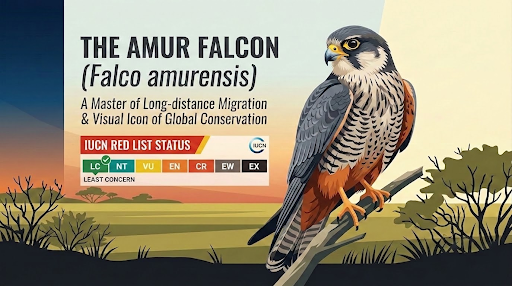
The Amur Falcon makes an incredible 22,000km journey, using Northeast India as a crucial stopover, while community conservation has successfully turned local hunters into protectors. Listed as Least Concern by the IUCN, this raptor remains a symbol of global migratory resilience.
Why In News?
A Amur Falcon named Apapang completed a record-breaking 4,750 km non-stop, 95-hour flight from Somalia to Bihar, as part of a tracking project to study migratory patterns.
About AMUR FALCON
Scientific Name: Falco amurensis.
Physical Characteristics: It is a small raptor, weighing around 150 grams.
Protection Status
Ecological Role and Diet
Distribution and Migration
Threats and Conservation Success
Threats: The flocking behavior of the Amur falcon exposed them to mass hunting.
The Pangti Conservation Model: After a global campaign, local authorities and the Pangti Village Council (Nagaland) banned hunting.
Falcon Festivals: To raise awareness and celebrate the bird, annual "Falcon Festivals" are held across the Northeast.
Source: INDIATODAY
|
PRACTICE QUESTION Q. Consider the following statements regarding the Amur Falcon: 1. It is categorized as 'Endangered' on the IUCN Red List. 2. It undertakes the longest continuous ocean crossing among birds of prey. 3. The Doyang reservoir in Nagaland is a significant stopover site for this bird. Which of the statements given above is/are correct? A) 1 and 2 only B) 2 and 3 only C) 1 and 3 only D) 1, 2, and 3 Answer: B Explanation: Statement 1 is incorrect: The Amur Falcon is categorized as 'Least Concern' on the IUCN Red List. Statement 2 is correct: The Amur Falcon (Falco amurensis) is known for undertaking one of the most remarkable migrations of any bird of prey. It flies roughly 22,000 km annually, including a continuous ocean crossing across the Indian Ocean from India to East Africa, which is the longest for any raptor. Statement 3 is correct: The Doyang reservoir in Wokha district, Nagaland, is a globally significant stopover site. This has earned Nagaland the title "Falcon Capital of the World". |
The Amur Falcon (Falco amurensis) is a small, insectivorous raptor renowned for undertaking one of the longest and most arduous trans-equatorial migrations of any bird, traveling up to 22,000 km annually.
It is protected under Schedule I of India's Wildlife Protection Act, 1972, and is listed as 'Least Concern' on the IUCN Red List.
Major stopovers include the Doyang reservoir in Nagaland and areas along the Barak and Irang rivers in the Tamenglong district of Manipur (such as Chiulon, Phalong, and Puching villages).





© 2026 iasgyan. All right reserved