The Birbal Sahni Institute of Palaeosciences established a biometric tool using grass pollen to distinguish ancient wild grasses from cultivated crops. This confirms the Central Ganga Plain as an independent, indigenous cradle of agriculture dating back to 7000 BCE
A study by the Birbal Sahni Institute of Palaeosciences (BSIP), Lucknow, provided the first robust scientific tool to distinguish between ancient "wild grasses" and "cultivated crops" in the Central Ganga Plain.
For decades, archaeologists struggled to differentiate between the pollen of wild grasses and cultivated cereals (like rice and wheat) because they look nearly identical under a microscope.
The Innovation: The BSIP study established a region-specific "biometric threshold."
Significance: Allows researchers to reconstruct exact timelines of when humans in the Ganga Plain transitioned from foraging (wild rice collection) to farming (systematic cultivation), offering distinct proof of indigenous agricultural evolution.
For a long time, it was believed that agriculture, particularly rice cultivation, diffused into India from China (Yangtze Valley). However, archaeological findings in the Ganga Plain challenge this diffusionist theory.
Key Archaeological Sites & Evidence
Lahuradewa (Sant Kabir Nagar, UP)
Jhusi (Prayagraj, UP)
Chirand (Saran, Bihar)
Evolution of Farming in the Region
The transition happened in distinct phases, which the new pollen study will help refine:
|
Phase |
Timeline |
Characteristics |
|
Mesolithic/Proto-Neolithic |
10,000 – 8,000 BCE |
Harvesting of Wild Rice (Oryza rufipogon) found in oxbow lakes (like those near Sarai Nahar Rai). No tillage yet. |
|
Early Farming (Neolithic) |
7,000 – 5,000 BCE |
Selective cultivation begins. Sites like Lahuradewa show morphological changes in rice grains (larger seeds), indicating domestication. |
|
Mature Farming |
4,000 – 2,000 BCE |
Introduction of double cropping. Winter crops (Wheat/Barley) arrive from the Harappan/Indus sphere, complementing the monsoon crop (Rice) (Source: BSIP Studies). |
Factors supported agriculture development in the Ganga Plain
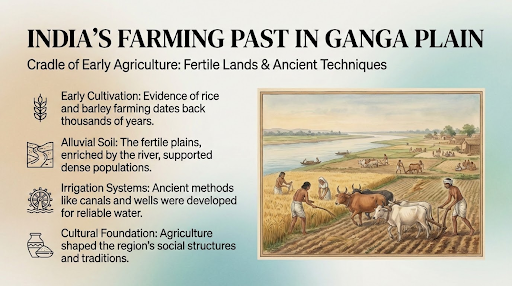
Alluvial Soil: The region is filled with Holocene alluvium, renewed annually by floods, requiring minimal ploughing effort for early farmers.
Oxbow Lakes: The meandering Ganga left behind numerous horseshoe lakes (e.g., Lahuradewa lake), which were ideal natural habitats for wild rice and provided water for early irrigation.
Monsoon Stability: Palaeo-climate data suggests a strong, stable monsoon during the early Holocene (9000-6000 BCE), supporting water-intensive crops like rice.
Cultural Pride & History: It solidifies the theory that Indian agriculture was not merely "imported" from West Asia (Wheat) or China (Rice) but had indigenous roots.
Climate Adaptation: Studying ancient pollen helps us understand how early farmers survived climate shifts (like the 4.2ka aridification event), offering lessons for modern climate-resilient agriculture.
Technological Indigenization: The shift from using "European pollen models" to "Indian biometric models" (as achieved by BSIP in 2026) aligns with the broader goal of decolonizing Indian scientific history.
Source: PIB
|
PRACTICE QUESTION Q. Which archaeological site in the Ganga Plain provides the earliest evidence of domesticated rice? A) Chirand B) Lothal C) Lahuradewa D) Burzahom Answer: C Explanation: Lahuradewa is located in the Sant Kabir Nagar district of Uttar Pradesh, within the Middle Ganga Plain. |
The BSIP (Birbal Sahni Institute of Palaeosciences) pollen breakthrough is a landmark study that developed a "paired biometric threshold." This scientific tool uses precise microscopic dimensions to distinguish between the fossilized pollen of ancient wild grasses and cultivated crops, allowing scientists to accurately map the timeline of early agriculture.
Archaeological sites in the Central Ganga Plain, such as Lahuradewa and Jhusi, have yielded scientific evidence of domesticated rice dating back to 7000–6000 BCE. This proves that farming evolved organically and independently in this region, rather than being imported from other ancient civilizations.
The diffusionist theory is a historically prevalent, colonial-era perspective suggesting that agriculture—specifically rice cultivation—originated in regions like China's Yangtze Valley and subsequently spread (diffused) into the Indian subcontinent. The BSIP study definitively dismantles this outdated theory.



© 2026 iasgyan. All right reserved