The debate on lowering age of consent under the POCSO Act has intensified after Supreme Court observations. Strict application criminalises consensual adolescent relationships, especially among 16–18-year-olds. While reform advocates seek judicial discretion or close-in-age exemptions, critics fear greater exploitation. A balanced path needs legal nuance and comprehensive sexuality education.

Copyright infringement not intended
Picture Courtesy: THEHINDU
The Supreme Court urged the Union government to amend the POCSO Act to exempt genuine consensual adolescent relationships, acknowledging the law's misuse and reigniting the 'age of consent' debate.
|
Read all about: AGE OF CONSENT: MEANING, CHALLENGES, WAY FORWARD l LAW COMMISSION AGAINST LOWERING THE AGE OF CONSENT |
The 'age of consent' is the minimum age at which a person is legally considered capable of consenting to sexual activity.
Its primary purpose is to protect children from sexual exploitation and abuse.
Any sexual activity with a person below this age is considered statutory rape, regardless of their willingness to participate.
Current Legal Framework: Protection of Children from Sexual Offences (POCSO) Act 2012
Definition of a Child: The Act defines a "child" as any person below the age of 18 years.
Age of Consent: Legal age for sexual consent in India is set at 18 years. Any sexual activity with a person below this age is considered a criminal offence (statutory rape), regardless of whether consent was given. This strict liability approach is gender-neutral.
Rationale: The law was designed to provide a strong protective shield for children, presuming that anyone below 18 lacks the emotional and cognitive maturity to give informed consent to sexual activity.
Proponents argue that the stringent nature of the POCSO Act has led to unintended consequences, necessitating a re-evaluation of the age of consent.
Recognition of Adolescent Autonomy
Advocates assert that 16- to 18-year-olds are mature enough to make informed decisions about their bodies, arguing that denying this right infringes upon their constitutional liberties, privacy, and dignity.
Preventing Criminalization of Consensual Romance
"Romeo and Juliet" Cases: Current laws often treat consensual romantic relationships between teenagers as "statutory rape," even when both parties are close in age and the relationship is voluntary.
Targeting Minorities: Parents sometimes misuse these laws to punish adolescents for inter-caste or inter-religious relationships, effectively using the state to enforce social control.
Legal Disparities: In India, a 16-year-old can be tried as an adult for "heinous" crimes under the Juvenile Justice Act, yet is considered incapable of giving sexual consent under the POCSO Act.
Biological Maturity
Proponents note that physiological maturity and the onset of puberty are occurring earlier than in previous generations, making the 18-year threshold disconnected from biological reality.
Improving Public Health Access
Mandatory reporting laws deter adolescents from seeking essential sexual and reproductive health services, such as contraception or STI testing, due to fear of legal repercussions for themselves or their partners.
Global Legal Standards
Many developed nations, including the UK, Canada, and several European countries, set the age of consent at 16 or lower, utilizing "close-in-age" exemptions to protect teenagers from criminal prosecution for peer-to-peer relationships.
Opponents caution that reducing the age of consent could undermine child protection efforts and expose children to greater risks.
Compromising Child Protection
Lowering the age could make it easier for sexual predators to exploit vulnerable children by claiming the relationship was consensual.
The 22nd Law Commission of India recommended retaining the age of 18, arguing that a reduction would negatively impact the fight against child marriage and child trafficking.
A firm age limit of 18 serves as a clear legal deterrent against the exploitation of minors.
Adverse Health and Social Consequences
Early sexual activity is associated with higher risks of sexually transmitted infections (STIs), unwanted pregnancies, and adverse mental health outcomes.
In a patriarchal society, lowering the age could disproportionately harm girls, potentially legitimizing early marriages and leading to them dropping out of school. According to the National Family Health Survey-5 (2019-21), 23.3% of women aged 20-24 were married before 18.
Introduce Nuanced Legal Provisions
Amend the POCSO Act to include "close-in-age exemptions". This would differentiate between predatory abuse by adults and consensual relationships between similarly-aged adolescents, as suggested by the Law Commission and the Supreme Court.
Strengthen Comprehensive Sexuality Education (CSE)
Implement age-appropriate, medically accurate CSE in schools. An informed adolescent is better equipped to understand consent, healthy relationships, and sexual health. Currently, the implementation of CSE in India is patchy and faces cultural resistance.
Promote Judicial Discretion and Rehabilitation
Allow judges greater flexibility to assess the context of cases involving adolescents. The focus should shift from punitive punishment to counselling and rehabilitation for teenagers in consensual relationships.
Improve Data Collection
Mandate the National Crime Records Bureau (NCRB) to disaggregate data to clearly distinguish between predatory POCSO cases and those involving consensual relationships. This will enable evidence-based policymaking.
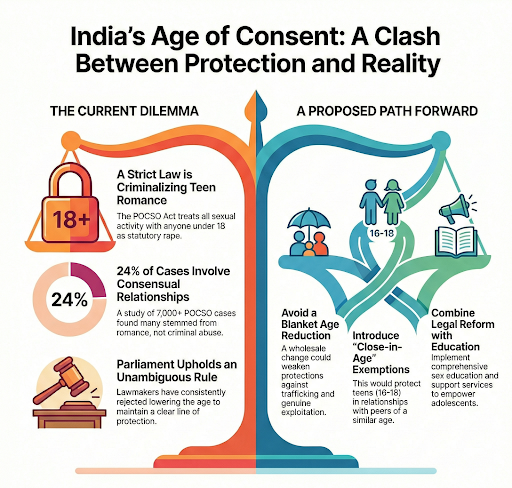
Reforming the POCSO Act requires a balanced approach to the age of consent. It must protect minors while allowing judicial discretion and exemptions for closely-aged adolescent relationships, supported by comprehensive educational programs.
Source: THEHINDU
|
PRACTICE QUESTION Q. "The Protection of Children from Sexual Offences (POCSO) Act, 2012, while noble in intent, often results in the over-criminalization of consensual adolescent relationships." Critically analyze. 250 words |
The current age of consent in India is 18 years, as established by the Protection of Children from Sexual Offences (POCSO) Act, 2012. Any sexual activity with a person below this age is considered a criminal offence, regardless of their consent.
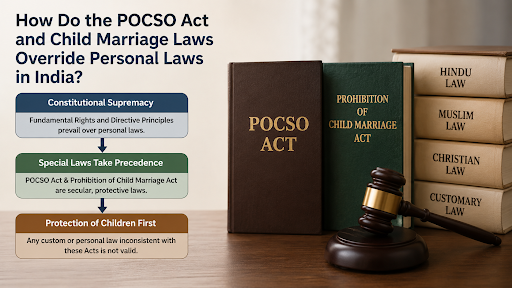
The Protection of Children from Sexual Offences (POCSO) Act, 2012, is a comprehensive and gender-neutral law in India that defines a "child" as anyone under 18. Its primary objective is to protect children from offences of sexual assault, sexual harassment, and pornography.
Opponents argue that lowering the age of consent would increase the vulnerability of children, especially girls, to sexual exploitation, trafficking, and coercion. It could undermine the fight against child marriage and is opposed on the grounds that adolescents may lack the emotional and cognitive maturity to give informed consent.



© 2026 iasgyan. All right reserved