Adi Shankaracharya was an 8th-century philosopher who consolidated Advaita Vedanta (non-dualism). He unified India by establishing four Mathas in cardinal directions and organizing the Shanmata system, fostering civilizational unity and intellectual revival of Vedic thought.
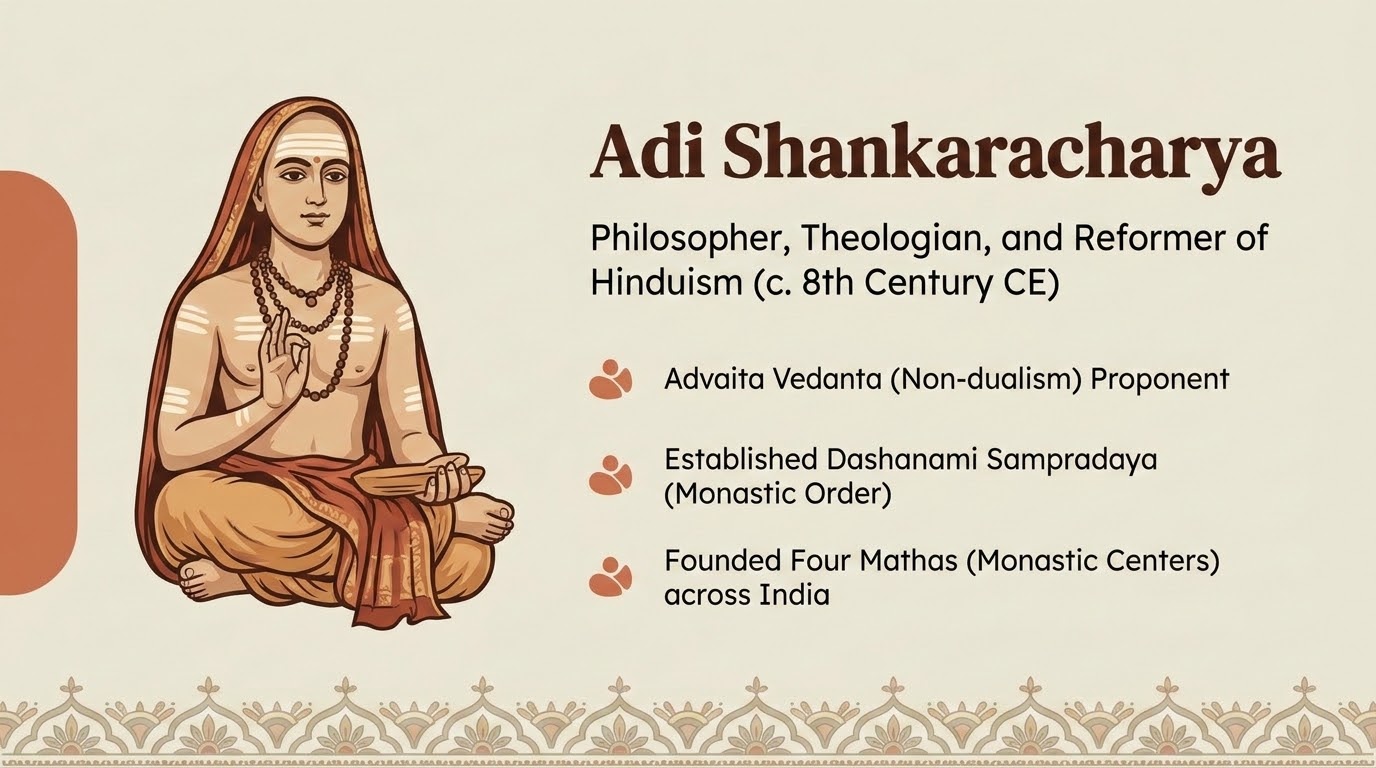
The Prime Minister honored philosopher-saint Adi Shankaracharya on his Jayanti, marking his 1,200th birth anniversary.
About Adi Shankaracharya
Adi Shankaracharya was a philosopher and reformer who consolidated Hinduism through Advaita Vedanta (Non-Dualism), and created metaphysical structure for Indian philosophy.
Biography
Birth and Lineage: Adi Shankara was born in Kalady, a village on the banks of the Periyar River in Kerala.
Early Life: Born to Shivaguru and Aryamba, he was a child prodigy who mastered Vedic texts at a young age.
The Guru: He found his guru, Govinda Bhagavatpada, on the banks of the river Narmada, under whom he studied the Vedas and Upanishads.
The Great Departure: He is believed to have attained Mahasamadhi at the young age of 32 in Kedarnath, Uttarakhand.
Philosophy: Advaita Vedanta (Non-Dualism)
Shankaracharya systematized the philosophy of Advaita Vedanta, which posits that there is no difference between the individual soul (Atman) and the ultimate reality (Brahman).
Major Literary Works
Commentaries (Prasthana Trayi Bhashya): He wrote extensive commentaries on the three authoritative texts of Hinduism, establishing the logical supremacy of Advaita.
Treatises (Prakarana Granthas): Independent philosophical manuals meant for students:
Stotras (Devotional Hymns): Despite being a proponent of Jnana Yoga (path of knowledge), he composed moving hymns to foster Bhakti (devotion):
Institutional Contributions & Revival of Dharma
Establishment of Four Mathas (Monasteries)
To ensure the continuity of Vedic teachings and cultural unity, Shankaracharya established four Mathas (monasteries) in the four cardinal directions. Each Math was assigned a specific Veda and a Mahavakya (Great Saying),
|
Direction |
Location |
Matha Name |
Veda Assigned |
Mahavakya |
|
North |
Badrinath, Uttarakhand |
Jyotir Math |
Atharva Veda |
Ayam Atma Brahma (This Self is Brahman) |
|
South |
Sringeri, Karnataka |
Sringeri Sharada Peetham |
Yajur Veda |
Aham Brahmasmi (I am Brahman) |
|
East |
Puri, Odisha |
Govardhan Math |
Rig Veda |
Prajnanam Brahma (Consciousness is Brahman) |
|
West |
Dwarka, Gujarat |
Dwarka Sharada Peeth |
Sama Veda |
Tat Tvam Asi (That Thou Art) |
Shanmata and Panchayatana Puja
Dashanami Sampradaya
He organized the ascetic order into ten lineages (Dashanami)—such as Giri, Puri, Bharati, and Saraswati—to streamline the monastic community.
Legacy
Cultural Unity: He is termed the first "National Integrator" of India for culturally uniting the sub-continent without political conquest, using Sanskrit as a link language.
Statue of Oneness: In 2023, the Madhya Pradesh government unveiled a 108-foot statue of Adi Shankaracharya at Omkareshwar, termed the 'Statue of Oneness', to honor his contribution to national unity.
Influence on Modern Thinkers: His interpretation of Vedanta influenced modern leaders like Swami Vivekananda, who took Advaita Vedanta to the global stage.
Source: TIMESOFINDIA
|
PRACTICE QUESTION Q. With reference to Adi Shankaracharya, consider the following works: 1. Vivekachudamani 2. Soundarya Lahari 3. Prasthanatrayi Commentaries Which of the above works were authored by him? a) 1 and 2 only b) 2 and 3 only c) 1 and 3 only d) 1, 2, and 3 Answer: d) Explanation: Adi Shankaracharya was a prolific writer. He wrote the Prasthanatrayi commentaries (on Upanishads, Bhagavad Gita, and Brahma Sutras), devotional hymns like Soundarya Lahari, and pedagogical manuals like Vivekachudamani. |
Born in the 8th century in Kaladi, Kerala, Adi Shankaracharya was a profound Indian philosopher, theologian, and ascetic. He is best known for consolidating Hindu thought through the philosophy of Advaita Vedanta (non-dualism) and for his role in mapping India's civilizational and cultural unity.
Advaita Vedanta is a philosophy of absolute non-dualism. It argues that Brahman (the ultimate formless reality) is the only absolute truth, while the material universe is an illusion called Maya. Liberation (Moksha) is achieved when an individual realizes that their soul (Atman) is identical to Brahman.
The 'Statue of Oneness' (Ekatmata Ki Pratima) is a 108-feet tall statue of Adi Shankaracharya located in Omkareshwar, Madhya Pradesh. It was unveiled to commemorate his immense contribution to fostering India's cultural and geographical integration.


© 2026 iasgyan. All right reserved