Acid attacks persist in India despite strong laws and Supreme Court directives. The failure lies in weak enforcement, unregulated acid sales, delayed compensation and poor rehabilitation. Addressing this crime demands strict implementation, speedy justice, survivor-centric rehabilitation and sustained efforts to challenge patriarchal attitudes.

Copyright infringement not intended
Picture Courtesy: THE HINDU
In the Shaheen Malik vs Union of India case, the Supreme Court decided to review flaws in implementing the Laxmi vs Union of India directives for acid attack survivors' protection and rehabilitation.
Acid attack is a brutal form of premeditated gender-based violence where the perpetrator throws acid on a victim, intending to disfigure, maim, or kill them.
National Crime Records Bureau (NCRB) data on acid attacks
Unequal gender norms fuel these attacks, an extreme attempt to control or retaliate against autonomous women.
Assaults often occur when individuals (mostly male) react violently to the rejection of marriage or romantic proposals.
Personal disputes, jealousy, and revenge for perceived slights often motivate interpersonal conflict and revenge.
Cheap, easily available corrosive substances lower the barrier to their use in violent assaults.
Weak law enforcement, fear, and social stigma allow acid attack perpetrators to act with impunity, despite existing legislation.
Criminal Law (Amendment) Act, 2013
Section 326A, IPC: Makes acid attack a specific, non-bailable offence. Punishment includes a minimum of 10 years imprisonment, extendable to life, along with a substantial fine that must be paid to the survivor for medical expenses.
Section 326B, IPC: Criminalizes the attempt to throw acid, with a punishment of 5 to 7 years imprisonment and a fine.
Bharatiya Nyaya Sanhita (BNS)
Section 124(1) BNS (replaces IPC Section 326A): Imprisonment of ten years to life, plus a fine covering the victim's medical costs, is mandated for causing grievous hurt with acid.
Section 124(2) BNS (replaces IPC Section 326B): Attempting to throw or administer acid, even without severe injury, is criminalized with five to seven years imprisonment and a fine.
"Acid" Definition: The law defines "acid" broadly to include any substance with corrosive properties causing injury or disfigurement.
Supreme Court Directives (Laxmi vs Union of India, 2013)
Regulation of Acid Sales: Over-the-counter acid sales are banned. Sellers must log buyer details (including photo ID) and purchase purpose; no sales to those under 18.
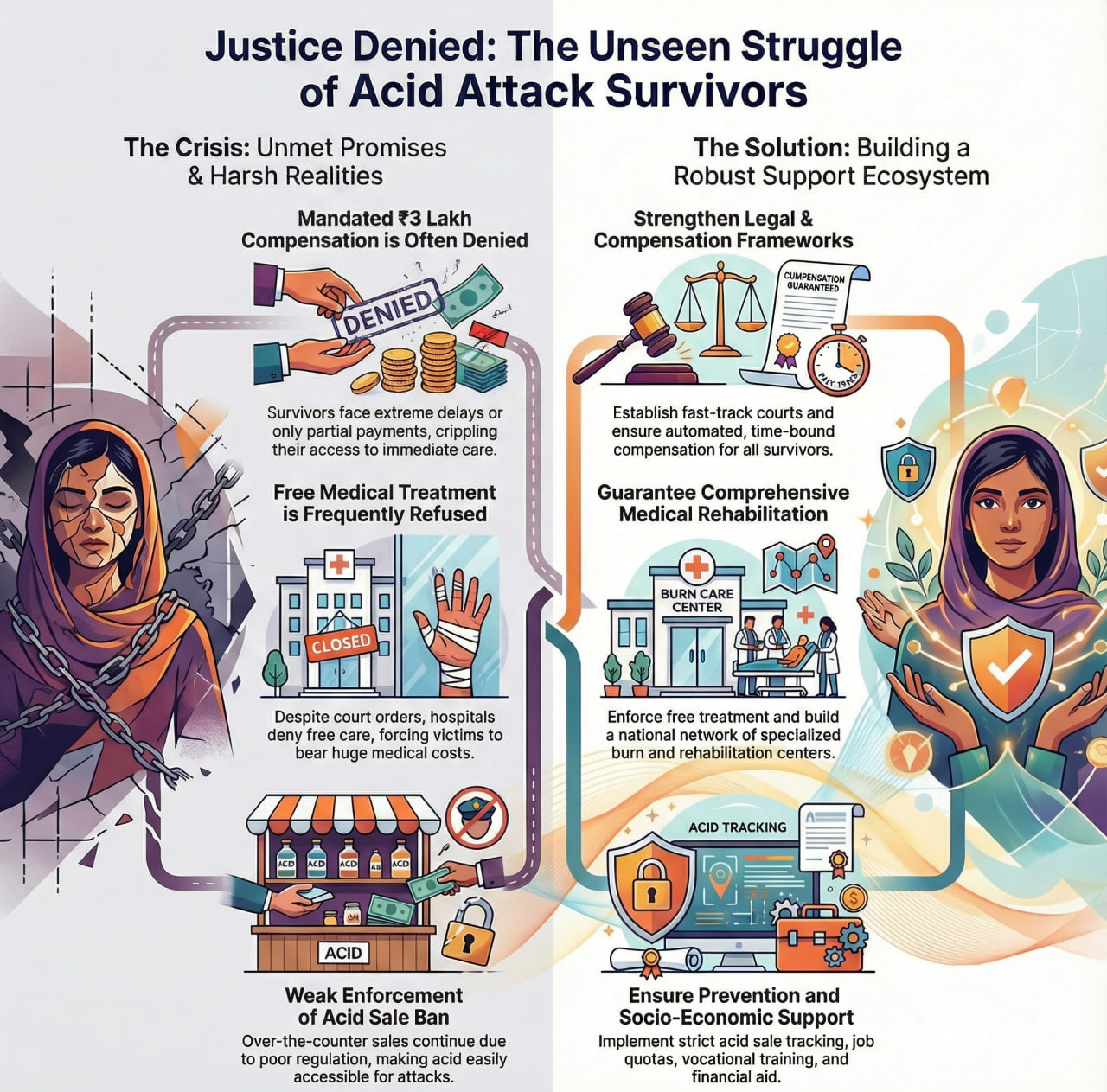
Mandatory Compensation: State governments must pay a minimum compensation of ₹3 lakh to each survivor.
Free Medical Treatment: All hospitals (public or private) are mandated to provide free and complete medical treatment, including reconstructive surgeries, medication, and accommodation, to survivors.
Other Supportive Measures
Central Victim Compensation Fund (CVCF): Created from the Nirbhaya Fund to supplement state compensation schemes and provide a uniform floor for victim compensation.
Rights of Persons with Disabilities Act, 2016: Recognizes acid attack survivors as persons with disabilities, making them eligible for a 4% reservation in government jobs and educational institutions. (Source: RPwD Act, 2016)
Delays in justice and trials: Lengthy trials and slow investigation/prosecution in acid attack cases delay justice for survivors, prolonging trauma and undermining deterrence.
Failure to Regulate Acid Sales: Open and unregulated sale of acid continues in many parts of the country, reflecting poor enforcement.
Inadequate Compensation: Although courts and the government mandate minimum compensation and free treatment, victims often receive lower amounts late or not at all in some states.
Social Stigma: Survivors are often ostracized by society, making their reintegration through education or employment extremely difficult.
Low conviction and case disposal rates: Low conviction rates and pending cases, even after investigation, indicate failings in policing, evidence gathering, and legal follow-through.
Limited survivor support and rehabilitation: Survivors often lack sufficient or accessible medical, psychological, and social reintegration services, increasing their difficulties post-court.
 Way Forward
Zero-Tolerance on Unregulated Acid Sales: District Magistrates must be held accountable for enforcing the Supreme Court's guidelines on acid sales, with regular inspections and heavy penalties for violators.
Comprehensive Rehabilitation Model: A national fund, as recommended by the Justice J.S. Verma Committee should be established to cover lifelong medical, psychological, educational, and skilling needs of survivors.
Speedy Justice: Establishing fast-track courts for gender-based violence cases is essential to reduce pendency and improve conviction rates, creating a stronger deterrent.
Mainstreaming Survivors: Government, in partnership with the private sector and Civil Societies, must create more employment opportunities for survivors, ensuring strict implementation of the RPwD Act, 2016.
Gender Sensitization: The root cause—a patriarchal mindset—must be addressed through sustained community-level awareness programs and the integration of gender equality in school curricula.
Combating acid attacks requires a multi-pronged strategy that goes beyond legislation to ensure strict enforcement, holistic rehabilitation, and fundamental social change.
Source: THE HINDU
|
PRACTICE QUESTION Q. Judicial pronouncements alone are insufficient without a robust and accountable implementation machinery. Critically analyze. 250 words |
The primary legal provisions are in the Indian Penal Code (IPC), specifically Section 326A (punishment for causing grievous hurt by acid) and Section 326B (punishment for attempting to throw acid), which were introduced through the Criminal Law (Amendment) Act, 2013.
The low conviction rates are attributed to several factors, including a slow judicial process with a high pendency of cases, difficulties in gathering evidence, and sometimes, the intimidation of victims and witnesses. This creates a lack of deterrent for perpetrators.
Established with an initial corpus from the Nirbhaya Fund, the CVCF aims to provide financial support to victims of various crimes, including acid attacks. It supplements the compensation provided by State Victim Compensation Schemes, helping to ensure that survivors receive timely and adequate financial assistance for their treatment and rehabilitation.





© 2026 iasgyan. All right reserved