Why In News?
Retail inflation, measured by the Consumer Price Index (CPI), was recorded at 3.4% in March 2026. This data represents the inaugural release under the newly implemented 2024 base year.
What is the Consumer Price Index (CPI)?
It is a macroeconomic indicator that measures the average change in prices paid by consumers for a basket of goods and services over time.
In India, it is the primary metric for measuring retail inflation and is used by the Reserve Bank of India (RBI) for inflation targeting.
Publisher: It is released monthly by the National Statistical Office (NSO), Ministry of Statistics and Programme Implementation (MoSPI).
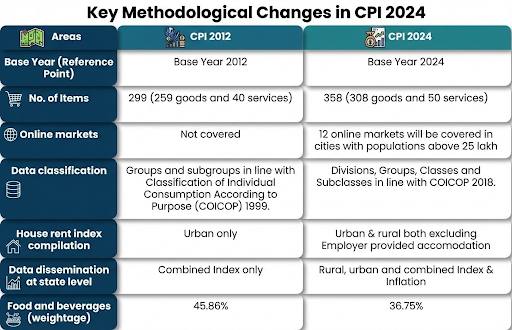
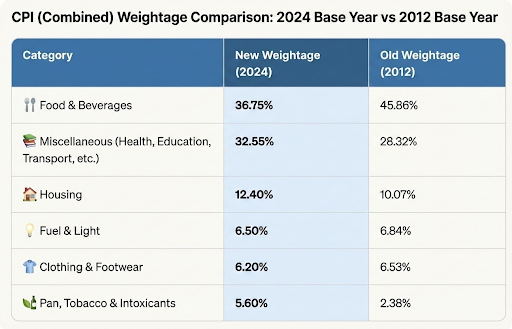
New Base Year (2024=100): Government updated the CPI base year to 2024 from 2012. This revision modernizes the "consumption basket" by adding digital services like streaming and increasing housing weightage, while lowering the weightage of food.
What are the Key Drivers Behind Current Inflation Trends?
Rising Food Prices (The Primary Driver)
Geopolitical Conflicts & Energy Costs
Surge in Precious Metals
Housing & Services Inflation
Core Inflation Stability
Challenges in Managing Inflation
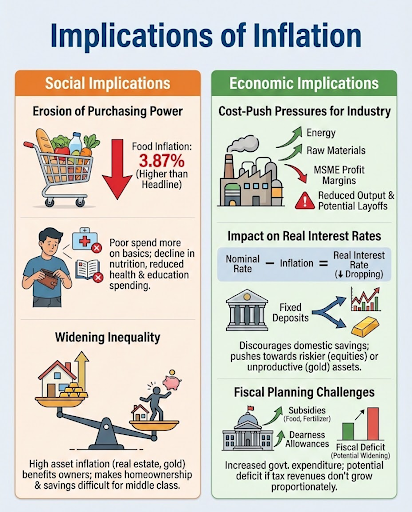
Supply-Side Rigidities (The "Food" Factor): Food inflation remains challenging despite the New CPI Series (Base Year 2024) reducing food's weight to 36.75%. Structural issues like poor cold storage and monsoon dependency (aggravated by El Niño) cause price spikes that monetary policy cannot directly address.
Geopolitical "Imported Inflation": The West Asia crisis threatens energy security. As India imports over 85% of its crude oil, regional escalations drive up domestic fuel and logistics costs, creating "cost-push" inflation.
The "Sacrifice Ratio" Dilemma: The RBI balances growth and stability. Aggressive rate hikes to control inflation risk dampening investment and consumption, potentially slowing progress toward the $5 Trillion goal.
Fiscal-Monetary Coordination: Expansionary fiscal policies can undermine RBI tightening by fueling demand. Aligning fiscal deficit targets with inflation goals remains a key governance challenge.
New CPI Data Integration: Transitioning to the 2024 Base Year requires capturing the "digital economy" and ensuring historical comparability to prevent policy errors through rigorous data validation.
Way Forward
Structural & Supply-Side Reforms
Climate-Resilient Agriculture: Invest in "Climate-Smart Agriculture" and micro-irrigation (PMKSY) to insulate food production from erratic monsoons. Expanding Operation Greens (from TOP to TOTAL) can help stabilize vegetable prices.
Logistics & Storage: Expand the National Logistics Policy to reduce logistics costs (currently 13-14% of GDP) to single digits. Enhanced cold chain infrastructure via the Agriculture Infrastructure Fund (AIF) to reduce post-harvest losses.
Monetary & Fiscal Prudence
Anchoring Expectations: Government has rightly retained the 4% (+/- 2%) inflation target for the 2026–2031 period.
Counter-Cyclical Fiscal Policy: Government should use "automatic stabilizers"—reducing excise duties on fuel during global spikes and rebuilding buffers during lulls—to shield the domestic economy from imported volatility.
Strategic Energy Security
Diversification: Accelerate the National Green Hydrogen Mission and increase the Ethanol Blending target from current 20%, to reduce the weight of imported fossil fuels in the inflation basket.
Strategic Reserves: Expand the Strategic Petroleum Reserves (SPR) to cushion against sudden geopolitical supply shocks from West Asia.
Conclusion
Effective inflation management relies on a dual strategy: the RBI's cautious monetary policy to hit the 4% target, combined with supply-side reforms to counter persistent food price volatility and protect consumer purchasing power.
Source: THEHINDU
|
PRACTICE QUESTION Q. Which of the following interventions is used by the Government of India to directly manage supply-side constraints and curb sudden spikes in prices of essential agricultural commodities like onions and pulses? a) Open Market Operations (OMO) b) Marginal Standing Facility (MSF) c) Price Stabilization Fund (PSF) d) Market Stabilization Scheme (MSS) Answer: C Explanation: The Price Stabilization Fund (PSF) was set up by the Government of India (specifically under the Department of Consumer Affairs) to manage extreme price volatility in agri-horticultural commodities, primarily onions, potatoes, and pulses. It operates by creating a buffer stock of these commodities, procured directly from farmers or Farmers' Producer Organizations (FPOs) during harvest, and releasing them during lean seasons to stabilize retail prices. |
The base year was updated to reflect modern Indian consumption patterns. Data from the Household Consumption Expenditure Survey (HCES) 2022-23 showed that households are spending proportionately less on food and more on services, healthcare, education, and digital commodities. The 2024 basket adjusts the weightages to match this reality.
Imported inflation occurs when the prices of imported goods (such as crude oil, fertilizers, or logistics costs) rise due to external global factors, like the West Asia geopolitical crisis. These increased costs transmit across borders and drive up domestic manufacturing and transportation costs.
FIT is a monetary policy framework adopted by the Reserve Bank of India (RBI). Under this system, the RBI’s Monetary Policy Committee (MPC) uses tools like the repo rate to maintain consumer price inflation at a median target of 4%, while keeping it within an acceptable tolerance band of 2% to 6%.


© 2026 iasgyan. All right reserved