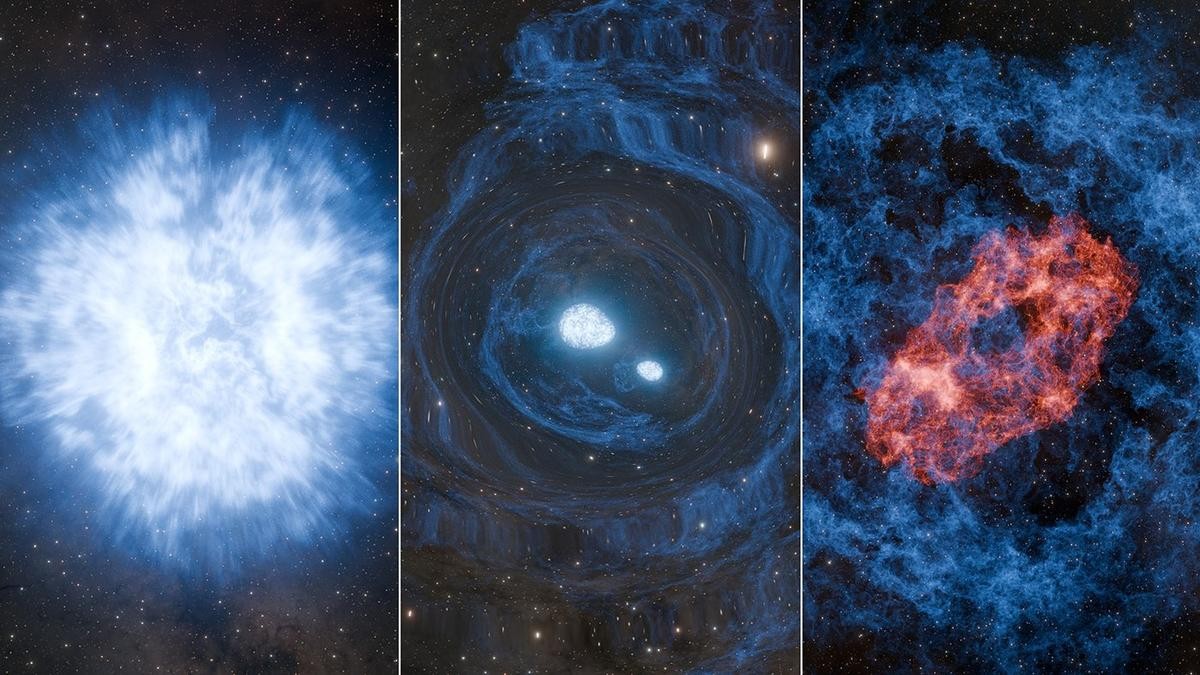
A superkilonova is a proposed and extremely powerful cosmic explosion that appears brighter and longer-lasting than a normal kilonova due to an additional energy source, such as fallback heating or a preceding supernova, and it offers new insights into neutron star mergers, heavy-element formation, and extreme astrophysical processes.
Copyright infringement not intended
Picture Courtesy: The Hindu
In a study of an international research team -- including from IIT-Bombay and the Indian Institute of Astrophysics, Bengaluru -- reported a possible discovery of Superkilonova.
A superkilonova is a hypothetical and extremely rare cosmic explosion that appears brighter, bluer, and longer-lasting than a normal kilonova, due to an additional energy source beyond the standard neutron-star merger.
It represents a new class of stellar explosion, still under scientific investigation.
Recent Scientific evidences:
A superkilonova differs from a standard kilonova because it involves additional energy input, which makes the explosion more luminous, bluer, and longer-lasting than what is produced by a simple neutron-star merger.
Fallback-Powered Superkilonova
Supernova-Triggered Superkilonova (New Hypothesis)
Significance of this discovery:
A superkilonova represents a potentially new and powerful class of cosmic explosion that bridges supernovae and kilonovae, offering fresh insights into stellar evolution, heavy-element synthesis, and extreme astrophysical energy processes, while highlighting the need for further observations to firmly establish its nature.
Source: The Hindu
|
Practice Questions 1. With reference to a superkilonova, consider the following statements: 1. It is associated with the merger of neutron stars and the synthesis of heavy elements through r-process nucleosynthesis. 2. It is brighter and longer-lasting than a standard kilonova due to the presence of an additional energy source. 3. It has been conclusively established as a distinct and well-confirmed class of cosmic explosion. Which of the statements given above are correct? Answer: (a) With reference to a superkilonova, consider the following statements Statement 1 correct: It is associated with the merger of neutron stars and the synthesis of heavy elements through r-process nucleosynthesis. Statement 2 correct: It is brighter and longer-lasting than a standard kilonova due to the presence of an additional energy source. The defining feature of a superkilonova is extra energy input (fallback heating or a preceding supernova), making it more luminous, bluer, and longer-lived than a typical kilonova. Statement 3 incorrect: It has been conclusively established as a distinct and well-confirmed class of cosmic explosion. |
Two main mechanisms are proposed: a fallback-powered process, where ejected matter falls back and heats the merger remnant, and a supernova-triggered process, where a supernova is followed by a rapid neutron-star merger.
Superkilonovae, like kilonovae, involve r-process nucleosynthesis, which is responsible for forming heavy elements such as gold and platinum, thereby improving understanding of the universe’s chemical evolution.
Superkilonovae are detected through optical and infrared telescopes by analysing their light curves and spectra, and future confirmation may involve gravitational-wave observations.






© 2026 iasgyan. All right reserved