The Mohenjo-daro Dancing Girl, a 10.5-cm bronze artefact from the Indus Valley Civilization, showcases advanced lost-wax metallurgical techniques. Discovered in 1926, this iconic sculpture reflects the high aesthetic sophistication, cultural richness, and artistic mastery of India's earliest urban society.
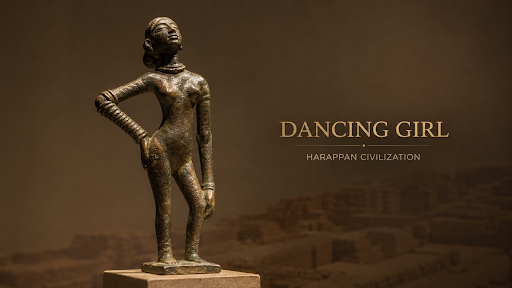
The NCERT sparks a historical debate by obscuring the nude torso of the iconic Mohenjo-daro 'Dancing Girl' sculpture in its new Class 9 art textbook, 'Madhurima'.
Discovery: British archaeologist Ernest Mackay discovered the statue in 1926 during excavations at Mohenjo-daro.
Artistic Significance: This 10.5 cm tall bronze sculpture represents the most iconic piece of prehistoric art from the Indus Valley Civilization.
Historical: The artifact dates to the Mature Harappan period (circa 2500–1900 BCE), placing it contemporaneously with the Great Pyramids of Egypt.
Current Location: The statue resides in the National Museum, New Delhi, serving as a centerpiece in the Indus Civilization gallery.
Features and Craftsmanship
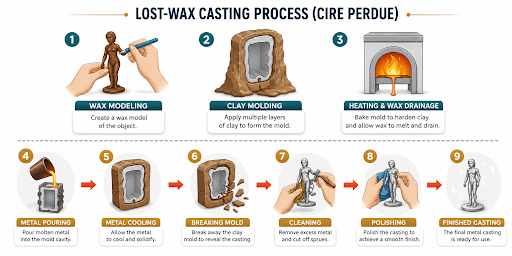
Lost-Wax Technique: Artisans employ the Lost-Wax casting technique (Cire Perdue), method, demonstrating advanced knowledge of metallurgy, metal blending, and temperature control.
Ornamentation: The figure features a cowry shell necklace, 24-25 bangles on the left arm, and a bracelet on the right arm.
Posture: The figurine adopts a naturalistic Tribhanga pose, characterized by an S-shaped curve with bends at the knees, waist, and neck.
Stylistic Traits: The statue exhibits common Harappan stylistic features, including a slightly tilted head, large eyes, and unnaturally long arms.
Reflection of Harappan Society
Metallurgical Mastery: The artifact confirms that Indus craftsmen successfully alloyed copper with tin to produce durable bronze, moving beyond stone-based tools.
Urban Sophistication: The existence of such luxury goods reflects a wealthy society supported by surplus agriculture, craft specialization, and extensive trade networks.
Cultural Values: The spirited, lifelike stance indicates that music, dance, and entertainment held high value in Harappan culture.
High Art: The statue serves as a purely aesthetic and symbolic object, proving the presence of "high art" in a civilization otherwise defined by utilitarian production.
Archaeological Significance and Legacy
Continuity of Tradition: Modern Sthapatis (traditional sculptors) continue to utilize the ancient Cire Perdue method to cast Panchaloha bronze idols.
Colonial Bias: Early archaeologists like John Marshall projected moral biases onto the figure, labeling it an "aboriginal nautch girl," whereas modern historians view it as a symbol of women's social status and artistic grace.
National Symbolism: The figurine serves as an icon of ancient Indian heritage, inspiring the official mascot of the International Museum Expo 2023.
Source: INDIANEXPRESS
|
PRACTICE QUESTION Q. Consider the following statements regarding the 'Dancing Girl' sculpture discovered at Mohenjo-daro:
Which of the statements given above are correct? A) 1 and 2 only B) 2 and 3 only C) 1 and 3 only D) 1, 2, and 3 Answer: B Explanation: Statement 1 is incorrect: The 'Dancing Girl' is a bronze sculpture, not steatite (soapstone), and she is depicted in a natural, confident standing pose with one hand on her hip, not in a meditative posture. Statement 2 is correct: The Indus Valley Civilization artisans cast the figurine using the cire perdue (lost-wax) technique. Statement 3 is correct: The figurine is shown wearing multiple rings/bangles on her arm (24 on one arm and 4 on the other) and displays an early, classical tribhanga (three-bend) posture. |
The Dancing Girl is a world-renowned, 4,500-year-old prehistoric bronze sculpture that depicts a stylized, confident young woman adorned with bangles standing in a fluid, natural posture.
British archaeologist Ernest Mackay excavated this masterpiece in 1926 from the ruins of the ancient Indus Valley metropolis of Mohenjo-daro, located in present-day Sindh, Pakistan.
The statue proves that Harappan metalsmiths had masterfully pioneered the cire perdue (lost-wax) casting method, demonstrating a highly advanced, sophisticated understanding of metallurgy and mold-making long before Western civilizations.
The sculpture reveals a socially vibrant society that deeply valued sophisticated performing arts like dance, excelled in complex alloy manufacturing, maintained extensive commercial trade networks for metals, and embraced expressive aesthetics.





© 2026 iasgyan. All right reserved