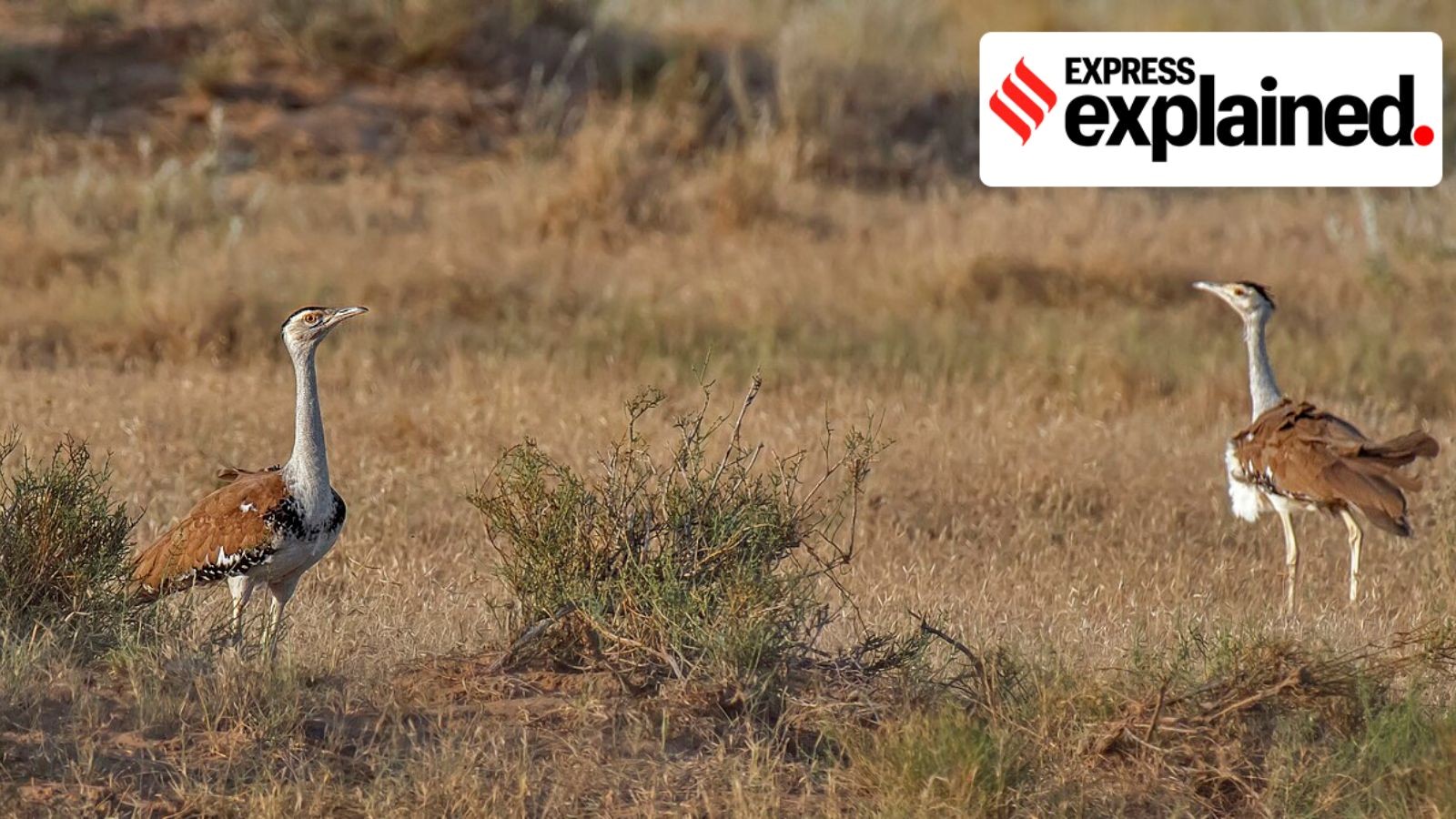
The Supreme Court has issued targeted directions to safeguard the critically endangered Great Indian Bustard, whose population has sharply declined due to habitat loss and collisions with power transmission lines in Rajasthan and Gujarat. The Court expanded priority conservation areas, created dedicated power-line corridors, ordered undergrounding and rerouting of high-risk lines, and restricted new wind and large solar projects in key habitats. It also directed state-specific conservation actions such as grassland restoration, predator management, captive breeding support, the “jump-start” technique in Gujarat, and greater community participation. These combined legal, ecological, and management measures aim to prevent the species’ extinction and ensure its long-term recovery.
Copyright infringement not intended
Picture Courtesy: Indian Express
The Supreme Court pronounced a significant judgement on December 19 addressing conservation issues of the Great Indian Bustard and on preventing their deaths due to collisions with power lines evacuating electricity from renewable energy projects.
|
Must Read: GREAT INDIAN BUSTARD | |
The Supreme Court was examining a petition filed in 2019 seeking urgent intervention to conserve the critically endangered Great Indian Bustard and to prevent its deaths caused by collisions with overhead power transmission lines in Rajasthan and Gujarat.
|
Great Indian Bustard The Great Indian Bustard is among the heaviest birds capable of sustained flight, with some adults reaching a body weight of nearly 15 kilograms. It primarily occupies arid grasslands and scrubland ecosystems of the Indian subcontinent. Distribution The species is endemic to the Indian subcontinent. In India, its remaining populations are mainly found in: ·Rajasthan (especially Desert National Park) ·Gujarat ·Madhya Pradesh ·Karnataka ·Andhra Pradesh Small numbers have also been recorded in adjoining regions of Pakistan. IUCN Red List: It is listed as Critically Endangered, with an estimated population of fewer than 150 individuals surviving in the wild. CITES: It is placed in Appendix I, which provides the highest level of international trade protection. Wildlife (Protection) Act, 1972: In India, it is included under Schedule I, offering the strictest legal protection. Characteristics: The Great Indian Bustard is a tall, long-legged, and long-necked bird, with some individuals attaining a height of about 1.2 metres.
|
National Bustard Recovery Programme: The Government of India has launched the National Bustard Recovery Programme to protect the Great Indian Bustard along with the Lesser Florican and Bengal Florican, focusing on habitat improvement, threat reduction, captive breeding, and involvement of local communities in conservation.
Project Great Indian Bustard (Project GIB): Project GIB specifically targets the long-term survival of the Great Indian Bustard by strengthening both in-situ protection in natural habitats and ex-situ conservation through breeding support, systematic monitoring, protection of nesting areas, and control of threats such as predators and power-line collisions.
Conservation Breeding Centres: The government, in collaboration with the Wildlife Institute of India and state forest departments, has established captive breeding and conservation breeding centres in Rajasthan where eggs collected from the wild are incubated artificially and chicks are reared for future release into secure habitats.
Habitat Management: The government has taken steps to restore grasslands by removing invasive species, managing grazing pressure, conserving fallow open lands, and creating secure nesting enclosures so that suitable breeding habitat is available for the species.
State-Level Initiatives: In Rajasthan, “Project Godawan” focuses on protection in the Desert National Park landscape through predator control, water provisioning, habitat management, and community engagement, while in Gujarat, special initiatives include the jump-start technique using fertile eggs, GPS tagging of birds, and targeted habitat management in the Kutch region.
The conservation of the Great Indian Bustard now rests on a combination of strong legal protection, targeted habitat management, reduction of power-line mortality, captive breeding, and community participation. With coordinated efforts by the Centre, states, scientists, and local communities, India still has a narrow but real opportunity to **prevent the species from going extinct and revive its remaining populations.
Source: Indian Express
|
Practice Question Q. Discuss the major threats faced by the Great Indian Bustard and critically evaluate the effectiveness of recent Supreme Court directions and government initiatives in ensuring its long-term conservation. (250 words) |
The Great Indian Bustard is critically endangered because its population has declined drastically due to habitat loss, collisions with power lines, predation of eggs, and disturbance in breeding areas, leaving fewer than about 150 birds in the wild.
It is mainly found in Rajasthan and Gujarat, with smaller remnant populations reported from Madhya Pradesh, Karnataka, and Andhra Pradesh.
The species prefers arid and semi-arid grasslands and scrublands, especially open landscapes with sparse vegetation.




© 2026 iasgyan. All right reserved