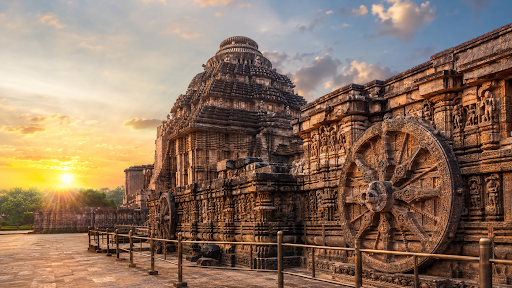
Built in the 13th century by King Narasimhadeva I, the Konark Sun Temple exemplifies Kalinga architecture. Designed as a colossal solar chariot with highly accurate sundial wheels, this UNESCO site undergoes extensive ASI and technological conservation to combat coastal erosion.
Why In News?
Sand removal from the Konark Sun Temple's sanctum sanctorum has entered its final phase.
About the Sun Temple at Konark
The Konark Sun Temple is located on the eastern coastline in the Puri District of Odisha.
Architects originally built the temple complex near the mouth of the Chandrabhaga River, although the waterline has receded over the centuries.
King Narasimhadeva I, a powerful monarch of the Eastern Ganga Dynasty, built this colossal monument around 1250 CE (13th century).
UNESCO declared the Konark Sun Temple a World Heritage Site in 1984.
Historical Background
Eastern Ganga Dynasty
Reign of King Narasimhadeva I
Maritime Significance
Architectural Features
Chariot of the Sun God
Twenty-Four Wheels
Seven Horses
Kalinga Architecture
Artistic Significance
Sculptural Excellence
Astronomical Symbolism
Religious Depictions
Conservation Challenges
Coastal Weathering
Structural Deterioration
Tourism Pressure
Archaeological Survey of India (ASI) manages the site's preservation. Currently, they are undertaking a project to remove the century-old sand from inside the assembly hall using mechanical platforms and stainless-steel support beams.
Source: prameyanews
|
PRACTICE QUESTION Q. With reference to the Konark Sun Temple, consider the following statements:
Which of the statements given above is/are correct? A) 1 and 2 only B) 2 and 3 only C) 1 and 3 only D) 1, 2, and 3 Answer: A Explanation: Statement 1 is correct: The Konark Sun Temple was built in the 13th century by King Narasimhadeva I of the Eastern Ganga Dynasty. Statement 2 is correct: The temple is designed in the shape of a massive chariot with 24 elaborately carved stone wheels. These wheels aren't just decorative; they function as precise sundials that can calculate time. Statement 3 is incorrect: The temple does not belong to the Dravida style. Instead, it is a prime example of the Kalinga (or Orissan) style, which is a sub-category of the Nagara (North Indian) style of temple architecture. |
King Narasimhadeva I of the Eastern Ganga Dynasty constructed this monumental stone temple complex during the 13th century around 1250 CE.
European sailors named it the Black Pagoda because its massive dark silhouette and black granite tower acted as a prominent coastal landmark that drew ships off-course due to magnetic anomalies.
Legend states that the temple's main iron-cast sun idol floated mid-air because it was perfectly balanced by a massive 52-tonne lodestone magnet placed at the peak of the main sanctuary.
The temple is masterfully designed as a colossal solar chariot drawn by seven stone horses and features 24 intricately carved stone wheels that function as highly accurate sundials.



© 2026 iasgyan. All right reserved