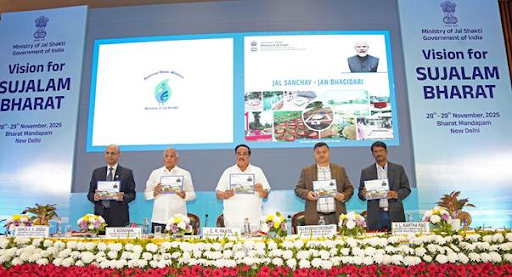
The Sujalam Bharat Summit 2025 seeks a unified national plan to tackle India’s water crisis. Led by the Jal Shakti Ministry, it sets five priorities across river revival, greywater use, and technology. A whole-of-government approach aims to fix governance gaps and scale community-driven solutions for water security.
Copyright infringement not intended
Picture Courtesy: pib
The Ministry of Jal Shakti hosted the “Vision for Sujalam Bharat Summit 2025” in New Delhi, to create a unified and actionable framework for national water security.
It aims to address India's water challenge, as the country supports 18% of the world's population with only 4% of its freshwater resources.
The goal is to accelerate India’s journey towards water sustainability. This is achieved through a 'whole-of-government' approach that emphasizes:
River & Spring Rejuvenation: Ensure continuous, clean flow (Aviral & Nirmal Dhara) via spring-shed/catchment management, wetland/riverfront restoration, and community stewardship.
Drinking Water Sustainability: Ensure adequate, safe water through source planning, climate-resilient infrastructure, community-based O&M, and digital governance.
Efficient Water Technology: Use digital tools, AI monitoring, micro-irrigation, loss/leak detection, and precision agriculture for demand-side management.
Water Conservation & Recharge: Implement community-led groundwater governance, managed aquifer recharge, revival of traditional systems, and LiFE-aligned behavioral interventions.
Greywater Management & Reuse: Promote circular water use via financing, pricing, nature-based solutions, septage management, and reuse in domestic, industrial, and urban sectors.
Community & Institutional Engagement: Strengthen community groups, frontline workers, and inter-departmental convergence for long-term water asset sustainability.
The Ministry of Jal Shakti has identified five national priorities to guide action.
|
Priority Area |
Strategic Action |
|
Source Sustainability |
Protecting and reviving the origins of water, such as rivers, springs, and aquifers. |
|
Groundwater Recharge |
Implementing large-scale artificial recharge and demand-side management. |
|
Modern & Nature-Based Solutions |
Integrating technology (AI, IoT) with traditional wisdom (revival of ponds, step-wells). |
|
Strengthened Community Institutions |
Building the capacity of local bodies for participatory water governance. |
|
Inter-Departmental Convergence |
Ensuring synergy between different ministries (e.g., Rural Development, Agriculture, Environment) for holistic outcomes. |
The summit ensures national policies are grounded in reality, promoting evidence-based decisions and stronger cooperative federalism.
The 'Vision for Sujalam Bharat' shifts water governance from a fragmented, supply-focused approach to an integrated, sustainable, and community-centric model. Implementing its six pillars and five national priorities is vital for India's water security, climate resilience, and achieving SDG 6 (Clean Water and Sanitation).
Source: PIB
|
PRACTICE QUESTION Q. Which of the following is not the core thematic pillars of the "Vision for Sujalam Bharat Summit 2025"? A) Rejuvenation of Rivers and Springs B) Greywater Management C) Inter-linking of National Rivers D) Technology-driven Water Management Answer: C Explanation: The "Vision for Sujalam Bharat Summit 2025" focuses on six core thematic pillars, and the inter-linking of national rivers is not one of them. |
The Vision for Sujalam Bharat Summit 2025 is an event hosted by the Ministry of Jal Shakti. It aims to create a unified and actionable framework for India's water security by bringing together central, state, and grassroots-level officers to integrate ground realities with national policymaking.
India needs a unified framework because it faces a severe water crisis. With 18% of the world's population but only 4% of its freshwater, the country suffers from rapidly depleting groundwater, high water stress affecting 600 million people, widespread surface water pollution, and fragmented governance that hinders effective policy implementation.
The summit focuses on six critical thematic pillars: Rejuvenation of Rivers and Springs, Greywater Management, Technology-driven Water Management, Water Conservation, Sustainable Drinking Water Supply, and Deep Community Engagement.


© 2026 iasgyan. All right reserved