The MNRE’s SHP Development Scheme aims for 1,500 MW by 2031, targeting decentralized, indigenous power. While offering financial aid for strategic electrification, success hinges on overcoming bureaucratic delays, terrain challenges, and DISCOM reluctance through streamlined clearances and Hydro Purchase Obligations.
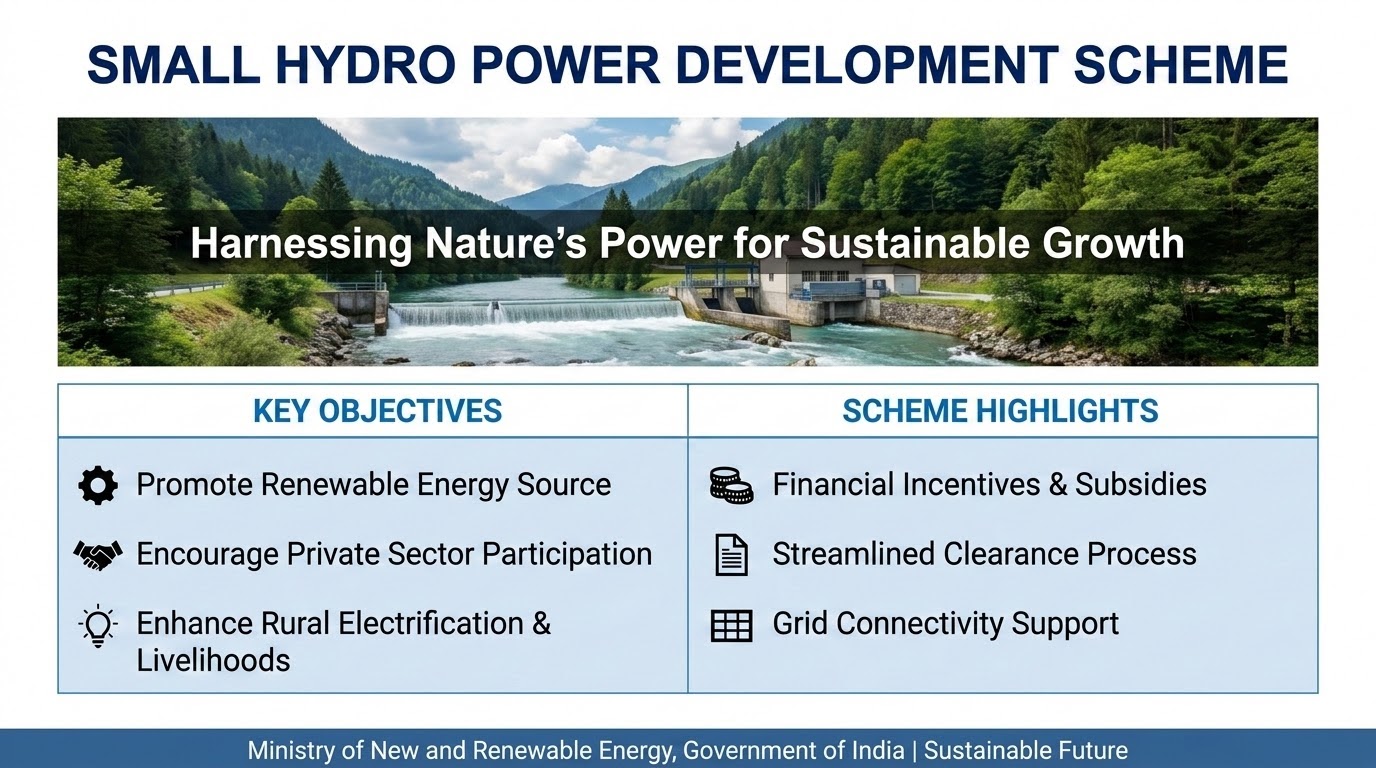
The Union Cabinet approved the Small Hydro Power (SHP) Development Scheme with an outlay of ₹2,584.60 crore to add 1,500 MW capacity from FY 2026-27 to FY 2030-31.
What is the Small Hydro Power Development Scheme?
The Scheme was launched by the Ministry of New and Renewable Energy (MNRE), to boost decentralized, community-based hydroelectric generation.
Objective & Target: The scheme aims to harness 1,500 MW of new capacity from small hydro projects (1 MW to 25 MW) to create a self-reliant energy ecosystem. (Source: PIB)
Timeline & Budget: It covers the period from FY 2026-27 to FY 2030-31 with a total financial outlay of ₹2,584.60 crore (Source: PIB).
Key Incentives (Central Financial Assistance):
Infrastructure Support: An allocation of ₹30 crore is set aside specifically to support government agencies in preparing Detailed Project Reports (DPRs) for approximately 200 future projects. (Source: PIB)
Domestic Manufacturing: The scheme mandates the use of 100% indigenous plant and machinery, directly supporting the "Atmanirbhar Bharat" initiative.
Reliable, Round-the-Clock Power
Small hydro plants offer firm, round-the-clock electricity, unlike intermittent solar or wind, which stabilizes the grid and ensures a steady baseload.
Decentralization Reduces Losses
Proximity to consumption centers allows SHP projects to minimize long-distance transmission, significantly cutting transmission and distribution losses while enhancing network efficiency.
Strategic Security for Border Areas
By prioritizing international border districts, the scheme strengthens energy independence in sensitive areas. Localized generation minimizes grid dependency and mitigates supply disruption risks.
Untapped Potential
India utilizes only 5,171 MW of its 21,133 MW SHP potential across 7,133 sites. Developing the remaining 15,960 MW is a key strategy for expanding renewable energy with minimal ecological impact. (Source: PIB).
Minimal Ecological Footprint
Most SHP projects utilize "run-of-the-river" systems, bypassing the need for large dams. This prevents the extensive deforestation and community displacement of major hydropower developments.
High Capital Cost & Financial Viability
Small hydro projects are capital-intensive, exceeding solar and wind in costs per MW. Developers face short-tenure loans (10–12 years) that mismatch the assets' 40-year lifespan, causing high tariffs that hinder Power Purchase Agreements (PPAs).
Complex Clearances & Land Acquisition
Projects encounter delays from multi-agency clearances (forest, environment, wildlife). Land acquisition in remote, hilly terrain is complicated by unclear records, causing cost overruns and construction halts.
Lack of Hydrological Data
Remote streams often lack precise river flow records, forcing developers to use estimates. This increases financial risk for lenders and risks inefficient plant designs that underperform on power generation.
Grid & Evacuation Infrastructure
SHP sites in remote areas lack reliable transmission grids. The high cost and technical difficulty of constructing evacuation infrastructure to connect these locations to the main grid remain obstacles.
Environmental & Climate Risks
Despite being cleaner than large-scale hydropower, SHP projects face climate threats like flash floods and glacial lake outburst floods (GLOFs), risking infrastructure damage. High Himalayan silt levels erode turbines, raising maintenance expenses.
Financial Reforms
Loan Tenure Extension: Institutions like IREDA should provide 15–20 year loans to align with the 40-year life of hydro assets, reducing tariffs and improving PPA viability.
Green Financing: Utilizing international green climate funds can offer low-interest capital to mitigate high initial construction expenses.
Administrative Reforms
Unified Approval Process: A single-window portal for forest and environmental clearances could slash commissioning time from 5–8 years to just 3–4 years.
Standardized DPR Templates: Uniform Detailed Project Report (DPR) formats would accelerate technical approvals and minimize site selection errors.
Infrastructure Reforms
Green Energy Corridors: States should prioritize transmission lines in remote hilly areas for SHP clusters to prevent power wastage from grid gaps.
Smart Grid Integration: Decentralized micro-grids for local communities can bypass long-distance transmission, enhancing energy security.
Policy Reforms
HPO Enforcement: Strict Hydropower Purchase Obligation enforcement for State Discoms ensures market demand, driving private investment in SHP.
Peak-Hour Tariffs: Rewards for power supply during peak evening hours, when solar is unavailable, improve SHP project revenue and viability.
Technical Reforms
Digitized Hydrological Mapping: Satellite and AI-based river flow mapping provides accurate streamflow data, mitigating project failure risks from low water levels.
Climate-Resilient Engineering: Turbines and structures must be designed to endure high silt and flash floods for stability in the Himalayan region.
Small Hydro Power represents the idea that sustainable progress lies not in massive expansion, but in smart and balanced utilization of natural resources.
SOURCE: PIB
|
PRACTICE QUESTION Q. Analyze the significance of the Small Hydro Power (SHP) Development Scheme in ensuring grid stability and strategic border electrification in India. 150 words |
In India, any hydroelectric power plant with an installed capacity of up to 25 Megawatts (MW) is officially classified as a Small Hydro Power (SHP) project.
Unlike large, conventional dams which are regulated by the Ministry of Power, SHP projects fall under the jurisdiction of the Ministry of New and Renewable Energy (MNRE).
Most SHPs operate as 'run-of-the-river' projects, meaning they utilize the natural downward flow of rivers to generate power. Because they do not require massive water reservoirs, they avoid large-scale land submergence, deforestation, and the forced displacement of local communities.



© 2026 iasgyan. All right reserved