The Skills Outcomes Fund is a performance-linked financing model that shifts skilling focus from training inputs to verified employment, paying providers only when participants—especially low-income women—secure and retain jobs, ensuring sustainable livelihoods through high-impact, outcome-based accountability.
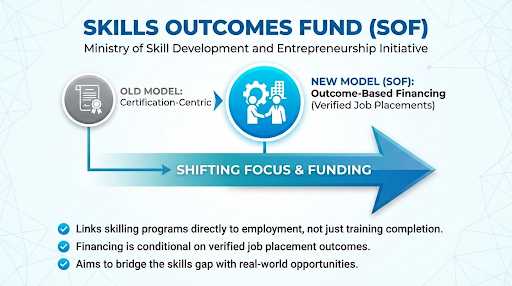
The Ministry of Skill Development and Entrepreneurship (MSDE) launched the innovative 'Skills Outcomes Fund'.
The Skills Outcomes Fund (SOF) is a financing initiative to shift India’s skilling ecosystem from a "training-led" model to an "employment-led" model.
Core Objective: Linking funding to job placement and retention to provide aspirational livelihoods for low-income youth.
Anchoring Body: Managed by the National Skill Development Corporation (NSDC), it uses a Blended Finance Model with government, private, and philanthropic capital.
Precursor: Modeled after the 2021 Skill Impact Bond, which proved outcome-linked funding improves job retention.
The fundamental difference lies in the "Pay-for-Success" structure. Traditional schemes pay for the activity (training), whereas the SOF pays for the result (employment).
|
Feature |
Traditional Skilling Schemes |
Skills Outcomes Fund (SOF) |
|
Funding Trigger |
Input-Based: Training providers are paid when they enroll or certify a student. |
Outcome-Based: Payments are released only when the student gets a job and retains it for a specific period (e.g., 3-6 months). |
|
Risk Allocation |
Government Risk: If the trained youth doesn't get a job, the government/funder still bears the cost. |
Implementer Risk: Service providers or risk investors bear the upfront cost; they are reimbursed only if targets are met. |
|
Success Metric |
Certification: Success is measured by the number of certificates issued. |
Retention: Success is measured by income gain and job retention. |
|
Market Connection |
Supply-Driven: Often creates a pool of skilled candidates hoping for demand. |
Demand-Driven: Employer-led curriculum ensures training is only for existing vacancies in high-growth sectors (e.g., Green Jobs, BFSI). |
By engaging risk investors, the fund incentivizes mentorship during early employment, not just initial training.
Risk Aversion of Training Providers: Small training centers might struggle without upfront government advances due to limited working capital.
Verification Complexity: Tracking long-term "job retention" (e.g., 6–12 months) is administratively challenging.
Sectoral Concentration: Outcome-based funding naturally favours sectors with high formal hiring (like IT/BFSI).
Geographic Bias: Training providers and investors may prioritize Tier-1 urban centers to maximize placement results, potentially neglecting youth in aspirational districts or rural regions.
Hybrid Funding for Smaller Players: To avoid corporate monopolies, the government should implement a "Partial Advance" model for NGOs and small centres, providing upfront, outcome-linked funding.
Digital Integration with e-Shram & Aadhaar: Integrate the SOF dashboard with DigiLocker and the e-Shram portal to automate verification, allowing the fund to track "Productive Inclusion" in gig and informal economies.
Incentivizing "High-Difficulty" Placements: To promote inclusivity, placements for Persons with Disabilities (PWD) and economically backward districts should utilize "Differential Pricing" with higher payouts. This ensures the fund supports marginalized candidates.
Focus on "Green and Future Skills": The fund should establish a specific window for Industry 4.0 (AI, Robotics) and Green Hydrogen sectors, balancing high training costs with transformative economic potential.
Corporate "Skill Surcharges": Prompting large industries to allocate CSR funds to the SOF can build a self-sustaining cycle where businesses finance the development of their own future workforce.
The Skills Outcomes Fund is a performance-linked financing model shifting skilling focus from training inputs to verified employment. It ensures high-impact accountability by paying providers only when participants secure and retain jobs.
Source: PIB
|
PRACTICE QUESTION Q. Consider the following statements regarding the 'Skills Outcomes Fund' (SOF): 1. It is purely funded by the central government without any private sector or philanthropic participation. 2. It explicitly links financial payouts to verified employment outcomes such as job retention rather than mere training certification. Which of the statements given above is/are correct? (a) 1 only (b) 2 only (c) Both 1 and 2 (d) Neither 1 nor 2 Answer: (b) Explanation: Statement 1 is incorrect: The SOF is not purely funded by the central government. It utilizes a blended finance model that combines government funding with investments from private sector companies, philanthropic organisations, and development agencies. Statement 2 is correct: The SOF aims to scale outcomes-based financing, directly linking funding to verified employment outcomes such as job placement and retention, rather than mere training completion or certification. |
The SOF is a blended finance initiative by the Indian government that utilizes Outcomes-Based Financing (OBF) to fund skill development. Unlike traditional models, it releases funds based on verified job placement and employment retention rather than just candidate enrollment or training certification.
OBF is a public policy and funding model where financial payouts to training providers are strictly linked to achieving predefined, measurable results—such as sustaining formal employment for a set period—rather than just the inputs (like opening centers) or the completion of training.
The National Skill Development Corporation (NSDC), functioning under the aegis of the Ministry of Skill Development and Entrepreneurship (MSDE), is anchoring the SOF in collaboration with private and philanthropic partners like the Gates Foundation and the British Asian Trust.






© 2026 iasgyan. All right reserved