PM Surya Ghar: Muft Bijli Yojana promotes rooftop solar through subsidies and concessional loans, cutting AT&C losses and boosting decentralised power. It faces DISCOM resistance, and grid “Duck Curve” risks. Battery storage and uniform net metering are vital for maximising the benefit and achieving Panchamrit goals.
Copyright infringement not intended
Picture Courtesy: DDNEWS
Context
The PM Surya Ghar: Muft Bijli Yojana, a central scheme for rooftop solar energy, recently hit a milestone of 30 lakh household installations.
What is PM Surya Ghar: Muft Bijli Yojana?
It was launched in February 2024 with a total outlay of ₹75,021 crore.
Objectives: Provide up to 300 units of free electricity per month to 1 crore households, transforming them from passive consumers to active energy producers, also known as "prosumers".
Key Benefits
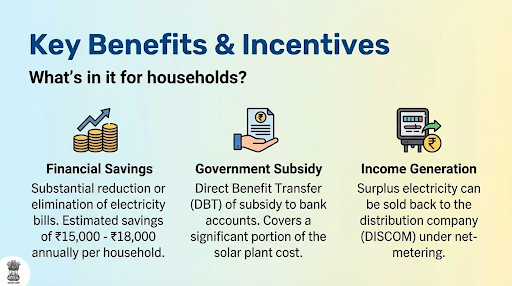
Direct Subsidy: Government provides a subsidy of up to ₹78,000 depending on the solar plant's capacity.
Income Generation: Any surplus electricity generated can be sold back to the grid (DISCOMs), providing an additional source of income for the family.
Low-Interest Loans: Applicants can access collateral-free, low-interest loan products for installing the systems.
Strategic Significance for India
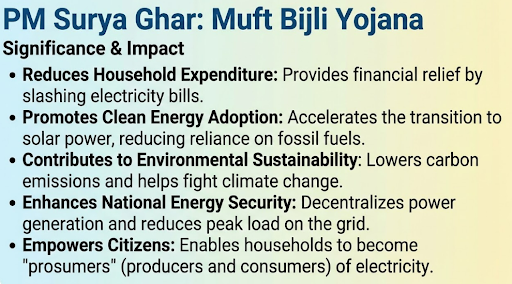
Economic Empowerment
Households can save an estimated ₹15,000 to ₹18,000 annually on electricity bills, boosting disposable income. (Source: Union Budget 2024-25)
Decentralized Energy Security
Rooftop solar generates power at the point of consumption, cutting Transmission and Distribution (T&D) losses and boosting grid efficiency and energy security.
Achieving Climate Goals
The scheme is a key driver for meeting India’s 'Panchamrit' commitment of achieving 500 GW of non-fossil fuel capacity by 2030.
What are the Challenges in India's Rooftop Solar Program?
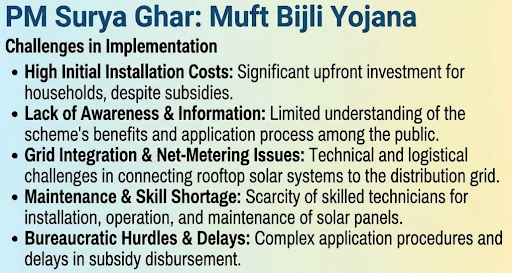
The DISCOM Dilemma
Distribution Companies (DISCOMs) fear revenue loss as their high-paying residential customers switch to rooftop solar. Their business model relies on cross-subsidizing lower-paying consumers with revenue from higher-paying ones.
Financial Barriers
High initial investment (₹1.5–2 lakh for 3 kW) and banks' reluctance to finance small rooftop projects due to perceived high risk are major hurdles for lower-income households.
Grid Stability and the "Duck Curve":
A massive influx of solar power during midday causes a sharp dip in the net load on the grid, followed by a steep rise in demand in the evening when solar generation stops. This volatility, known as the "Duck Curve," strains grid infrastructure.
Supply Chain Constraints
The scheme mandates a Domestic Content Requirement (DCR) to boost 'Make in India'. However, domestic manufacturing capacity for solar cells and modules has not kept pace with the sudden surge in demand.
Way Forward
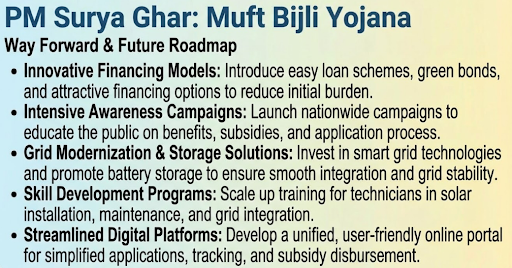
Promoting Hybrid Systems
Incentivizing the integration of Battery Energy Storage Systems (BESS) with solar installations to store energy for use during peak evening hours.
Grid Modernization
Rapidly deploying Smart Meters and Smart Inverters to enable real-time grid monitoring and management of Distributed Renewable Energy (DRE) sources.
Innovative Financing
Introducing models like "on-bill financing," where the loan for the solar system is repaid through the savings generated on the electricity bill, making it accessible to lower-income groups.
Local "Solar Mitras" Cadre
Train local youth (similar to ASHA workers) as "Solar Mitras" to handhold applicants through the digital registration and bank loan process, bridging the digital divide in rural areas.
Learn from Global Lessons
India can learn from global leaders like Australia, which has nearly one in three households with rooftop solar, and implemented "Dynamic Operating Envelopes" to manage grid congestion and power flow dynamically.
Conclusion
The PM Surya Ghar Yojana's true success lies in transitioning from achieving installation targets to seamlessly integrating new "prosumers" into a modern, resilient, and green national energy grid, addressing DISCOM, grid, and supply chain challenges.
Source: DDNEWS
|
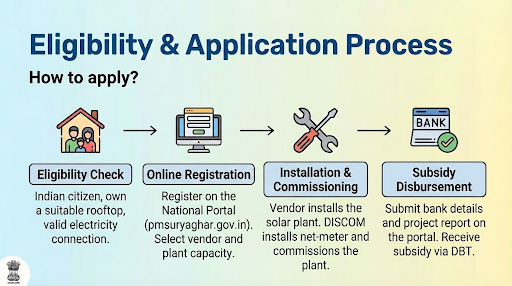
PRACTICE QUESTION Q. Consider the following statements regarding the 'PM Surya Ghar: Muft Bijli Yojana': 1. It aims to provide up to 300 units of free electricity every month to one crore households. 2. The central government provides a 100% subsidy for the installation of solar systems up to 2 kW. 3. The scheme utilizes a National Portal and Direct Benefit Transfer (DBT) for subsidy distribution. Which of the statements given above is/are correct? A) 1 only B) 1 and 3 only C) 2 and 3 only D) 1, 2, and 3 Answer: B Explanation: Statement 1 is correct: The primary objective of the PM Surya Ghar: Muft Bijli Yojana is to provide up to 300 units of free electricity every month to one crore households in India through rooftop solar installations. Statement 2 is incorrect: The central government does not provide a 100% subsidy. Instead, it provides a 60% subsidy for solar systems up to 2 kW capacity and a 40% subsidy for additional capacity between 2 kW and 3 kW. Statement 3 is correct: The scheme is implemented through a National Online Portal for applications and management. Subsidies are disbursed directly into the beneficiaries' bank accounts via Direct Benefit Transfer (DBT). |
It is a central government scheme launched in February 2024 aiming to install rooftop solar systems in one crore households. It provides up to 300 units of free electricity monthly and offers subsidies covering up to 60% of the installation cost for systems up to 2 kW.
Rooftop solar generates power at the point of consumption (the household), eliminating the need to transmit electricity over long distances. This reduces Aggregate Technical and Commercial (AT&C) losses, which are often caused by transmission inefficiencies and theft.
The 'Duck Curve' describes a graph of power demand over a day. It shows a deep dip in net demand during the day when solar energy is abundant (the duck's belly) and a sharp ramp-up in demand in the evening when solar generation stops but household usage peaks (the duck's neck), causing grid instability.



© 2026 iasgyan. All right reserved