Members of the Rajya Sabha are elected indirectly by elected members of State Legislative Assemblies (MLAs). They use the system of proportional representation with a single transferable vote. One-third of members retire every two years, ensuring the House is permanent.
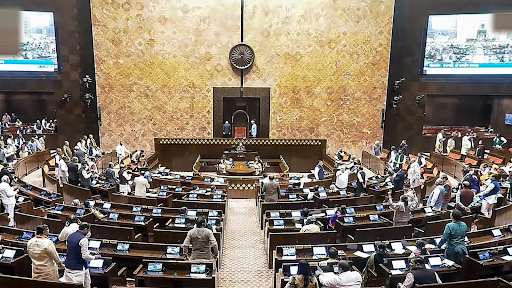
Copyright infringement not intended
Picture Courtesy: INDIANEXPRESS
Context
Elections for 37 Rajya Sabha seats across 10 states—Maharashtra, Odisha, Tamil Nadu, West Bengal, Assam, Bihar, Chhattisgarh, Haryana, Himachal Pradesh, and Telangana—was held on March 16, 2026.
What is Rajya Sabha?
The Rajya Sabha acts as a permanent "House of Elders" that represents the interests of States and Union Territories, providing checks on legislation passed by the Lok Sabha to maintain a federal balance of power.
Key Characteristics
Permanent Body: Unlike the Lok Sabha, the Rajya Sabha is a continuing chamber and is never fully dissolved.
Membership Tenure: Each member is elected for a six-year term. To ensure continuity, one-third of the members retire every second year, and fresh elections are held for those vacant seats.
Presiding Officers: The Vice-President of India serves as the ex-officio Chairman of the Rajya Sabha. The house also elects a Deputy Chairman from among its members to preside in the Chairman's absence.
Powers and Functions
The Rajya Sabha enjoys equal powers with the Lok Sabha in most legislative matters, but there are some distinctions:
Eligibility for Membership
According to Article 84 of the Constitution, a person must:
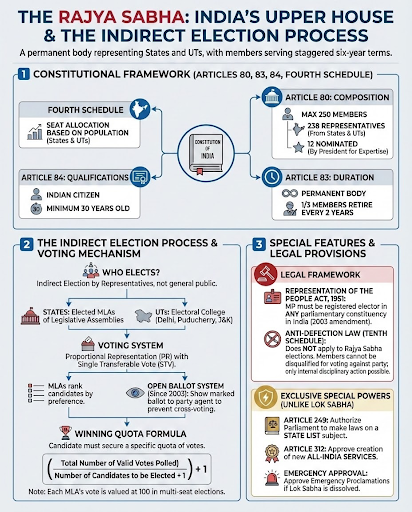
The Rajya Sabha Election Process
Constitutional Basis and Method
Election Method: Members of the Rajya Sabha are elected by the elected Members of the State Legislative Assemblies (MLAs).
System Used: The election follows the system of Proportional Representation by means of a Single Transferable Vote (PR-STV), as mandated by Article 80(4) of the Constitution.
The Quota Formula
To win, a candidate must secure a minimum number of votes, known as the 'quota'. This is calculated using a specific formula.
Cross-Voting
Cross-voting, where an MLA votes against their party's official candidate, happens due to a unique legal exception => Anti-Defection Law Doesn't Apply
Open Ballot System
Global Comparison of Upper Houses
|
Feature |
India (Rajya Sabha) |
USA (Senate) |
Australia (Senate) |
|
State Representation |
Based on population (e.g., Uttar Pradesh has 31 seats, many NE states have 1). |
Equal representation for all states (2 Senators per state), regardless of size. |
Equal representation for states (12 Senators per state). |
|
Election Method |
Indirect election by state MLAs. |
Direct election by the people of the state. |
Direct election by the people using a proportional representation system. |
Source: INDIANEXPRESS
|
PRACTICE QUESTION Q. With reference to the election of members to the Rajya Sabha, consider the following statements:
Which of the statements given above is/are correct? A. 1 and 2 only B. 2 only C. 2 and 3 only D. 1, 2, and 3 Answer: B Explanation: Statement 1 is incorrect: While representatives of states are elected by the elected members of the State Legislative Assembly, they are elected through the system of proportional representation by means of the single transferable vote (STV), not the first-past-the-post system. The first-past-the-post system is used for Lok Sabha and State Assembly elections. Statement 2 is correct: According to Article 80(5) of the Constitution, the representatives of Union Territories in the Rajya Sabha are chosen in such a manner as Parliament may by law prescribe. Parliament has prescribed that they be indirectly elected by an electoral college specially constituted for this purpose. Statement 3 is incorrect: According to Article 84(b), the minimum age required to become a member of the Rajya Sabha is 30 years. The minimum age of 25 years applies to the Lok Sabha and State Legislative Assemblies. |
Members of the Rajya Sabha are indirectly elected by the elected members of State Legislative Assemblies (MLAs) using the system of Proportional Representation by means of a Single Transferable Vote (PR-STV).
No, political parties cannot issue mandatory whips to their members for Rajya Sabha elections. Therefore, cross-voting in these elections does not automatically trigger disqualification under the Tenth Schedule (Anti-Defection Law).
Introduced via an amendment in 2003 to curb corruption, the open ballot system requires MLAs to show their marked ballot to an authorized party agent before casting it into the ballot box.


© 2026 iasgyan. All right reserved