The Supreme Court directed the Centre to create a no-fault compensation policy for severe COVID-19 vaccine injuries under Article 21. This framework bypasses litigation, providing swift redressal through a Vaccine Injury Trust Fund. It ensures a socio-economic safety net, maintains public trust, and strengthens future pandemic preparedness.
Copyright infringement not intended
Picture Courtesy: THEHINDU
Context
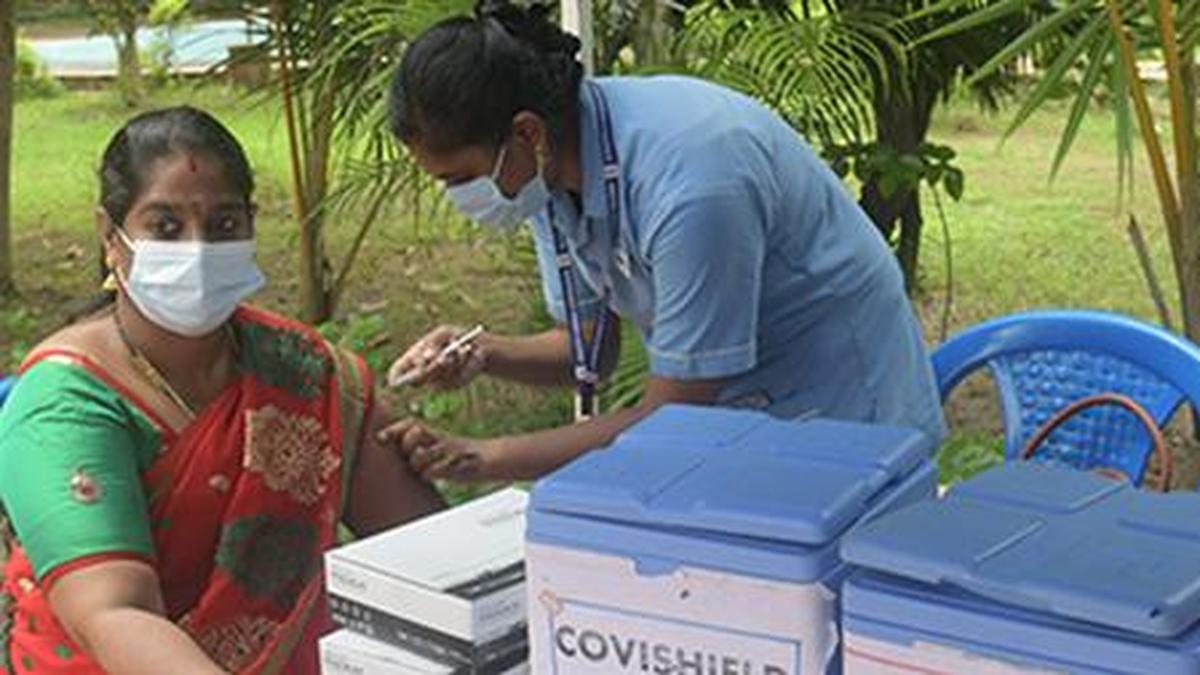
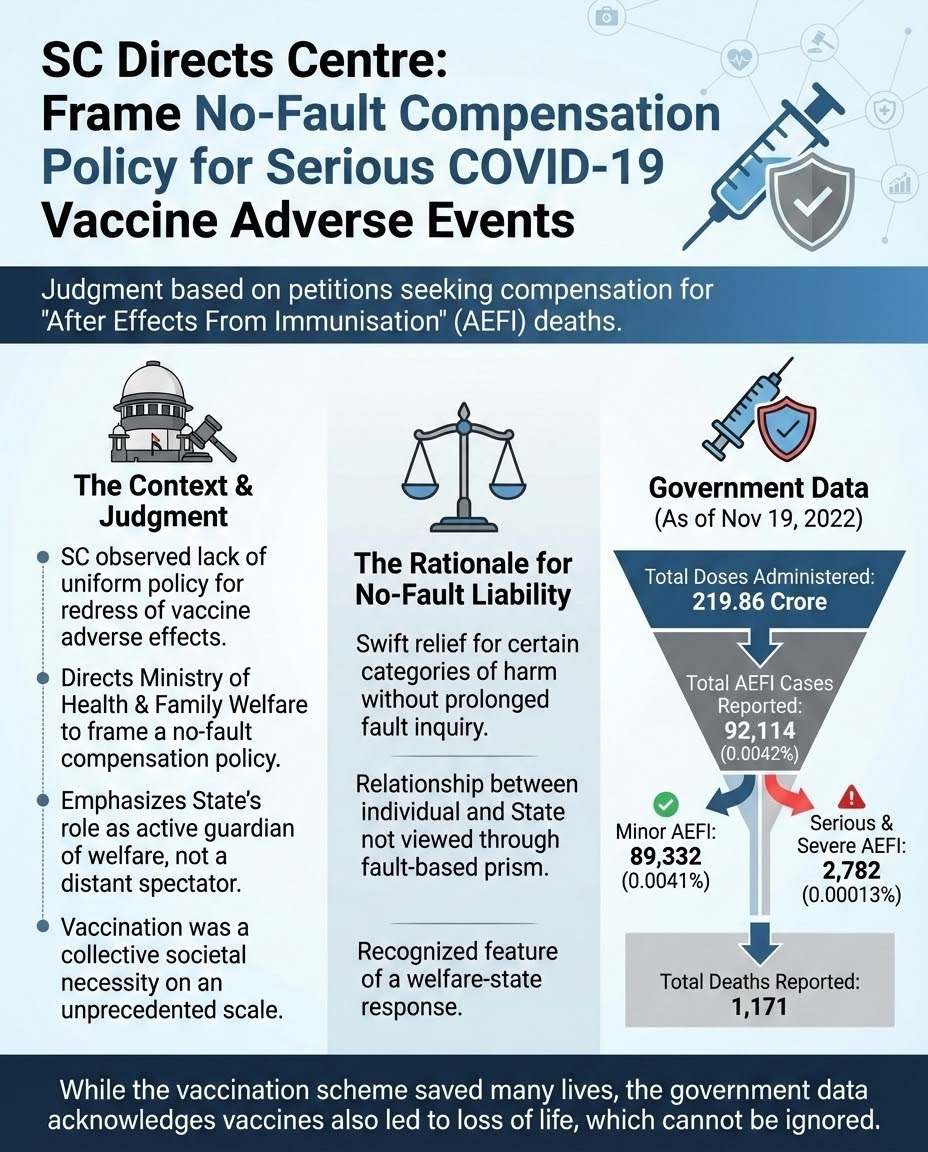
The Supreme Court directed the Union government to formulate a 'no-fault compensation policy' for individuals who suffered severe adverse effects or death following COVID-19 vaccination.
What are the Supreme Court's Directive?
The court emphasized that while the mass vaccination drive was a public health necessity, the State has a duty to provide relief to those who suffered rare but serious harm for the collective good.
The court observed that:
What is 'No-Fault' Policy?
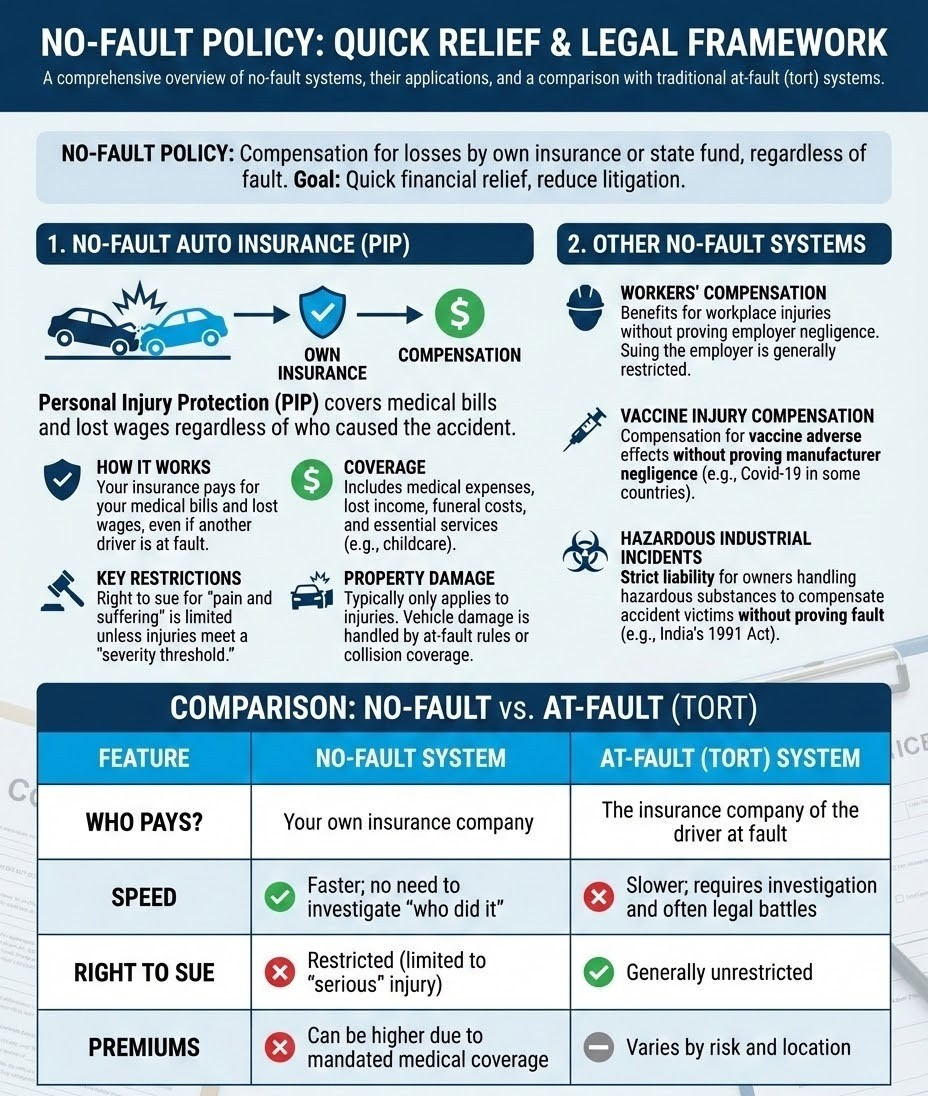
A no-fault policy is a type of insurance or legal framework where individuals are compensated for losses by their own insurance company or a state fund, regardless of who caused the accident.
Its primary goal is to provide quick financial relief and reduce expensive, time-consuming litigation over proving "fault".
Why is a 'No-Fault' Policy Essential?
Provides Swift Justice
Traditional legal routes require proving negligence, which is a lengthy and complex process in medical science.
Fulfills Constitutional Obligations
It aligns with Article 21 (Right to Life) and the State's welfare duty under the Directive Principles. In the Jacob Puliyel vs Union of India (2022) case, the SC noted that when citizens accept vaccination for the greater public good, the State has a reciprocal duty to compensate for any unforeseen harm.
Acts as a Socio-Economic Safety Net
It prevents families from falling into poverty due to the death or severe disability of a breadwinner, mitigating catastrophic out-of-pocket expenditure.
Maintains Public Trust
Acknowledging rare adverse events and offering transparent compensation builds public confidence in immunization programs, which is crucial for future public health initiatives.
Global Best Practices in Vaccine Injury Compensation
|
Model |
Country/Organization |
Key Features |
Funding Mechanism |
|
National Vaccine Injury Compensation Program (VICP) |
United States |
Established in 1986. Provides compensation for specific vaccine-related injuries and deaths. |
Funded by a $0.75 excise tax on every dose of a covered vaccine purchased. |
|
Vaccine Damage Payment Scheme (VDPS) |
United Kingdom |
Established in 1979. Provides a one-time, tax-free payment of £120,000 for severe disablement (60% or more) caused by a vaccine. |
Funded directly by the government exchequer. |
|
COVAX No-Fault Compensation Program |
WHO & Gavi |
World's first international vaccine injury compensation mechanism. Serves 92 low- and middle-income countries for COVAX-distributed vaccines. |
Funded by a small levy on each vaccine dose distributed through the COVAX facility. |
Challenges for Implementation in India
Complex Causality Assessment
Scientifically establishing a direct link between vaccination and an adverse event is difficult, especially when pre-existing health conditions (comorbidities) are present.
Financial Viability
Creating a fund for a population of over 1.4 billion people, especially for past vaccinations, poses a fiscal challenge without a pre-existing funding mechanism like a cess.
Administrative Hurdles
Verifying claims can be difficult due to incomplete medical records and the lack of universal digitized health data, particularly from rural and remote areas.
Way Forward
Establish a Statutory Trust Fund
The government should create a permanent 'Vaccine Injury Trust Fund' through a dedicated Act of Parliament. It can be funded by health cess on future commercial vaccine sales.
Set Up Independent Medical Tribunals
Create specialized medical boards with epidemiologists and other experts to assess claims in a time-bound manner (e.g., within 90 days) to avoid delays.
Define Clear Eligibility Criteria
The policy must have clear, unambiguous standards for what constitutes a severe adverse event and standardize compensation amounts based on the level of disability or death, similar to the UK model.
Institutionalize Pandemic Preparedness
Amend existing laws like the Epidemic Diseases Act, 1897, or the National Disaster Management Act, 2005, to make no-fault compensation a mandatory component of the response to all future public health emergencies.
Conclusion
A no-fault compensation policy reinforces the State’s commitment to citizen welfare and constitutional principles, building the enduring public trust necessary for a resilient public health framework.
Source: THEHINDU
|
PRACTICE QUESTION Q. Consider the following statements regarding 'No-fault liability' in the context of healthcare and vaccines: 1. Under a no-fault compensation scheme, the claimant must legally prove the negligence of the manufacturer or the state. 2. The World Health Organization (WHO) and Gavi operate the COVAX No-Fault Compensation Program for low- and middle-income countries. Which of the statements given above is/are correct? a) 1 only b) 2 only c) Both 1 and 2 d) Neither 1 nor 2 Answer: b Explanation: Statement 1 is incorrect. Under a 'no-fault' compensation scheme, the claimant is not required to prove the negligence or fault of the manufacturer or the state. Instead, it allows victims to receive compensation without needing to prove negligence or intentional wrongdoing, recognizing that rare adverse reactions can occur even with safe vaccines. Statement 2 is correct. The World Health Organization (WHO), Gavi, and other partners operate the COVAX No-Fault Compensation Program, which is a global mechanism for 92 low- and middle-income countries (Advance Market Commitment eligible economies) to provide compensation for serious adverse events following vaccination with vaccines distributed through the COVAX Facility. |
AEFI refers to any untoward medical occurrence that follows immunization. It may not necessarily have a causal relationship with the usage of the vaccine. It can range from minor issues like fever to severe events leading to disability or death.
The Supreme Court directed the Centre to create a policy where victims of severe vaccine adverse events are compensated directly without having to legally prove "fault" or medical negligence by the State or pharmaceutical companies in standard civil courts.
It provides swift justice and financial relief without lengthy court battles, fulfills the State's welfare obligations under Article 21 (Right to Life), prevents financial ruin from catastrophic Out-Of-Pocket Expenditures, and helps maintain public trust in mass immunization programs.



© 2026 iasgyan. All right reserved