Launched in 2019, PM-KISAN is a Central Sector Scheme providing ₹6,000 annually to all landholding farmer families via Direct Benefit Transfer. While it effectively boosts rural liquidity and agricultural investments, challenges like land record digitization and digital illiteracy hinder seamless implementation.
Prime Minister Narendra Modi releases the 23rd instalment of the PM-KISAN scheme.
The Union Government launched PM-KISAN on February 24, 2019, as a Central Sector Scheme to supplement farmer incomes, modeling the initiative after the Rythu Bandhu scheme of Telangana.
Objectives: The scheme augments the financial capacity of farmers to procure agricultural inputs and sustains domestic expenses, effectively shielding households from informal credit dependencies and market volatility.
Beneficiary Coverage: The government initially restricted the scheme to small and marginal farmers owning up to two hectares, but expanded the scope in June 2019 to include all landholding farmer families across India.
Key Features
Annual Income Support: The scheme provides ₹6,000 per year to every eligible landholding farmer family.
Disbursement Structure: The government releases the total amount in three equal installments of ₹2,000 each to ensure liquidity during sowing seasons.
Direct Benefit Transfer (DBT): The state transfers funds directly into Aadhaar-seeded bank accounts, bypassing middlemen and minimizing leakages.
Funding Model: The Union Government classifies this as a 100% centrally funded initiative, placing no financial liability on state governments.
Eligibility and Authentication
Criteria: Families must own cultivable land documented in state revenue records.
Exclusion Categories: The framework strictly excludes institutional landholders, constitutional post holders, government employees, professionals (doctors/engineers), and individuals who paid income tax in the previous assessment year.
Digital Mandates: The government mandates e-KYC and Aadhaar-linked bank accounts for all beneficiaries. The newly introduced Farmer ID consolidates land records and Aadhaar details into a single verified database.
Achievements and Impact
Scale of Reach: The scheme supports over 9.59 crore beneficiaries, including 2.18 crore women farmers in the 23rd instalment alone.
Financial Disbursement: The government has disbursed over ₹4.46 lakh crore since 2019.
Productive Investment: Over 92% of beneficiaries utilize funds for essential inputs like seeds, fertilizers, and pesticides.
Socio-Economic Gains: Approximately 85% of farmers report increased income, while the scheme reduces reliance on informal money lenders and enhances risk-taking capacity for farm investments.
Identification Gaps: Vulnerable groups, particularly female farmers and SC/ST communities, face lower awareness levels.
Technical Bottlenecks: Incomplete digitization of land records causes application rejections. Surveys identify Aadhaar mismatch and bank account errors as primary causes for payment failures.
Digital Divide: Poor rural internet connectivity hinders the completion of e-KYC and Farmer ID registration.
Way Forward
Land Record Digitization: State governments must accelerate the integration of local revenue records with the central PM-KISAN portal.
Grassroots Support: The administration must leverage Common Service Centres (CSCs) to provide offline assistance for e-KYC and Aadhaar linking.
Scheme Convergence: Policymakers should integrate PM-KISAN databases with the Pradhan Mantri Fasal Bima Yojana (PMFBY) and Kisan Credit Card (KCC) to create a unified safety net.
Grievance Redressal: The government must deploy AI-driven, multilingual systems and expand Kisan Call Centres (KCC) to resolve technical mismatches in real-time.
Although PM-KISAN revolutionizes rural welfare with direct support, optimizing it requires closing the digital gap, updating land records, and fixing technical glitches.
Source: NEWSONAIR
|
PRACTICE QUESTION Q. Consider the following statements regarding the Pradhan Mantri Kisan Samman Nidhi (PM-KISAN) scheme:
Which of the statements given above is/are correct? (a) 1 and 2 only (b) 3 only (c) 2 and 3 only (d) 1, 2, and 3 Answer: (b) 3 only. Explanation: Statement 1 is incorrect: The Pradhan Mantri Kisan Samman Nidhi (PM-KISAN) is a Central Sector Scheme, meaning it is 100% funded by the Central Government. It is not a Centrally Sponsored Scheme, and there is no 60:40 cost-sharing ratio between the Centre and States. Statement 2 is incorrect: While the scheme was initially limited to small and marginal farmers owning up to 2 hectares of cultivable land, it was revised in June 2019. The landholding size restriction was removed, and all landholding farmer families are currently eligible, subject to certain exclusion criteria. Statement 3 is correct: The scheme strictly excludes individuals of higher economic status to ensure benefits reach targeted populations. Individuals who paid income tax in the last assessment year, as well as serving or retired government employees (except Multi-Tasking Staff, Class IV, or Group D employees), are entirely excluded. |
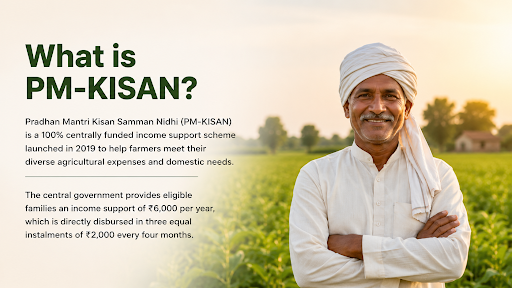
Pradhan Mantri Kisan Samman Nidhi (PM-KISAN) is a 100% centrally funded income support scheme launched in 2019 to help farmers meet their diverse agricultural expenses and domestic needs.
The central government provides eligible families an income support of ₹6,000 per year, which is directly disbursed in three equal installments of ₹2,000 every four months.
All landholding farmer families with cultivable land registered in their names qualify for the scheme, excluding institutional landowners and individuals of higher economic status like income tax payers.
The scheme dramatically reduces farmers' dependence on informal moneylenders, enhances rural productivity by funding immediate inputs like seeds and fertilisers, and enforces complete financial transparency through a leakage-free Direct Benefit Transfer (DBT) system.



.jpg)


© 2026 iasgyan. All right reserved