Copyright infringement not intended
Picture Courtesy: The Hindu
Context:
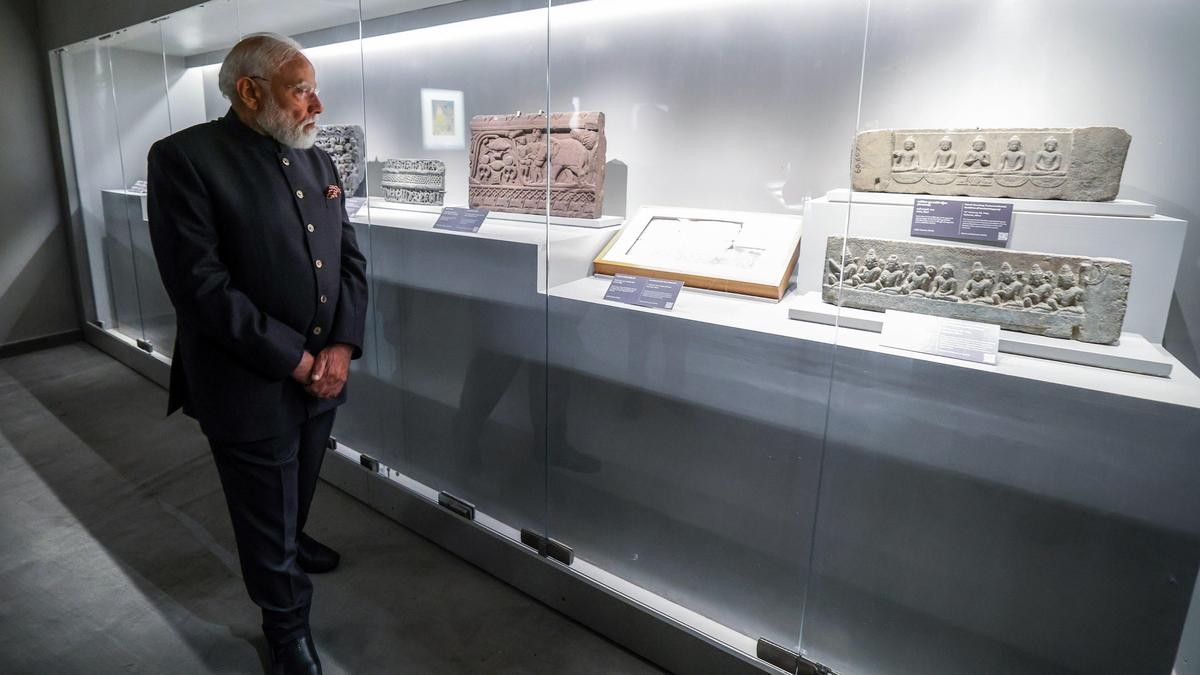
The Piprawaha (Piprahwa) relics, associated with the corporeal remains of Gautama Buddha, were excavated in Uttar Pradesh in the late 19th century and later dispersed abroad. Their recent restitution and exhibition in Delhi mark a significant moment in India’s cultural diplomacy and heritage stewardship.
Piprahwa Relics:
The Piprahwa relics were discovered in 1898 at Piprahwa in present-day Siddharthnagar district of Uttar Pradesh, located close to the India–Nepal border. The site is widely identified with ancient Kapilavastu, associated with the early life of Gautama Buddha.
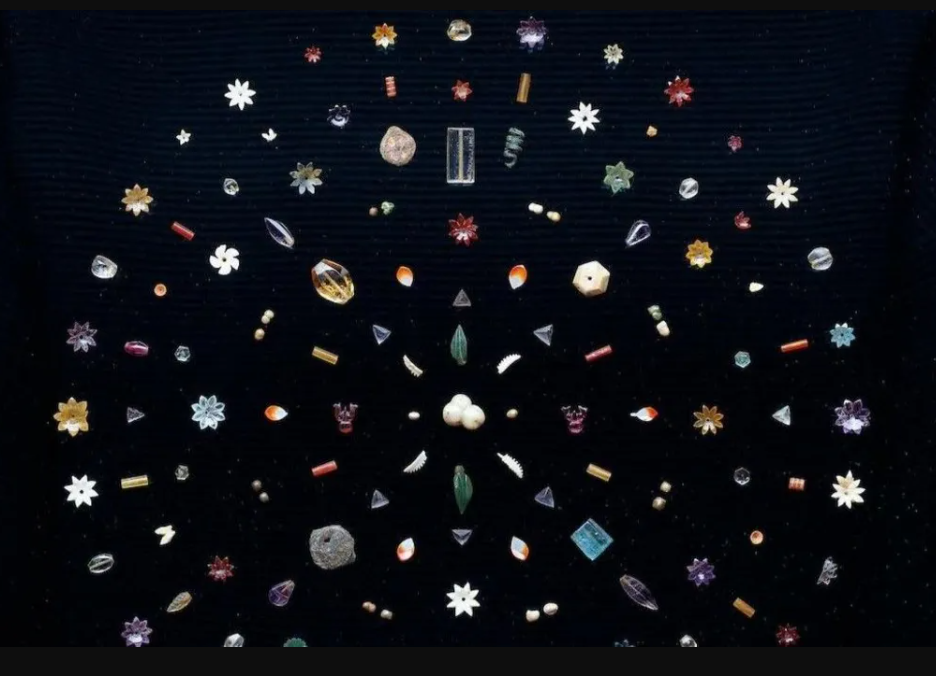
Archaeological Findings: The excavation was carried out by William Claxton Peppé, an English engineer, who unearthed a large stone coffer buried beneath a Buddhist stupa. Inside the coffer were multiple reliquaries made of sandstone, crystal, and soapstone, along with bone fragments believed to be part of the Buddha’s cremated remains. The deposit also contained an assortment of gold ornaments and precious gemstones, indicating ritual offerings.
Nature of the Artefacts: The recovered materials included pearls, rubies, sapphires, topaz, gold sheets, and other decorative elements, numbering over 1,800 individual items. These were not objects of display alone but formed part of a reliquary assemblage, meant to sanctify the remains enshrined within the stupa.
Colonial Intervention: Following the excavation, the British colonial administration invoked the Indian Treasure Trove Act, 1878, to assert control over the findings. As a result, a substantial portion of the artefacts was transferred to the Indian Museum, Kolkata, while some items were dispersed abroad.
Picture Courtesy: BBC
Significance of the exposition of the Piprahwa Relics:
- Historic reunification of dispersed relics: The exposition represents a landmark moment as relics that had remained scattered for more than a century have been reassembled at a single location, alongside authenticated archaeological materials preserved in premier Indian institutions such as the National Museum and the Indian Museum. This reunification symbolises a corrective step in India’s heritage narrative by restoring physical and contextual continuity to sacred artefacts.
- Repatriation and heritage restoration: The exhibition highlights the success of repatriation efforts, reflecting India’s growing capacity to reclaim and safeguard cultural property that was dispersed during the colonial period. It also demonstrates evolving mechanisms of heritage recovery through coordinated action between the government, cultural institutions, and private stakeholders.
- Cultural and spiritual resonance: By foregrounding relics associated with the Buddha, the exposition reinforces India’s identity as the birthplace of Buddhism and emphasises the enduring relevance of Buddhist philosophy. The event conveys that these relics are not merely archaeological remains but constitute a living spiritual heritage that continues to inspire ethical and contemplative traditions.
- Contemporary interpretation of buddhist teachings: The exposition echoes the view that the Buddha’s teachings possess universal and timeless significance, extending beyond historical boundaries to address modern challenges of conflict, materialism, and moral uncertainty. In this sense, the relics function as conduits of values rather than static historical objects.
- Public engagement and youth connect: Through carefully curated narratives and immersive multimedia elements, the exhibition aims to reconnect younger generations with India’s cultural and spiritual legacy, encouraging deeper engagement with the life, teachings, and historical influence of the Buddha.
- Cultural diplomacy and soft power: The repatriation and public display of the Piprahwa relics form an integral part of India’s cultural diplomacy strategy, strengthening its leadership role in the global Buddhist world and enhancing its soft power outreach, particularly across Asia.
- Institutional innovation in heritage governance: The process behind the exposition reflects new models of heritage governance, marked by institutional collaboration, government facilitation, and innovative public–private partnerships, signalling a shift towards more proactive and ethical approaches to cultural restitution.
Challenges associated with the piprahwa relics and their exhibition:
- Colonial legacy of museum practices: Indian museums continue to be influenced by colonial traditions that prioritise static display, visual consumption, and objectification, often ignoring the sacred and living dimensions of religious relics.
- Balancing sacred use and scientific conservation: A major challenge lies in reconciling devotional practices such as prayer, chanting, and proximity with modern conservation standards that emphasise controlled environments and minimal handling.
- Institutional and human resource constraints: Many cultural institutions lack trained interdisciplinary professionals, including experts in heritage ethics, anthropology, conservation science, and public interpretation, limiting holistic relic management.
- Legal and regulatory gaps: Existing heritage laws are often outdated and fragmented, making it difficult to address contemporary concerns such as restitution, ethical display, and cross-border cultural claims.
- Risk of illicit trafficking: High-value relics remain vulnerable to smuggling networks and organised crime, particularly in the absence of strong surveillance, documentation, and community participation.
Conclusion:
The Piprahwa relics are not merely archaeological discoveries but living symbols of India’s civilisational, spiritual, and ethical heritage. Their repatriation and display present a unique opportunity to move beyond colonial museum practices and adopt a more inclusive, respectful, and community-oriented approach to heritage stewardship. By balancing conservation with spiritual sensitivity and aligning institutional practices with global ethical standards, India can ensure that the Piprahwa relics truly reclaim their place in the land of the Buddha and continue to inspire future generations.
Source: The Hindu
|
Practice Questions
Q. Discuss how the handling of Buddhist relics like those from Piprawaha challenges colonial museum practices and calls for a rethinking of heritage stewardship in India. (150 words)
|
Frequently Asked Questions (FAQs)
They are among the earliest archaeological remains associated with the historical Buddha.
Because Buddhist relics derive meaning from ritual, belief, and proximity — not visual aesthetics alone.
The need to decolonise museums and adopt ethical heritage governance.