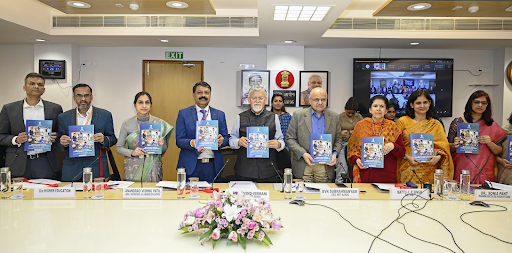
NITI Aayog’s Revitalizing Apprenticeship Ecosystem urges transforming apprenticeships into strategic human capital investment for Viksit Bharat @2047. It recommends merging NAPS and NATS, linking credits with the National Credit Framework, covering gig workers, and adopting tools like an Apprenticeship Engagement Index, inspired by Germany’s Dual VET model.
Copyright infringement not intended
Picture Courtesy: PIB
Context
The NITI Aayog launched a policy report titled “Revitalizing Apprenticeship Ecosystem”, to leverage apprenticeships for employment generation and skill development.
What is Apprenticeships?
An apprenticeship is a structured, paid program combining on-the-job and theoretical training to provide industry-specific skills, a salary, and a recognized qualification.
It is legally governed by the Apprentices Act, 1961.
|
Internship v/s Apprenticeship |
||
|
|
Internship |
Apprenticeship |
|
Duration |
Short-term (1–6 months) |
Long-term (1–4 years) |
|
Purpose |
Exploration & general exposure |
In-depth skill mastery & career entry |
|
Pay |
Paid, unpaid, or college credit |
Always paid (wages often increase) |
|
Outcome |
Experience & professional network |
Industry-recognised certification |
|
Commitment |
Low; often for students/graduates |
High; often leads to a permanent job |
Challenges Hindering the Apprenticeship Ecosystem
Despite schemes like the National Apprenticeship Promotion Scheme (NAPS), the uptake of apprenticeships remains lower than in other developed economies.
Institutional & Policy Barriers
Industry & Establishment Challenges
Supply-Side & Societal Hurdles
NITI Aayog's Recommendations for Revitalization
Legal & Regulatory Reforms
Financial & Non-Financial Incentives
Quality & Appeal for Youth
Institutional Strengthening
Way Forward To Improve Apprenticeship Ecosystem
Inclusivity
Promote apprenticeships for marginalized groups, including women, Persons with Disabilities (PwDs), and youth from rural/tribal areas, to ensure equitable growth.
Informal Sector Integration
Innovative, flexible apprenticeship models are essential for formalizing skills in the informal sector.
Centre-State Coordination
Skill development is a concurrent subject. Effective revitalization depends on seamless collaboration between the central government, state governments, and local industrial bodies.
Paradigm Shift
Move from a supply-driven to a demand-driven ecosystem, where apprenticeships are seen not just as a government scheme but as a mainstream and aspirational career choice.
Learn from Global Best Practices
Conclusion
Revitalizing the apprenticeship ecosystem through streamlined regulations, increased industry involvement, and improved public perception is essential for a 'Skilled India' to bridge the skills gap and establish India as a global economic power.
Source: PIB
|
PRACTICE QUESTION Q. With reference to the NITI Aayog report on Apprenticeships, consider the following statements regarding the proposed "Apprenticeship Engagement Index": 1. It aims to benchmark the performance of States and sectors to foster competitive federalism. 2. It is designed solely to monitor the performance of Central Public Sector Enterprises (CPSEs). 3. It will replace the National Apprenticeship Promotion Scheme (NAPS). Which of the statements given above is/are correct? A) 1 only B) 2 and 3 only C) 1 and 3 only D) 1, 2 and 3 Answer: A Explanation: Statement 1 is correct: The NITI Aayog report, titled "Revitalizing Apprenticeship Ecosystem: Insights, Challenges, Recommendations and Best Practices" (released in February 2026), proposes the Apprenticeship Engagement Index to benchmark the performance of States and sectors. This initiative aims to promote competitive federalism by ranking performance and encouraging states to improve their apprenticeship ecosystems. Statement 2 is incorrect: The index is not designed solely for Central Public Sector Enterprises (CPSEs). It is a broader tool intended to benchmark States, Union Territories, and various industrial sectors to identify regional disparities and drive nationwide growth. Statement 3 is incorrect: The index is a benchmarking tool, not a replacement for the National Apprenticeship Promotion Scheme (NAPS). In fact, the report recommends strengthening NAPS and NATS (National Apprenticeship Training Scheme) by integrating them into a unified National Apprenticeship Mission (NAM) to streamline governance. |
The report aims to provide a roadmap to transform India's apprenticeship landscape from a compliance-based obligation into a strategic human capital investment, ensuring the workforce is skilled enough to drive the vision of Viksit Bharat @2047.
It is a proposed benchmarking tool designed to measure and rank the performance of different States and industrial sectors in engaging apprentices. The goal is to promote "competitive federalism" and encourage states to improve their apprenticeship adoption.
Recognizing the shift in employment patterns, the report recommends creating apprenticeship models specifically for the gig and platform economy. This would formalize skill-building in this sector and provide structured pathways for gig workers.


© 2026 iasgyan. All right reserved