NYP 2026 leverages the MY Bharat platform to drive Viksit Bharat 2047, addressing unemployment through experiential skilling and data-driven governance. By focusing on outcome-oriented pillars and localized monitoring, it transforms India's youth into engines of sustainable national development.
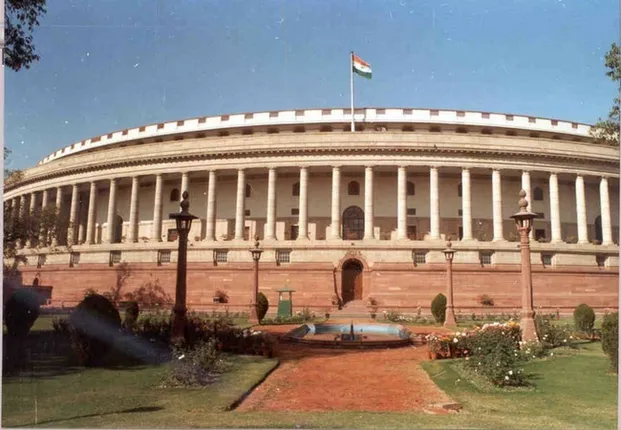
Copyright infringement not intended
Picture Courtesy: odishatv
Why In News?
The Minister of Youth Affairs and Sports in Rajya Sabha discussed the National Youth Policy (NYP) 2026.
What is National Youth Policy (NYP) 2026?
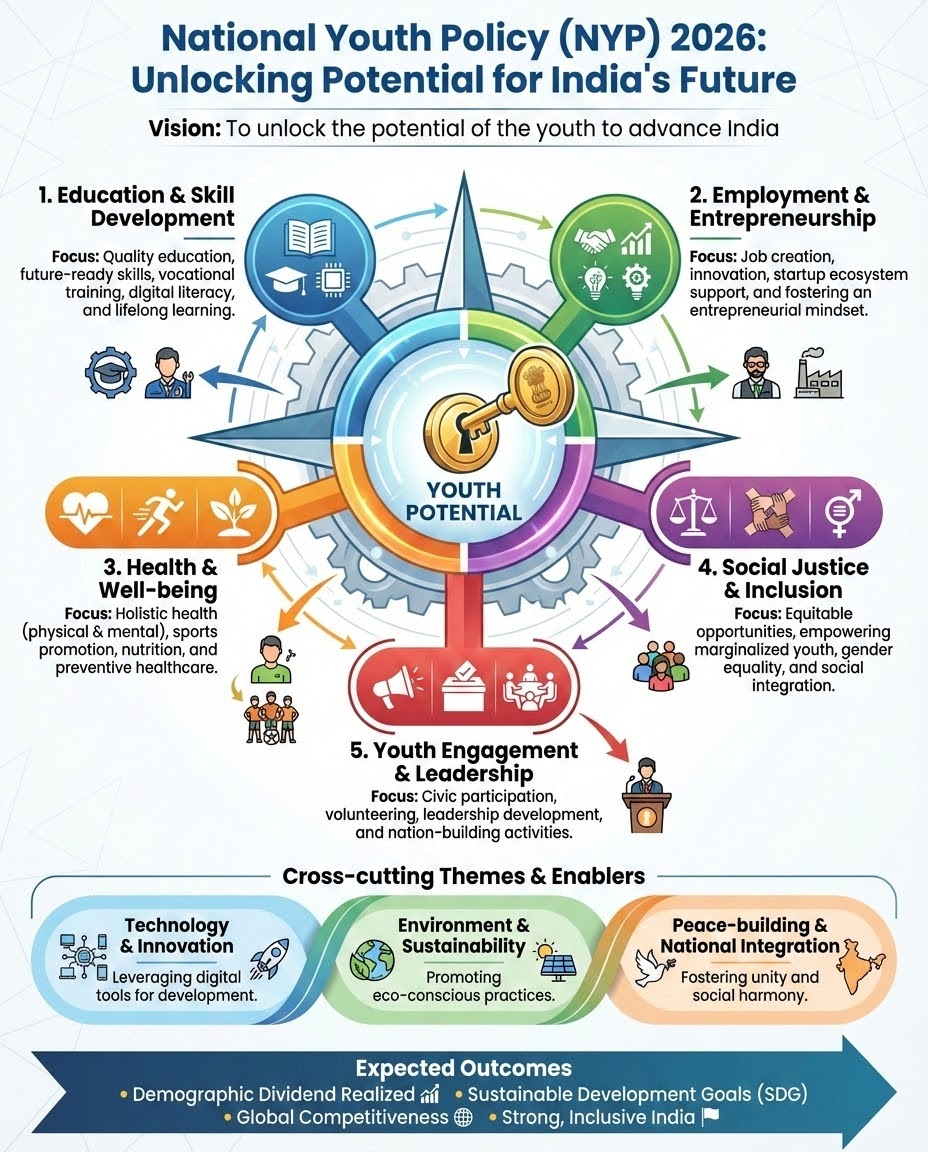
NYP 2026 shifts from the general guidance of NYP 2014 to a structured, outcome-driven framework that integrates youth development with the Viksit Bharat 2047 vision through six key priority areas.
Comparing NYP 2014 and NYP 2026
|
|
National Youth Policy (NYP) 2014 |
Proposed National Youth Policy (NYP) 2026 |
|
Approach |
Broad, guiding framework. |
Structured, action-oriented, and outcome-based. |
|
Focus |
General youth development. |
Targeted focus on Skilling, Employability, and alignment with Viksit Bharat 2047. |
|
Monitoring |
Primarily outlay-based (focused on expenditure). |
Strictly outcome-based, integrated with NITI Aayog's framework. |
|
Youth Role |
Youth viewed as passive beneficiaries. |
Youth reconceptualized as active stakeholders and 'green agents'. |
Key Drivers for a New Policy
Shrinking Demographic Window
India has the world's largest youth population, with over 65% of people under 35 and a median age of just 28.4 years.
Skill Gap
The India Skills Report 2024 highlights that only 51.25% of Indian youth are considered highly employable, pointing towards a skill gap of 30-40% in the modern workforce.
Addressing Economic Vulnerability
Gap between education and job creation, with nearly 40% of graduates under 25 remaining unemployed. (Source: Azim Premji University Report)
Mental Health Crisis
Over 50% of Indian youth (18–24) report poor mental health, driven by academic pressure, job insecurity, and social media addiction. Over 60% of all mental health cases in India are now among those under 35. (Source: Indian Psychiatric Society)
Digital Transformation
The policy integrates the MY Bharat platform, a digital ecosystem designed to connect over 1.81 crore registered youth with experiential learning and volunteering opportunities. (Source: PIB)
Environmental Responsibility
Unlike earlier iterations, the 2026 policy explicitly identifies Environment and Climate Action as one of its six core focus areas.
Core Pillars of NYP 2026
The policy is built on six multi-dimensional pillars for holistic youth development.
Operational Mechanism: The 'MY Bharat' Platform
The Mera Yuva Bharat (MY Bharat) platform implementing the NYP 2026. It is an autonomous body designed to be a comprehensive ecosystem for the youth.
Phygital Ecosystem: It is a digital-physical platform that acts as a one-stop shop for opportunities from government ministries, NGOs, and the private sector.
Data-Driven Governance: The platform provides real-time data on youth engagement, which enables evidence-based policymaking and helps in monitoring the policy's effectiveness.
Consultative Design: The policy was formulated through a democratic process, incorporating feedback from youth via the MY Gov portal and through inter-ministerial consultations at the State/UT level.
Monitoring and Evaluation Framework
Output-Outcome Monitoring
It moves from a traditional 'outlay-based' review to an 'outcome-based' approach, integrating directly with NITI Aayog’s Output-Outcome Monitoring Framework.
India Youth Development Index (YDI)
The policy uses analytical tools like the YDI, developed by the Rajiv Gandhi National Institute of Youth Development (RGNIYD).
Way Forward
Tackling Gender Disparity: Strict Implementation of localized and safe skilling models is needed to reduce the high urban female youth unemployment rate.
Bridging the Digital Divide: Ensuring equitable access to the MY Bharat platform for rural and socio-economically disadvantaged youth is crucial.
Strengthening Linkages: Deeper structural connections between educational institutions, private industries, and global youth programs are required, taking cues from international best practices like Singapore’s National Youth Council.
Conclusion
The National Youth Policy 2026 leverages the MY Bharat ecosystem to transform India’s demographic dividend into a catalyst for Viksit Bharat 2047 through data-driven accountability and rigorous implementation.
Source: PIB
|
PRACTICE QUESTION Q. "Despite a rising Gross Enrolment Ratio, India faces a severe 'employability paradox'." Analyze. 150 words |
The NYP 2026 is a proposed policy framework by the Government of India aimed at transitioning youth development from broad guidelines to a structured, outcome-oriented strategy. It directly aligns with the *Viksit Bharat 2047* vision to harness India's shrinking demographic dividend
The employability paradox refers to the phenomenon where despite a rising Gross Enrolment Ratio (GER) in higher education, actual job-readiness remains low. Recent data shows only about 51.25% of assessed Indian youth are highly employable, indicating a massive skill gap in the contemporary workforce.
‘Mera Yuva Bharat' (MY Bharat) is an autonomous, centralized 'phygital' (physical + digital) ecosystem approved by the Union Cabinet. It acts as a digital interface connecting youth with experiential learning, volunteering, and governance participation opportunities across various ministries and private sectors.

© 2026 iasgyan. All right reserved