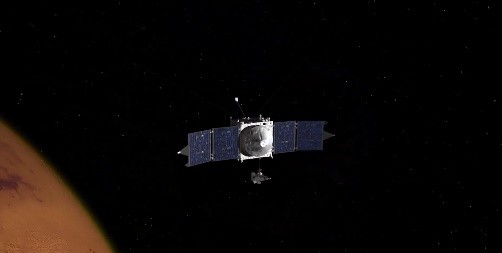
The Mars Atmosphere and Volatile Evolution (MAVEN) mission is a NASA Mars orbiter that studies how the Red Planet lost much of its atmosphere due to solar wind and radiation, helping explain Mars’s climatic transformation and providing key insights into planetary atmosphere evolution and habitability.
Copyright infringement not intended
Picture Courtesy: News on Air
Recently, NASA temporarily lost contact with the Mars Atmosphere and Volatile Evolution (MAVEN) spacecraft, which has been orbiting Mars for over a decade.
The MAVEN mission is the first dedicated spacecraft designed specifically to study the upper atmosphere of Mars and its interaction with the Sun. It is a key part of NASA’s long-term Mars Exploration Program, which seeks to understand the planet’s climate history and assess whether Mars could have supported life in the past.
MAVEN was launched in November 2013 and reached Mars in September 2014. It follows an elliptical orbit, completing one revolution around Mars roughly every 3.5 hours, and approaches as close as 150 km above the Martian surface, allowing it to directly sample the upper atmosphere.
Scientific instruments on board:
MAVEN carries three main instrument packages that work together to study atmospheric loss:
Significance of MAVEN Mission:
The Mars Atmosphere and Volatile Evolution (MAVEN) mission has been crucial in revealing how atmospheric loss shaped Mars’s climate and habitability, while also providing broader insights into planetary evolution and the conditions required for sustaining atmospheres on Earth-like worlds across the universe.
Source: News on Air
|
Practice Question Q. With reference to the Mars Atmosphere and Volatile Evolution (MAVEN) mission, consider the following statements: 1. MAVEN is the first mission specifically designed to study the upper atmosphere of Mars and its interaction with the Sun. 2. The mission aims to understand how atmospheric escape processes contributed to the climatic transformation of Mars over time. 3. MAVEN studies the impact of the solar wind on Mars’s atmosphere despite the planet having a strong global magnetic field. Which of the statements given above are correct? Answer: (a) Explanation: · Statements 1 and 2 are correct because the Mars Atmosphere and Volatile Evolution (MAVEN) mission focuses on studying Mars’s upper atmosphere and the processes responsible for its long-term atmospheric loss. · Statement 3 is incorrect because Mars lacks a strong global magnetic field, which makes its atmosphere more vulnerable to erosion by the solar wind. |
The Mars Atmosphere and Volatile Evolution (MAVEN) is a NASA mission designed to study the upper atmosphere of Mars and understand how it has been lost to space over time.
MAVEN was launched to explain how and why Mars lost most of its atmosphere, a process that transformed the planet from a potentially warm and wet world into the cold and dry planet seen today.
MAVEN was launched in November 2013 and successfully entered orbit around Mars in September 2014.






© 2026 iasgyan. All right reserved