Lala Lajpat Rai was not only a prominent freedom fighter but also an influential writer and journalist who used literature to promote nationalism and social reform. Through newspapers, journals, and books, he exposed the economic and political exploitation under British rule and emphasized the need for national education and social upliftment. His works such as England’s Debt to India, Young India, and The Story of My Deportation connected India’s struggle with global movements for freedom. His writings played a vital role in shaping political awareness and inspiring participation in the Indian independence movement.
Copyright infringement not intended
Picture Courtesy: Times of India
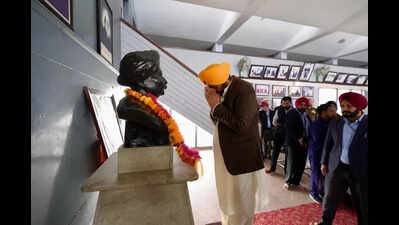
Punjab chief minister paid floral tribute to Punjab Kesari on 161st Birth anniversary.
|
Must Read: Lala Lajpat Rai | |
Lala Lajpat Rai (1865–1928):
Early Life:
Lala Lajpat Rai was born on 28 January 1865 in Dhudike village of Punjab. His father, Munshi Radha Krishan, was a school teacher, while his mother, Gulab Devi, was known for her strong moral and religious values. From childhood, he was exposed to ideas of social reform, education, and nationalism, which later shaped his political and social outlook.
Political journey of Lala Lajpat Rai:
Early political activism and deportation (1907): Lala Lajpat Rai’s growing nationalist activities made him a target of the British authorities. In 1907, he was arrested and deported to Mandalay (in present-day Myanmar) without trial. This action reflected British fears about the rising influence of assertive nationalist leaders. After about a year in exile, he was released, and the experience further strengthened his resolve against colonial rule.
Use of writing as a political tool: Deeply committed to India’s freedom, Lajpat Rai gave up his legal career to work full-time for the national cause. He believed that India’s struggle needed international attention, so he wrote extensively to expose the exploitative nature of British rule. His writings aimed to inform the world about the economic drain, political repression, and suffering of Indians under colonial governance.
International Advocacy (1914–1920): Understanding the importance of global opinion, Lajpat Rai traveled abroad to build support for India’s independence.
His international outreach helped present India’s freedom struggle as part of a broader global fight for democratic rights.
Role in the Indian National Movement: Lala Lajpat Rai emerged as one of the most prominent nationalist leaders during the freedom struggle.
Protests Against British Repression in Punjab:
Lajpat Rai strongly opposed British repressive policies, especially in Punjab.
His leadership helped mobilize public opinion in Punjab against colonial injustice.
Protest against the Simon Commission (1928):
One of the most defining moments of his life came during the protest against the Simon Commission, which arrived in India in 1928 without any Indian representation.
Lala Lajpat Rai led a peaceful demonstration in Lahore on 30 October 1928 against the Commission. During the protest, the police carried out a brutal lathi charge under the orders of a British officer. Rai suffered serious injuries in this incident and passed away on 17 November 1928.
Before his death, he declared that the blows he received would prove fatal to British rule in India. His martyrdom deeply stirred nationalist sentiments across the country.
Contributions to education and social reform:
Lajpat Rai was not only a political leader but also a committed social reformer.
Arya Samaj influence: He was closely associated with the Arya Samaj and worked for social upliftment, education, and reform of orthodox practices.
Servants of the People Society: In 1921, he founded the Servants of the People Society, an organization aimed at promoting education, social service, upliftment of the underprivileged, and women’s welfare.
Role in Journalism: Lala Lajpat Rai used the press as a powerful medium to spread nationalist thought and social reform ideas. He was associated with several Hindi, Punjabi, English, and Urdu newspapers and journals, through which he voiced criticism of British policies and encouraged political awareness among Indians. He also founded and edited the Arya Gazette, which became an important platform for reformist and nationalist discourse.
Biographical writings: Rai drew inspiration from great historical and nationalist figures across the world. To motivate Indians, he wrote biographies of personalities such as Giuseppe Mazzini, Giuseppe Garibaldi, Chhatrapati Shivaji, and Lord Krishna. Through these works, he highlighted themes of patriotism, sacrifice, and resistance to oppression.
Major political and social works: Lala Lajpat Rai was a prolific author whose books reflected his deep engagement with politics, society, religion, and education. His important writings include:
Historical significance:
Lala Lajpat Rai is remembered as one of the most fearless leaders of India’s freedom struggle. His sacrifice inspired revolutionaries such as Bhagat Singh and his associates, who later avenged the lathi charge incident. He came to be known as “Punjab Kesari” (Lion of Punjab) for his courage and leadership. His life symbolizes patriotism, sacrifice, and dedication to social reform and national freedom.
Conclusion:
Lala Lajpat Rai’s literary contributions were an extension of his nationalist mission, using the power of the written word to awaken political consciousness and social reform. Through journalism, biographies, and analytical works, he exposed the injustices of British rule, promoted national education, and inspired pride in India’s cultural and spiritual heritage. His writings not only strengthened the freedom movement but also left a lasting intellectual legacy in modern Indian political thought.
Source: Times of India
|
Practice Question Q. Lala Lajpat Rai used literature and journalism as powerful tools of nationalism and social reform. Discuss. (250 words) |
He used his writings to spread awareness about British exploitation, the need for self-rule, social reform, and national education, making literature a tool for political awakening.
In this work, he explained how British rule led to the economic drain of India’s wealth, highlighting the financial exploitation of the country.
In The Problem of National Education in India, he argued for an education system rooted in Indian culture and values, rather than one shaped entirely by colonial priorities.


© 2026 iasgyan. All right reserved