Copyright infringement not intended
Picture Courtesy: PIB
Context:
Industrial parks have emerged as a principal vehicle for accelerating the country’s industry and innovation agenda. Developed in partnership with state governments and the private sector, these parks are reinforcing India’s industrial base by promoting investment, progress-driven development, and economic ascendancy. They stimulate employment generation while also encouraging sustainable development.
What are Industrial Parks?
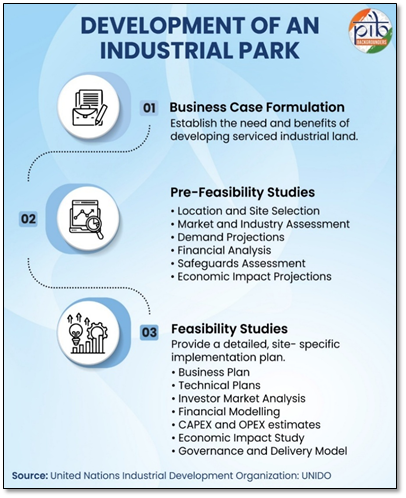
Industrial Parks are planned and designated areas of land developed specifically for industrial and manufacturing activities, where multiple firms operate within a common, serviced ecosystem. They are equipped with shared infrastructure, facilities, and governance systems to reduce costs, improve efficiency, and accelerate industrial growth.
An industrial park typically provides pre-developed plots or ready-built factory units, along with plug-and-play infrastructure such as power, water, roads, waste management, logistics facilities, and digital connectivity. A single management authority usually oversees approvals, compliance, and day-to-day operations, enabling ease of doing business.
Core features of Industrial Parks:
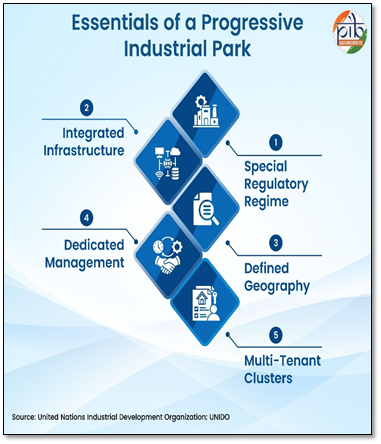
- Planned land use and spatial organisation: Industrial parks are developed on clearly demarcated, master-planned land parcels with predefined zoning norms for factories, utilities, green buffers, and logistics, which reduces land-use conflicts and regulatory uncertainty; in India, over 4,500 industrial parks covering about 7.70 lakh hectares are mapped on the India Industrial Land Bank, ensuring transparency and predictability for investors across States and Union Territories.
- Shared physical and soft infrastructure: Industrial parks provide common infrastructure such as uninterrupted power, water supply, internal roads, drainage, waste treatment plants, warehouses, testing laboratories, and digital connectivity, which lowers per-unit costs for firms; for example, plug-and-play parks under the National Industrial Corridor Development Corporation Limited offer ready-built industrial sheds and integrated logistics, significantly reducing project gestation periods for manufacturing units.
- Single-window governance and ease of compliance: A defining feature of industrial parks is single-window clearance and unified park-level administration, which coordinates approvals related to land allotment, construction, utilities, and environmental compliance; this approach aligns with India’s ease-of-doing-business reforms, where digitised approvals and inspection reforms have contributed to higher occupancy rates and faster operationalisation of industrial units.
- Multi-tenant clustering and agglomeration economies: Industrial parks host multiple firms within the same geographic space, enabling agglomeration benefits such as shared suppliers, specialised labour pools, and faster knowledge spillovers; evidence from large industrial corridors shows that clustered manufacturing leads to higher productivity, lower logistics costs, and stronger supply-chain integration, especially in sectors like automobiles, electronics, and textiles.
- Regulatory facilitation and investment incentives: Industrial parks often operate under liberal and incentive-based regulatory regimes, including flexible land-use norms, state-level fiscal incentives, and facilitation of foreign direct investment; such policy support has helped India emerge among the top five global destinations for Greenfield and project finance investments, as reported by United Nations Conference on Trade and Development (UNCTAD, 2025).
Picture Courtesy: PIB
Significance of Industrial Parks:
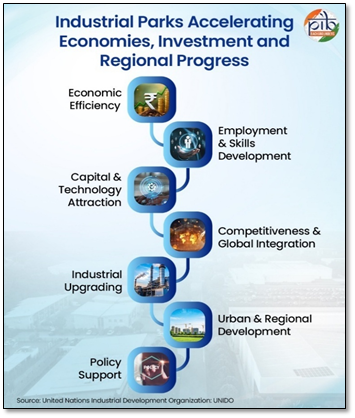
Productivity enhancement and cost efficiency: By concentrating infrastructure and services within defined zones, industrial parks reduce transaction, coordination, and logistics costs, which directly improves firm-level productivity and operational efficiency, particularly for small and medium enterprises that cannot individually invest in high-quality infrastructure.
Investment attraction and industrial expansion: The availability of ready-to-use industrial land and plug-and-play facilities significantly improves investor confidence; as of December 2025, about 1.35 lakh hectares of industrial land remain readily available across India, making industrial parks a critical instrument for attracting both domestic and foreign investment.
Employment generation and skill development: Industrial parks act as employment hubs, creating direct jobs in manufacturing and indirect jobs in logistics, services, and construction, while also enabling industry–skill institution linkages that strengthen local human capital and raise regional income levels.
Innovation, technology transfer, and competitiveness: The close proximity of firms within industrial parks facilitates technology diffusion, managerial learning, and innovation, helping domestic enterprises upgrade processes and integrate into global value chains, thereby enhancing national industrial competitiveness.
Environmental sustainability and social outcomes: Industrial parks support sustainable development through shared environmental infrastructure such as common effluent treatment plants, waste recycling systems, and green buffers, while also improving labour welfare through safer workplaces, social infrastructure, and better compliance with environmental and social standards.
Picture Courtesy: PIB
Current Status of Industrial Parks:
India has 4,523 industrial parks mapped on the India Industrial Land Bank (IILB), covering 7.70 lakh hectares, with 1.35 lakh hectares still available. (Source: PIB)
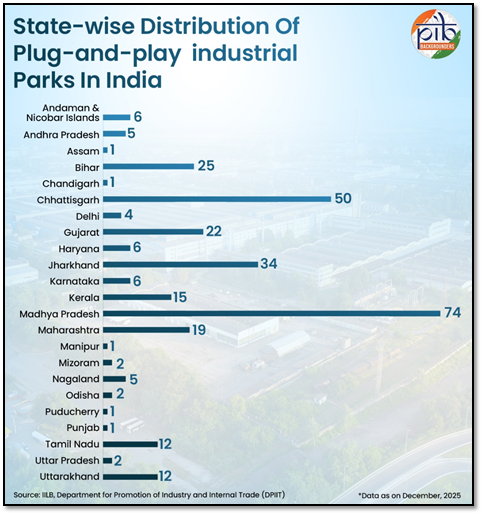
306 plug-and-play parks operational; 20 more (parks/smart cities) under National Industrial Corridor Development Corporation Limited (NICDC). (Source: PIB)
Industrial Park Rating System (IPRS) 3.0 sharpens focus on sustainability, green infrastructure, logistics, digitalisation, skill linkages, and tenant feedback. (Source: PIB)
Challenges of industrial parks in India:
- Land acquisition and underutilisation: Despite large-scale creation of industrial parks, land acquisition delays, fragmented ownership, and local resistance continue to impede timely development; data from the India Industrial Land Bank shows that out of ~7.70 lakh hectares mapped, nearly 35 lakh hectares remain vacant, indicating that availability of land alone does not automatically translate into industrial activity.
- Infrastructure gaps and uneven quality: While flagship parks and corridors offer world-class facilities, many state-level and older industrial estates suffer from poor internal roads, unreliable power supply, water stress, and inadequate waste treatment, raising operational costs for firms; for example, several MSME-dominated industrial areas continue to rely on diesel generators due to power instability, eroding competitiveness and environmental sustainability.
- Delays in project implementation: Industrial parks often face cost overruns and time delays due to slow clearances, coordination failures among agencies, and financing constraints; even within major industrial corridors under the National Industrial Corridor Development Corporation Limited, multiple nodes remain under construction years after approval, postponing expected employment and investment benefits.
- Low occupancy and weak investor response: Many industrial parks, particularly in backward or remote regions, struggle with low occupancy rates because of inadequate connectivity, distance from markets, or lack of skilled labour; this has resulted in “infrastructure without industry”, where capital-intensive parks fail to attract anchor tenants despite fiscal incentives.
- Environmental stress and regulatory compliance issues: Concentrated industrial activity places significant pressure on local air, water, and land resources, especially where common effluent treatment plants or waste-management systems are insufficient; industrial clusters in water-scarce regions have faced regulatory shutdowns due to groundwater over-extraction and pollution, undermining both sustainability and investor confidence.
What are key measures required to improve the condition of Industrial Parks?
- Accelerating plug-and-play and brownfield upgradation: The foremost requirement is to expand plug-and-play infrastructure and modernise existing industrial estates, so that firms can commence operations with minimal lead time; the Union Budget 2025–26 allocation of ₹2,500 crore for plug-and-play industrial parks and the development of 306 such parks nationwide, including projects under the National Industrial Corridor Development Corporation Limited, directly address delays in project gestation and low occupancy.
Picture Courtesy: PIB
- Strengthening digital land and infrastructure transparency: Improving the quality, granularity, and real-time updating of land and infrastructure data is essential to boost investor confidence; the India Industrial Land Bank, developed by the Department for Promotion of Industry and Internal Trade, enables investors to remotely evaluate over 4,500 industrial parks and should be further integrated with state single-window portals and logistics data for end-to-end decision-making.
- Deepening ease of doing business reforms at park level: Industrial parks need effective on-ground implementation of single-window systems, time-bound approvals, and inspection rationalisation, building on the National Business Reforms Action Plan (BRAP); linking park authorities with online building permissions, labour compliances, and environmental clearances can significantly reduce transaction costs and improve park occupancy.
- Improving logistics and multimodal connectivity: To make parks globally competitive, seamless integration with ports, railways, highways, and logistics parks is critical; alignment with the PM Gati Shakti National Master Plan can reduce logistics costs, which currently account for around 13–14% of India’s GDP, compared to about 8–9% in advanced economies.
- Promoting green and sustainable industrial parks: Upgrading industrial parks with common effluent treatment plants, renewable energy, water recycling, and green buffers is necessary to meet climate and ESG expectations; the enhanced parameters under Industrial Park Rating System (IPRS) 3.0 incentivise sustainability, green infrastructure, and resource efficiency, encouraging park authorities to move towards low-carbon and circular industrial ecosystems.
Picture Courtesy: PIB
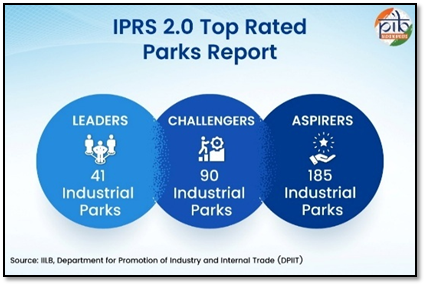
- Enhancing governance, accountability, and performance benchmarking: Introducing regular performance audits, tenant feedback mechanisms, and competitive benchmarking can improve service delivery and transparency; the IPRS framework, by classifying parks as Leaders, Challengers, and Aspirers, provides an evidence-based roadmap for targeted interventions and inter-state competition.
Conclusion:
Industrial parks are emerging as the backbone of India’s manufacturing and investment strategy, but their effectiveness depends on timely infrastructure delivery, strong governance, and sustainability integration. By leveraging plug-and-play parks, digital land platforms, logistics integration under PM Gati Shakti, and quality benchmarking through IPRS, the Government of India can transform industrial parks into globally competitive, job-rich, and environmentally responsible growth engines, ensuring balanced and resilient industrial development across regions.
Source: PIB
|
Practice Question
Q. “Industrial parks are no longer mere land banks but strategic instruments of industrial policy.”
In this context, examine the role of industrial parks in promoting manufacturing-led growth in India. (250 words)
|
Frequently Asked Questions (FAQs)
An industrial park is a planned and designated area developed for industrial and manufacturing activities, where multiple firms operate with shared infrastructure, common facilities, and streamlined regulatory governance to reduce costs and improve efficiency.
Industrial parks are localized industrial estates, whereas industrial corridors are large, multi-nodal development frameworks connecting several industrial parks, cities, and logistics hubs through major transport networks.
Industrial parks attract domestic and foreign investment, generate employment, support MSMEs, promote technology transfer, and help integrate India into global value chains while enabling regionally balanced development.