Prime Minister Modi’s historic 2026 visit to Slovakia elevated bilateral ties to a Comprehensive Partnership. India and Slovakia signed 11 pacts covering defence, digital technologies, post-quantum cryptography, and labour migration, enhancing India's strategic and economic footprint in Central Europe.
Prime Minister Narendra Modi’s historic visit to Bratislava, the first since Slovakia’s 1993 independence, resulted in a Comprehensive Partnership. Both nations signed 11 strategic agreements to advance technology, defence, and industrial cooperation.
The Comprehensive Partnership elevates India-Slovakia diplomacy into a structured framework. Beyond trade, it institutionalizes strategic alignment on security, high-end defense manufacturing, and critical technologies.
Institutional Mechanism: The partnership operates through the India-Slovakia Joint Economic Committee, which facilitates actionable, rule-based collaboration.
Scope of Engagement: It integrates cooperation on counter-terrorism, disaster risk reduction, public health management, and meteorology.
|
SLOVAKIA
|
Key Areas of Cooperation
Trade and Investment: Bilateral trade surged by 28% to reach $1.8 billion in 2025, with $1.52 billion attributed to Indian exports.
Automotive Manufacturing: Tata Motors operates a €1.4 billion Jaguar Land Rover (JLR) facility in Nitra, producing 150,000 vehicles annually.
Rail Infrastructure: Tatravagonka holds a 26% stake in India's Jupiter Group, establishing India's first private forged railwheel factory.
Defence Cooperation: A signed Letter of Intent on Defence Cooperation accelerates joint research and industrial production, focusing specifically on artillery and armoured systems.
Technology and Innovation: India established its first ICCR (Indian Council for Cultural Relations) Chair in Artificial Intelligence at the Technical University of Košice. A new MoU on Digital Technologies drives collaboration in semiconductors, 5G/6G standards, Internet of Things (IoT), and post-quantum cryptography.
Renewable Energy: Both nations prioritize clean energy transitions, exploring deep cooperation in geothermal power and civil nuclear energy.
Strategic Gateway: Slovakia serves as a vital gateway into Central and Eastern Europe, bolstering India’s reach within the Visegrad Four (V4), Slavkov Three (S3), and the Three Seas Initiative.
Global Governance: Slovakia backs India’s bid for permanent membership in the UN Security Council and entry into the Nuclear Suppliers Group (NSG).
Market Access: Slovak Prime Minister Robert Fico advocates for the India-EU Free Trade Agreement (FTA), which promises a 10% duty framework on automobiles, providing Indian manufacturers lucrative access to European markets.
Trade Diversification: While trade reached $1.8 billion, the volume remains below potential. Authorities must diversify the export basket beyond automotive parts and telecom equipment.
Labour Mobility: Managing social protections for the 11,000 Indian professionals currently working in Slovakia remains a critical administrative priority.
Cybersecurity: Developing quantum-resistant cryptographic standards presents technical hurdles, requiring the seamless integration of cybersecurity frameworks to protect critical databases.
Social Security: India and Slovakia must finalize the pending Social Security Agreement to secure welfare benefits for expatriate professionals, complementing the recently signed Labour Migration MoU.
Industrial Scaling: Both states must leverage the Joint Economic Committee to scale joint ventures in green technologies, battery storage, and advanced robotics.
Counter-Terrorism: The nations must institutionalize the Joint Working Group on Counter-Terrorism to ensure robust intelligence sharing and advance the Comprehensive Convention on International Terrorism (CCIT) at the United Nations.
The India-Slovakia Comprehensive Partnership strategically aligns Indian digital expertise with Slovak manufacturing. By strengthening defence ties and supply chains, it deepens India’s European Union integration and promotes long-term geopolitical stability.
Source: INDIANEXPRESS
|
PRACTICE QUESTION Q. Consider the following countries:
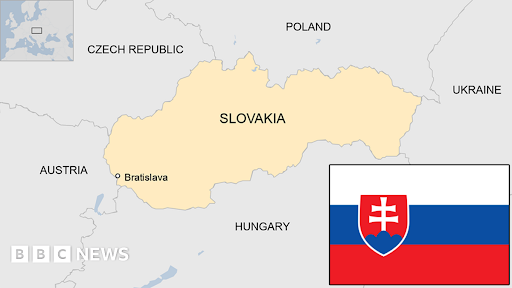
How many of the above countries share a direct land border with Slovakia? (a) Only two (b) Only three (c) Only four (d) All five Answer: (c) Explanation: Slovakia is a landlocked country in Central Europe. It shares borders with 5 nations: Poland (in the north), Ukraine (in the east), Hungary (in the south), Austria (in the southwest), and the Czech Republic (in the west). It does not share a border with Romania. |
A Comprehensive Partnership is an elevated, multi-tiered diplomatic framework that institutionalizes regular, high-level political dialogues and coordinates strategic cooperation across defense, trade, technology, and multilateral forums.
Slovakia serves as a high-priority central European industrial gateway for India, offering advanced defense engineering, a world-class automotive manufacturing hub, and a strategic entry point into the European Union common market.
The enhanced alignment directly benefits heavy manufacturing, military defense joint ventures, solar energy technology, and IT development, while streamlining talent mobility for skilled Indian engineers.
This partnership expands India's European footprint by diversifying ties beyond traditional western powers like France and Germany, building crucial strategic relationships with the highly industrialized, fast-growing economies of Central and Eastern Europe.

© 2026 iasgyan. All right reserved