The India-France Innovation Roadmap 2030 elevates bilateral ties to a Special Global Strategic Partnership. It prioritizes co-development in artificial intelligence, space technologies, and deep-tech startups, integrating frameworks like DEPA to secure digital sovereignty and robust global supply chains.
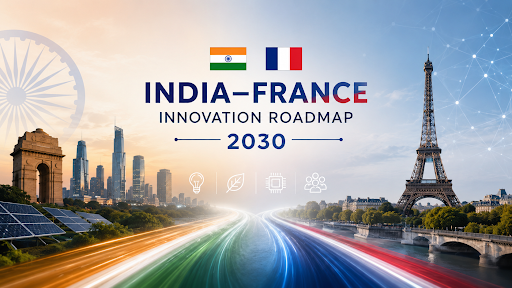
In June 2026, Prime Minister Narendra Modi and French President Emmanuel Macron adopted the 'India-France Innovation Roadmap 2030'.
Strategic Vision: The roadmap aligns India’s Viksit Bharat 2047 vision with France’s France 2030 investment ambition to co-develop critical technologies.
Global Impact: It deepens academic mobility and research partnerships to deliver concrete solutions for global challenges.
Economic Driver: Both nations position innovation as the central pillar for industrial sovereignty, economic resilience, and sustainable development.
Key Pillars of the Roadmap
Artificial Intelligence (AI): The nations establish a Joint India-France AI Working Group to promote 'Trusted AI' governance and launch the Indo-French Centre for AI in Health at AIIMS, New Delhi.
Advanced Computing: The Department of Science and Technology (DST) and INRIA establish a Centre of Digital Sciences to scale supercomputing and joint R&D.
Space Technologies: ISRO and CNES co-develop the TRISHNA satellite mission for climate monitoring and expand microgravity research to support the Gaganyaan program and the Bharatiya Antariksh Station.
Semiconductors: The roadmap deepens industrial collaboration to secure semiconductor ecosystems and mitigate global supply chain vulnerabilities.
Economic Security and Strategic Protection
General Security Agreement: Both nations sign a pact to legally protect and exchange classified information, facilitating secure defence industrial collaboration under Make in India.
Economic Risk Management: A High-Level Annual Mechanism monitors trade and addresses sectoral challenges to double bilateral trade within five years.
Supply Chain Resilience: The roadmap mandates stronger industry-academia linkages to build trusted supply chains across strategic sectors.
Strategic Partnership and Defence
Horizon 2047: The roadmap builds upon the Horizon 2047 framework, setting the long-term strategic direction for the alliance.
Co-production: The partnership shifts from a buyer-seller model to active co-production, exemplified by the Tata-Airbus H125 helicopter assembly line and the BEL-Safran joint venture for HAMMER missiles.
Clean Energy: Both nations collaborate on Small Modular Reactors (SMR) and Advanced Modular Reactors (AMR) under the SHANTI Act.
Digital Sovereignty: India leverages the Data Empowerment and Protection Architecture (DEPA) for international data-sharing models and expands the Unified Payments Interface (UPI) footprint across European airports.
Innovation Ecosystem: The India-France Innovation Network (IFIN) operationalizes ecosystem connectivity, while Station F in Paris incubates 10 additional Indian startups.
Skilling: The National Centre of Excellence for Skilling in Aeronautics at NSTI, Kanpur, builds workforce readiness for aerospace manufacturing and MRO (Maintenance, Repair, and Overhaul) services.
The India-France Innovation Roadmap 2030 transforms the bilateral relationship into a formidable deep-tech and defence alliance, driving mutual technological sovereignty, 'Trusted AI' governance, and robust supply chain resilience.
Source: THEHINDU
|
PRACTICE QUESTION Q. With reference to bilateral cooperation between India and France in the space sector, the 'TRISHNA' mission is primarily designed for: A) Deep-space manned exploration to Mars. B) High-resolution thermal infrared observation for climate and environmental monitoring. C) Establishing a joint anti-satellite (ASAT) weapon testing facility. D) Deploying a constellation of military communication satellites over the Indo-Pacific. Answer: B Explanation: The TRISHNA (Thermal infraRed Imaging Satellite for High-resolution Natural resource Assessment) mission is a collaborative Earth observation endeavor between the Indian Space Research Organisation (ISRO) and the French National Centre for Space Studies (CNES). |
Adopted on June 14, 2026, the India–France Innovation Roadmap 2030 is a long-term, future-oriented digital framework designed to drive bilateral co-development in critical emerging technologies, startup ecosystems, and cross-border research.
The Economic Security Dialogue is a newly instituted high-level bilateral forum focused on protecting supply chain resilience against geopolitical shocks in highly strategic sectors like critical minerals, energy networks, and cybersecurity.
These core pillars are prioritized because they secure technological and industrial sovereignty, enabling both nations to build trusted hardware supply lines and co-develop "Trusted AI" models aligned with human rights and democratic principles.
The architecture elevates ties under the newly minted Special Global Strategic Partnership by shifting the traditional relationship beyond basic defense procurement into deep institutional technology integration, tech-talent mobility, and commercial space ventures.

© 2026 iasgyan. All right reserved