India and Finland upgraded ties to a Strategic Partnership in Digitalization and Sustainability after the Finnish President’s visit. Cooperation will expand in 6G, AI, quantum computing, and circular economy initiatives. Both aim to double trade by 2030, support mobility partnerships, and advance India’s Viksit Bharat 2047 vision.

Copyright infringement not intended
Picture Courtesy: indianexpress
Context
The President of Finland's March 2026 visit to India elevated bilateral ties to a "Strategic Partnership in Digitalization and Sustainability."
What are the Key Outcomes of the Visit?
Elevation to Strategic Partnership
Trade and Investment
Digital and Technology Cooperation
Sustainability and Green Transition
Mobility and People-to-People Ties
Signing of a Memorandum of Understanding (MoU) on a Migration and Mobility Partnership to facilitate smoother movement for skilled workers, professionals, and students.
Multilateral and Geopolitical Alignment
Why is Finland a Significant Partner for India?
Finland's strengths in technology, innovation, and sustainability align perfectly with India's national development goals.
|
Area of Significance |
Details |
Key Examples/Case Studies |
|
Technology & Innovation Powerhouse |
A global leader in 6G, AI, and quantum computing, which directly supports India's 'Make in India' and 'Digital India' missions. |
Nokia's 6G Lab in Bengaluru (2023): The first-of-its-kind facility in India, supporting the 'Bharat 6G Vision'. Nokia also partnered with IISc for joint research on 6G radio tech (2024). |
|
Pioneer in Sustainability |
The first country to create a national roadmap for a circular economy (2016). This expertise is vital for India's Smart Cities and Swachh Bharat Missions. |
Finland's Circular Economy Model: Aims to base its economy on circular principles by 2035. Its expertise in waste-to-energy and sustainable materials offers valuable lessons for India (Source: Ministry of the Environment, Finland). |
|
Gateway to Europe & the Nordic Region |
As a member of the EU and Nordic Council, Finland is a trusted partner for India within these blocs, strengthening regional cooperation. |
The India-Nordic Summits (2018, 2022) have established a strong foundation for collaboration in innovation, green transition, and the blue economy. |
Strategic Importance of Finland for India's National Goals
The partnership's twin pillars—Digitalization and Sustainability—are central to India's ambition of becoming a developed nation ('Viksit Bharat') by 2047.
Fueling Tech-Driven Growth: Access to Finland's R&D in 6G, semiconductors, and quantum computing directly supports initiatives like the National Quantum Mission and the India Semiconductor Mission.
Enabling Green Transformation: Finland's expertise in clean tech can accelerate India's journey towards its Net Zero by 2070 target.
Building Resilient Economies: Collaborating on critical technologies and green solutions helps diversify supply chains and build economic models that are less vulnerable to geopolitical and environmental shocks.
Way Forward
Effective Implementation: The new Joint Working Groups must create time-bound action plans with regular high-level monitoring to ensure progress.
Leveraging the India-EU FTA: Both countries must facilitate business-to-business interactions to fully utilize the opportunities created by the new trade agreement.
Deepening People-to-People Connect: The MoU on Migration is a good start. Expanding educational exchanges and joint research will further strengthen ties.
Expanding Multilateral Coordination: India and Finland should enhance their coordination in forums like the Arctic Council, WTO, and climate platforms to promote a rules-based global order.
Conclusion
The India-Finland Strategic Partnership focused on the digital revolution and the green transition, combining Finnish innovation with Indian scale to drive economic growth, create scalable solutions for global challenges, and contribute to a more sustainable and secure future.
Source: PIB
|
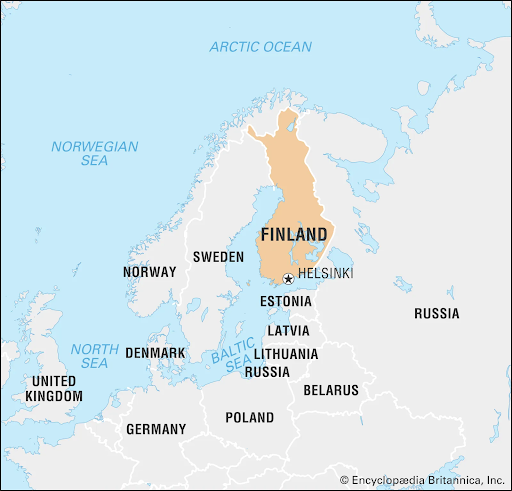
PRACTICE QUESTION Q. Consider the following statements about the geographical location of Finland: 1. It shares land borders with Norway, Sweden, and Russia. 2. The Gulf of Bothnia lies to its east, while the Gulf of Finland is located to its west. 3. Nearly one-third of the country lies north of the Arctic Circle. Which of the statements given above is/are correct? A) 1 and 2 only B) 2 and 3 only C) 1 and 3 only D) 1, 2 and 3 Answer: C Explanation: Statement 1 is correct: Finland is situated in Northern Europe and shares its land borders with Sweden to the west, Norway to the north and northwest, and Russia to the east. Statement 2 is incorrect: The geographical positions of the gulfs are reversed in the statement. The Gulf of Bothnia lies to the west of Finland (between Finland and Sweden), while the Gulf of Finland lies to the south (between Finland and Estonia). Statement 3 is correct: Finland is one of the world's northernmost countries. Approximately one-third of its total length lies above the Arctic Circle. |
The bilateral ties between India and Finland have been elevated to a "Strategic Partnership in Digitalization and Sustainability" following the state visit of Finland's President to India in March 2026.
The partnership is built on two key pillars:
Sustainability: Focusing on clean energy, circular economy, and green transition.
Finland is located in Northern Europe. It shares land borders with Norway to the north, Sweden to the northwest, and Russia to the east.



© 2026 iasgyan. All right reserved