Researchers have developed an innovative helium leak detection sensor that works using sound waves instead of chemical reactions. Built with a special geometric structure known as a Kagome lattice, the device traps sound at its corners and monitors changes in resonance frequency. When helium enters the sensor, it alters the speed of sound inside, allowing the system to quickly detect both the presence and direction of a leak. This durable, low-maintenance technology could significantly improve helium monitoring in critical sectors such as healthcare, semiconductors, aerospace, and scientific research, where helium is essential but scarce.
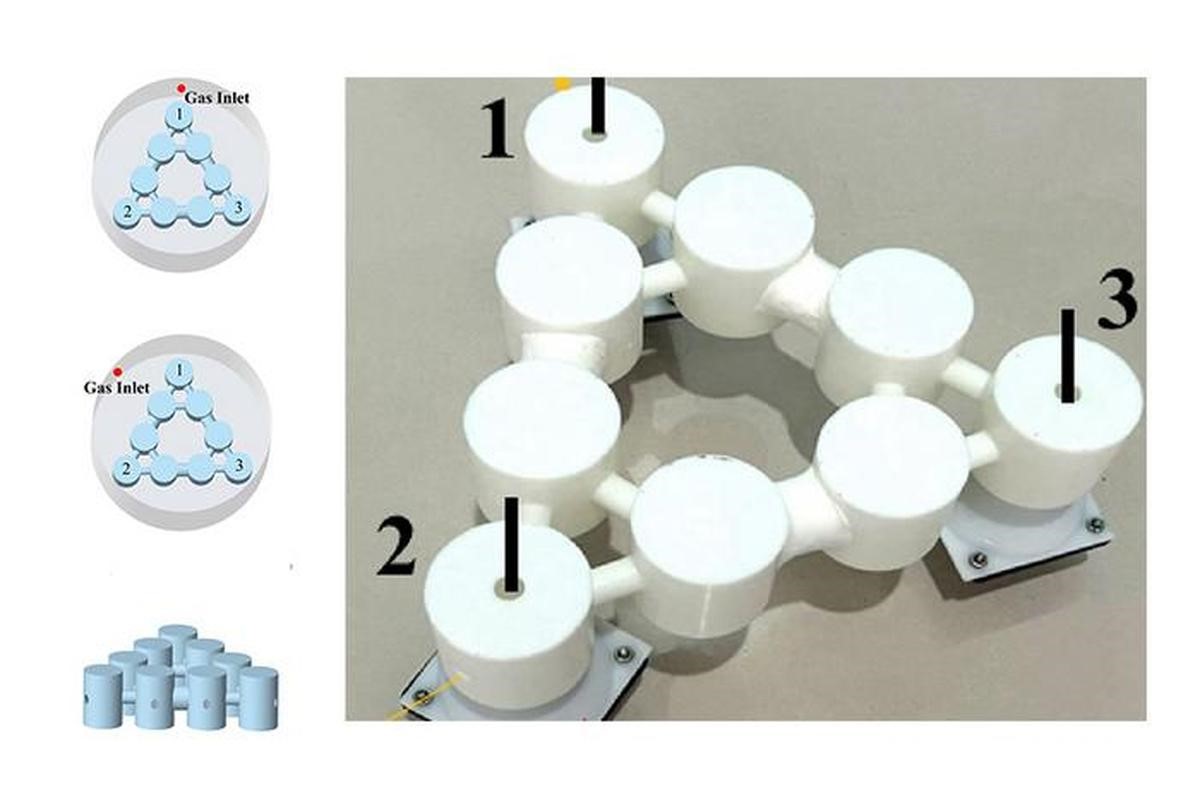
Copyright infringement not intended
Picture Courtesy: The Hindu
Context:
Researchers developed sound based sensors to detect helium leaks.
|
Must Read: HELIUM | NEW METHOD TO RELIABLY ESTIMATE HELIUM ABUNDANCE IN THE SUN | |
Helium (He):
Helium is a noble gas with atomic number 2 and symbol He, known for being colourless, odourless, non-toxic, and extremely chemically inert. It is the second lightest element after hydrogen and has an exceptionally low boiling point of about –268.9°C, allowing it to remain liquid near absolute zero and making it indispensable for ultra-low-temperature applications. Because helium atoms are very small and light, they escape easily from containers and even from Earth’s atmosphere, which makes long-term storage difficult.
Origin:
Helium was first identified in the Sun’s spectrum before it was discovered on Earth, and most of the helium in the universe was formed during the Big Bang, with additional helium continuously produced inside stars through nuclear fusion. On Earth, helium is mainly generated through the radioactive decay of heavy elements such as uranium and thorium, which release alpha particles that become helium atoms over geological timescales. This helium accumulates in certain natural gas reservoirs underground, from where it is commercially extracted as a by-product during natural gas processing, since atmospheric helium escapes into space and is not a practical source.
Applications:
How Helium changes the sound?
Speed of sound is higher in Helium: Sound travels as vibrations through gas molecules, and its speed depends largely on the gas’s density and molecular mass. Helium atoms are much lighter than the nitrogen and oxygen molecules that make up air, so sound waves move significantly faster through helium than through normal air.
Effect on voice pitch: When a person inhales helium, the vocal cords vibrate at the same rate as usual, but the sound waves produced travel faster through the helium-filled vocal tract. This increases the resonant frequencies of the throat, mouth, and nasal passages, which amplifies higher-frequency components of the voice and makes it sound squeaky or high-pitched.
Change in resonance, not vocal cord vibration: The key change happens in the resonance of the vocal tract rather than in the actual vibration of the vocal cords. The faster speed of sound shifts the natural resonant frequencies upward, similar to how a smaller musical instrument produces higher notes than a larger one.
Application in gas detection: This same principle is used in advanced helium leak sensors, where sound is passed through a chamber and the resonant frequency is monitored. When helium enters and mixes with air, the speed of sound in the chamber increases, causing a measurable shift in resonance frequency that reveals both the presence and concentration of helium.
Technological significance of sound-based Helium sensing:
Works for a chemically inert gas: Helium is a noble gas that barely reacts with other substances, which makes traditional chemical gas sensors ineffective. By relying on changes in the speed of sound rather than chemical reactions, this device can detect helium reliably where many existing sensors fail.
Faster and more practical leak detection: Helium atoms are extremely small and escape through tiny cracks, causing costly and hard-to-find leaks in industrial systems. This acoustic sensor can detect leaks quickly because gas can enter the structure easily without damaging its sound-trapping ability, allowing rapid monitoring in real time.
Rugged and low maintenance: Unlike chemical sensors that use delicate coatings that degrade over time or react to humidity, this sensor is based on a solid physical structure. That makes it more durable, less sensitive to environmental changes, and less dependent on frequent recalibration, which lowers maintenance costs.
Helps in locating the leaks: Because the device has multiple sound-trapping corners, it can compare how the acoustic signal changes at different points. This allows it not only to detect helium but also to estimate the direction of the leak, which saves time during inspection and repair.
Conclusion:
The development of an acoustic, topological helium sensor marks a significant shift from chemistry-based gas detection to physics-based sensing. By using changes in the speed and resonance of sound, the device enables fast, reliable, and low-maintenance detection of helium leaks, even in harsh environments. This innovation is especially important for industries like healthcare, semiconductors, and aerospace, where helium is both essential and scarce, making efficient monitoring crucial for cost savings and resource conservation.
Source: The Hindu
|
Practice Question With reference to recent advances in helium leak detection technology, consider the following statements: 1. The new helium sensor works by detecting chemical reactions between helium and a reactive coating. 2. The device uses specially designed acoustic structures that trap sound waves at specific locations. 3. The presence of helium changes the speed of sound inside the sensor, leading to a measurable shift in resonance frequency. 4. The sensor’s design allows it to help determine the direction of a helium leak. Which of the statements given above are correct? A. 1 and 2 only Answer: B Explanation: |
Helium is a noble gas that is chemically inert, meaning it does not readily react with other substances. Most conventional gas sensors rely on chemical reactions or gas absorption, so they struggle to detect helium effectively.
The sensor works by using sound waves instead of chemical reactions. When helium enters the device and mixes with air, it changes the speed of sound inside the structure, which shifts the resonance frequency of trapped sound waves and signals the presence of helium.
A Kagome lattice is a geometric pattern made of interlocking triangles and hexagons. In this sensor, the structure helps trap sound waves at specific corners through topological effects, making the detection signal stable and resistant to structural defects.



© 2026 iasgyan. All right reserved