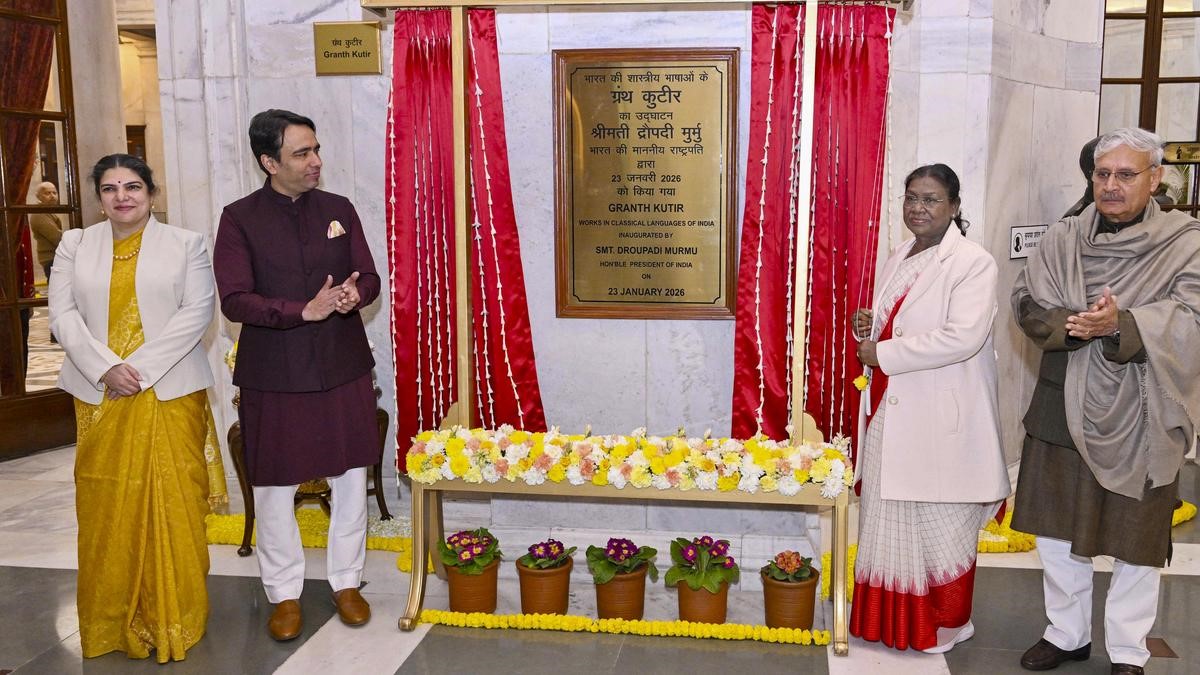
President Droupadi Murmu inaugurated Granth Kutir at Rashtrapati Bhavan as a national repository of India’s classical literary and knowledge heritage. The collection includes around 2,300 books and nearly 50 manuscripts in 11 classical Indian languages, covering subjects from epics and philosophy to science and the Constitution of India. Developed with support from the Ministries of Education and Culture and technical expertise from IGNCA, the initiative aims to preserve fragile manuscripts, promote awareness of India’s intellectual traditions, and symbolically connect ancient wisdom with modern democratic values.
Copyright infringement not intended
Picture Courtesy: The Hindu
|
Must Read: NATIONAL MISSION FOR MANUSCRIPTS | GYAN BHARTAM MISSION | |
What is Granth Kutir?
Granth Kutir is a curated collection of manuscripts and rare books representing India’s classical knowledge systems and literary heritage.
It highlights India’s cultural, philosophical, literary, and intellectual traditions across centuries.
Objectives of Granth Kutir:
This aligns with India’s broader push for cultural revival, knowledge preservation, and civilizational identity.
Coverage
Granth Kutir is designed as a repository of India’s classical knowledge and literary traditions.
Languages Covered (11 Classical Languages):
Tamil, Sanskrit, Kannada, Malayalam, Odia, Marathi, Pali, Prakrit, Assamese, and Bengali.
Nature of Collection
Subject Areas Represented
Institutional Support
Significance of Granth Kutir:
Cultural coverage: Granth Kutir houses around 2,300 books and nearly 50 manuscripts in 11 classical Indian languages, reflecting the depth and diversity of India’s literary, philosophical, and knowledge traditions preserved across centuries.
Linguistic heritage: By representing languages such as Tamil, Sanskrit, Kannada, Malayalam, Odia, Marathi, Pali, Prakrit, Assamese, and Bengali, the initiative reinforces the constitutional and civilizational recognition of India’s multilingual classical heritage.
Knowledge spectrum: The collection spans epics, philosophy, linguistics, governance, history, science, devotional literature, and even the Constitution of India, thereby bridging ancient intellectual traditions with modern democratic thought.
Manuscript preservation: The inclusion of handwritten manuscripts on palm leaf, bark, cloth, and handmade paper highlights India’s traditional knowledge-recording practices and the urgent need for conservation of fragile heritage materials.
What are Manuscripts?
Manuscripts are handwritten records of knowledge created before the widespread use of printing technology. In India, they were written on materials such as palm leaves, birch bark, handmade paper, cloth, and metal plates, depending on the region and period. These texts covered a vast range of subjects including religion, philosophy, literature, mathematics, astronomy, medicine (Ayurveda), polity, law, grammar, and art. Manuscripts were preserved in temples, monasteries, gurukuls, royal courts, and private collections, forming the backbone of India’s traditional knowledge systems.
Historical value of manuscripts:
Sources of primary history: Manuscripts serve as primary historical sources because they contain original compositions, commentaries, and copies made close to the time of writing, allowing historians to reconstruct intellectual and cultural history.
Insight into society and governance: They provide information about administration, taxation, land grants, trade, social customs, and legal systems, especially through inscriptions, legal digests, and royal orders recorded in manuscript form.
Development of languages and scripts: Manuscripts help trace the evolution of languages, scripts, and literary styles, offering evidence of how Sanskrit, Prakrit, Tamil, Persian, and other languages developed over time.
Scientific and intellectual traditions: Texts on astronomy, mathematics, metallurgy, architecture, and medicine show that India had well-developed scientific traditions, many of which influenced other civilizations.
Cultural and religious movements: Bhakti, Sufi, Buddhist, and Jain traditions are documented through devotional poetry, philosophical treatises, and monastic records preserved in manuscript form.
Material culture evidence: Details such as scribal notes, dates, patron names, and places of copying (colophons) give historians information about centres of learning, patronage systems, and transmission of knowledge.
British interest in preservation of manuscripts
Orientalist scholarship: Early British scholars known as Orientalists were fascinated by India’s ancient civilization and began collecting and translating Sanskrit, Persian, and Arabic manuscripts to study Indian laws, religion, and philosophy.
Administrative necessity: The British needed to understand local customs and legal systems to govern effectively, so they translated texts like the Dharmashastras and Islamic legal works to frame Anglo-Hindu and Anglo-Mohammedan laws.
Institutional efforts: Institutions such as the Asiatic Society of Bengal (founded in 1784) were established to collect, catalogue, and preserve Indian manuscripts. Libraries and archives were created to systematically store these materials.
Preservation through archiving: Many fragile manuscripts were preserved in controlled environments in colonial libraries and museums, which helped save some texts from decay, though it also led to the removal of manuscripts from their original cultural contexts.
Translation and global awareness: British translations of works like the Bhagavad Gita, Manusmriti, and Kalidasa’s plays introduced Indian literature and philosophy to the Western world, making India a major field of study in global academia.
|
National Mission for Manuscripts (NMM) The National Mission for Manuscripts (NMM) is a Government of India initiative launched in 2003 to safeguard the country’s vast manuscript heritage. It functions under the Ministry of Culture (earlier under the Ministry of Tourism and Culture) and serves as a nodal body for locating, documenting, and preserving handwritten knowledge materials across the country. Objectives: The mission aims to create a comprehensive record of India’s manuscript wealth through systematic surveying and documentation. It also focuses on scientific conservation to protect fragile materials, digitisation to ensure long-term access, and wider dissemination so that scholars and the public can engage with this knowledge heritage. Institutional Network: To carry out its work on a national scale, the mission has built a wide support system that includes Manuscript Resource Centres (MRCs) for identification and cataloguing, and Manuscript Conservation Centres (MCCs) for preservation and restoration. These centres are spread across different regions of India and work with libraries, temples, monasteries, and private collectors. India is estimated to possess around ten million manuscripts, making it one of the largest repositories of handwritten knowledge in the world. These manuscripts vary widely in subject matter, scripts, languages, artistic styles, calligraphy, illustrations, and decorative elements, reflecting the country’s rich intellectual and artistic traditions. |
Conclusion:
Granth Kutir stands as a symbolic and practical effort to preserve India’s civilizational memory by bringing together classical languages, rare manuscripts, and foundational texts within the nation’s highest constitutional space. It not only safeguards literary and knowledge traditions but also reinforces the continuity between India’s ancient intellectual heritage and its modern democratic identity.
Source: The Hindu
|
Practice Question Q. “Initiatives like Granth Kutir reflect India’s effort to preserve civilizational knowledge while strengthening cultural identity.” Discuss. (150 words) |
Granth Kutir is a dedicated book and manuscript collection established at Rashtrapati Bhavan to showcase India’s classical literary and knowledge traditions.
It is situated within the premises of Rashtrapati Bhavan, New Delhi, giving it national and symbolic importance.
The collection includes around 2,300 books and nearly 50 rare manuscripts.


© 2026 iasgyan. All right reserved