The proposed 2026 FCRA amendments tighten asset oversight and centralize investigations to curb terror financing. While aligning with FATF standards, the Bill risks chilling grassroots activism, increasing personal liability, and causing federal friction over State investigative autonomy.

Copyright infringement not intended
Picture Courtesy: THEHINDU
Why In News?
The Union Cabinet approved the Foreign Contribution (Regulation) Amendment Bill 2026 to introduce a statutory framework for the control and disposition of assets created using foreign funds.
|
Read all about: FOREIGN CONTRIBUTION REGULATION ACT (FCRA) l MHA AMENDED FCRA RULES FOR NGOS |
What is FCRA?
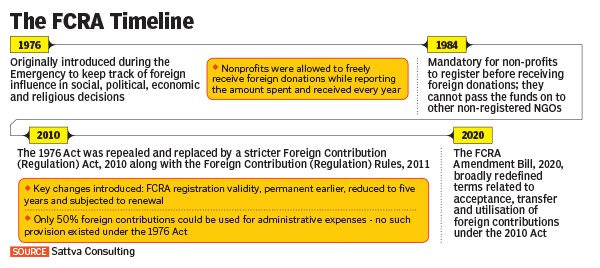
The FCRA was first enacted in 1976 during the Emergency, later replaced by the FCRA 2010 to consolidate the law on utilizing foreign funds.
Regulating Authority: The Ministry of Home Affairs (MHA).
Core Objective: To ensure that foreign contributions do not adversely affect the internal security, sovereign integrity, or public interest of India.
Key Provisions of the Act (Post-2020 Amendments)
Prohibition on Sub-Granting: NGOs can no longer transfer foreign funds to other NGOs or individuals, even if the second party has an FCRA license. This ensures a clear "money trail".
Mandatory SBI Account: All foreign contributions must be received in a designated "FCRA Account" at the State Bank of India (SBI), New Delhi Main Branch.
Aadhaar Requirement: Aadhaar is mandatory for all office-bearers of the NGO for identification purposes.
Administrative Expenses Cap: Spending on administrative items (salaries, rent, etc.) was reduced from 50% to 20% of the total foreign funds received.
Surrender of Certificate: The government can permit an entity to voluntarily surrender its certificate if it no longer wishes to receive foreign funds.
What are the Key Provisions of the Foreign Contribution (Regulation) Amendment Bill 2026?
Asset Management & Disposal
A "designated authority" will be appointed by the government to manage and dispose of assets created from foreign funds if an NGO's FCRA registration is cancelled, suspended, or expires.
Expanded Definition of "Key Functionary"
The bill broadens the definition to include not just office-bearers but also directors, trustees, partners, the Karta of a Hindu Undivided Family (HUF), and any individual with control over the organization.
Personal Liability for Functionaries
Key functionaries will be held personally liable for FCRA violations. They can only avoid liability by providing concrete evidence that they had no knowledge of the violation or had exercised due diligence to prevent it. This introduces a reverse burden of proof.
Centralization of Investigations
Under the amended Section 43, state police and other agencies will require prior approval from the Central government before initiating any investigation into FCRA-related complaints.
"Real-Time" Digital Tracking
Mandatory integration of the NGO's local utilization bank accounts with the Public Financial Management System (PFMS), to allow the government to monitor every transaction in real-time, ensuring funds are not diverted from the declared purpose.
Expansion of "Prohibited" Categories
Inclusion of "Digital News Aggregators" and "Social Media Influencers" under the list of entities prohibited from receiving foreign funds if they engage in political commentary.
Compulsory "Field Verification" for Renewal
Physical verification of the NGO’s registered office and field activities by local intelligence or designated authorities is now mandatory before the 5-year license renewal.
Enhanced Penalty for "Non-Utilization"
If foreign funds remain unutilized for more than three years, the government can direct the funds to be transferred to the Consolidated Fund of India or a government-designated social welfare fund.
Why Does the Government Restrict Foreign Funds?
Sovereign Integrity: Preventing foreign powers from using the "civil society route" to influence Indian policy decisions.
Terror Financing: Stricter norms prevent the "round-tripping" of money that could be used for radicalization or forced religious conversions.
National Security: Reports from the Intelligence Bureau have suggested that "anti-developmental" NGOs have stalled major infrastructure projects, leading to a loss of 2-3% of GDP growth .
Money Laundering: Compliance with Financial Action Task Force (FATF) standards requires India to have a robust mechanism to prevent "Non-Profit Organisations" (NPOs) from being used for terror financing.
Concerns Raised by Civil Society Organisations (CSOs) and Legal Experts
Vague Terminology: Critics argue that terms like "public interest" and "economic security" are loosely defined, allowing the executive to target NGOs that are critical of government infrastructure or environmental policies.
Financial and Operational Paralysis: The 20% limit on administrative expenses is cited as a major hurdle for "knowledge-based" NGOs (think tanks/research bodies) where the primary cost is high-skilled human resources and salaries.
Compliance Burden on Small NGOs: Forcing all NGOs to open their primary FCRA account at a single SBI branch in New Delhi has created massive logistical hurdles for rural organisations located thousands of kilometres away.
Impact on Social Welfare Delivery: Civil society argues that the closure of thousands of NGOs has created a void in sectors like primary healthcare, disability rights, and education where the state’s reach is limited.
Privacy Concerns: Making Aadhaar compulsory for all office-bearers is seen by privacy advocates as a violation of the K.S. Puttaswamy judgment, as it links personal identity to the right to associate and express.
Way Forward
Graded Regulatory Approach
Establish a "fast-track" or "green channel" for organizations with a 10-year track record of flawless compliance and audited transparency, to reduce their administrative burden and frequent renewal hurdles.
Risk-Based Supervision
Instead of universal physical verification, the Ministry of Home Affairs (MHA) should adopt a risk-based model, focusing oversight on "high-risk" sectors or entities with unexplained fund fluctuations.
Rationalizing Administrative Expenses
The 20% cap on administrative expenses should be reconsidered for "knowledge-intensive" NGOs (think tanks, research bodies, and advocacy groups) where human capital and expertise are the primary "output".
Strengthening Self-Regulation
Civil society should develop an independent, self-regulatory accreditation system (similar to the GuideStar model) to verify the financial integrity and social impact of NGOs, reducing the need for intrusive state intervention.
Digital Transparency
Integrate the FCRA portal with other regulatory platforms like DARPAN and the Income Tax (12A/80G) portals to eliminate redundant documentation and data entry for small NGOs.
Decentralized Banking
While the SBI New Delhi account ensures a centralized trail, allowing "view-only" access to local utilization accounts for the MHA could provide transparency without forcing rural NGOs to navigate Delhi-based banking.
Enhancing Judicial and Appellate Oversight
Establish a dedicated FCRA Appellate Tribunal to ensure that license cancellations or suspensions are reviewed by a specialized judicial body within a fixed timeframe, preventing long-drawn-out litigation.
Conclusion
The goal should be to transform the FCRA from a "Control-based" law to a "Compliance-based" law, where the state acts as a facilitator for genuine social work while remaining a sentinel against security threats.
Source: THEHINDU
|
PRACTICE QUESTION Q. "While stringent regulations on foreign contributions are vital for internal security, they must not stifle the operational capacity of civil society." Analyze. 150 word |
The primary objective is to shift the regulatory focus towards managing physical assets created from foreign funds, standardizing investigation processes, rationalizing penalties, and complying with FATF anti-terror financing mandates to safeguard internal security.
Under the proposed amendment to Section 43, State governments and local law enforcement agencies must obtain prior approval from the Central government before initiating any investigation into FCRA-related complaints. This aims to stop multiple investigations by local police.
Police and public order are State subjects under the Seventh Schedule of the Indian Constitution. By requiring Central approval for local police to investigate FCRA violations, the Bill effectively curtails the investigative autonomy of the States, causing potential constitutional friction.


© 2026 iasgyan. All right reserved