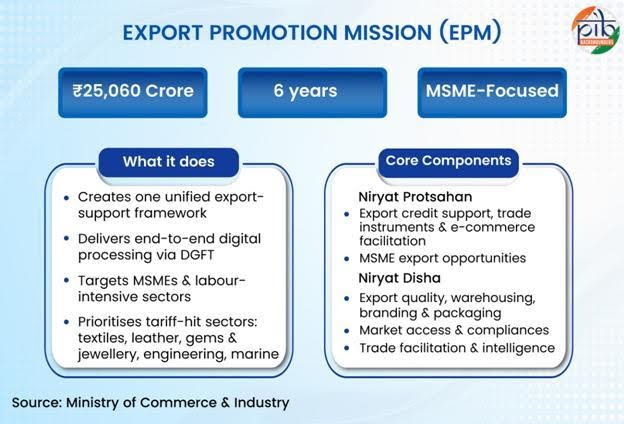
The Export Promotion Mission (EPM) is a comprehensive initiative aimed at strengthening India’s export ecosystem, particularly for MSMEs, new exporters and labour-intensive sectors. Through its twin components Niryat Protsahan (financial support) and Niryat Disha (ecosystem and market support), the Mission reduces the cost of finance, improves compliance with global standards, enhances logistics and warehousing access, and promotes entry into new markets. By integrating digital monitoring, credit support, trade intelligence and district-level export promotion, EPM seeks to boost export competitiveness, diversify markets and ensure inclusive, regionally balanced growth while deepening India’s integration into global value chains.
Copyright infringement not intended
Picture Courtesy: PIB
Context:
The Union Minister of Commerce and Industry, Piyush Goyal, launched seven new interventions under the Export Promotion Mission (EPM) to strengthen Micro, Small and Medium Enterprises (MSMEs) and enhance India’s global export competitiveness.
|
Must Read: Export Promotion | FOREIGN TRADE POLICY | |
Export Promotion Mission (EPM):
The Export Promotion Mission (EPM) is a flagship initiative announced in the Union Budget 2025–26 to enhance India’s export performance and global competitiveness. The Mission is designed to support MSMEs, new exporters, and labour-intensive industries through a comprehensive, technology-enabled and outcome-oriented framework.
Key features of the mission:
Priority Sectors: Focused assistance will be provided to sectors facing global trade pressures and tariff challenges, such as:
Sub schemes under Export Promotion Mission (EPM):
Niryat Protsahan (Financial Enablers): Niryat Protsahan is designed to improve access to affordable and diversified trade finance for MSMEs so that financial constraints do not limit their participation in global markets. Under this component, exporters receive interest subvention on pre- and post-shipment export credit, which reduces the cost of borrowing and improves working capital availability. The scheme also promotes export factoring, enabling MSMEs to convert receivables into immediate liquidity and manage cash flow efficiently.
To address the problem of limited collateral, the programme provides collateral-free or credit-guaranteed loan facilities, thereby encouraging banks to extend credit to small exporters. Recognising the growing role of digital trade, special credit support is extended to e-commerce exporters to help them expand through online global platforms. In addition, the scheme offers financial assistance and risk-sharing support for entering new and emerging markets, enabling exporters to diversify beyond traditional destinations and reduce market concentration risks.
Niryat Disha (Ecosystem and Market Support): Niryat Disha focuses on strengthening the non-financial ecosystem required to enhance export competitiveness and market readiness. The component provides support for meeting international quality standards, including assistance for testing, inspection and certification, which helps exporters comply with regulatory requirements in foreign markets. It also promotes global branding, improved packaging and better product positioning, enabling Indian goods to compete more effectively in international markets.
To increase market exposure, exporters are supported in participating in international trade fairs, buyer-seller meets and exhibitions. The scheme further facilitates access to overseas warehousing and logistics infrastructure, which improves delivery efficiency and reduces turnaround time. To address regional disadvantages, assistance is provided for inland transport and freight costs, especially for exporters located in interior and low-export districts.
In addition, Niryat Disha strengthens long-term capacity through trade intelligence systems, market information services, exporter training and cluster-level capacity-building initiatives, thereby improving strategic decision-making and export preparedness.
Key interventions under Export Promotion Mission (EPM):
Niryat Protsahan: Financial Enablers
Support for Alternative Trade Instruments (Export Factoring): This intervention encourages MSMEs to use export factoring as a means to improve liquidity by providing interest subvention of 2.75% on factoring charges for eligible transactions, with financial support limited to ₹50 lakh per MSME per year. Export factoring is a financing arrangement where an exporter assigns its overseas receivables to a specialised financial institution (factor) at a discounted value in exchange for immediate funds, thereby reducing the waiting period for payment from foreign buyers.
Credit Support for E-Commerce Exporters: To strengthen digital export channels, two dedicated credit windows have been introduced. The Direct E-Commerce Credit Facility offers loans up to ₹50 lakh with 90% credit guarantee coverage, while the Overseas Inventory Credit Facility provides financing up to ₹5 crore with 75% guarantee coverage for exporters maintaining stock in foreign markets. Both facilities are eligible for 2.75% interest subvention, subject to a maximum annual benefit of ₹15 lakh per exporter.
Support for Emerging Export Opportunities: This measure assists exporters in expanding into new or relatively risky markets through structured credit arrangements and risk-sharing mechanisms. The objective is to ease financial uncertainty, improve cash flow stability and encourage market diversification.
Niryat Disha: Non-Financial Enablers
Trade Regulations, Accreditation and Compliance Enablement (TRACE): TRACE helps exporters meet international regulatory standards related to testing, inspection and certification (TIC). It offers reimbursement of 60% of eligible costs for items under the Positive List and 75% for the Priority Positive List, subject to an annual ceiling of ₹25 lakh per Importer-Exporter Code (IEC).
Facilitating Logistics, Overseas Warehousing and Fulfilment (FLOW): This intervention supports the establishment and utilisation of overseas warehousing and fulfilment infrastructure, including facilities linked to global e-commerce distribution networks. Financial assistance of up to 30% of the approved project cost is available for a period of up to three years, helping exporters reduce delivery time and improve market responsiveness.
Logistics Interventions for Freight and Transport (LIFT): LIFT addresses cost disadvantages faced by exporters located in interior and low-export-intensity districts by providing reimbursement of up to 30% of eligible freight expenses, with a maximum limit of ₹20 lakh per IEC per financial year.
Integrated Support for Trade Intelligence and Facilitation (INSIGHT): INSIGHT strengthens exporter preparedness through market intelligence, training, and district-level export facilitation under the Districts as Export Hubs initiative. Financial assistance is available up to 50% of project cost, while proposals from Central and State government bodies and Indian Missions abroad may receive full funding (up to 100%) within prescribed limits.
Importance of the Interventions under Export Promotion Mission (EPM):
Conclusion:
The Export Promotion Mission (EPM) and its targeted interventions represent a strategic shift toward a unified, digital, and outcome-oriented export ecosystem. By reducing the cost of finance, improving compliance readiness, strengthening logistics support, and enabling access to new markets, the initiative addresses key structural barriers faced by MSMEs. Overall, the Mission is expected to enhance export competitiveness, promote inclusive regional growth, and strengthen India’s integration into global value chains.
Source: PIB
|
Practice Question Q. How can targeted financial and logistics interventions under the Export Promotion Mission help integrate Indian MSMEs into global value chains? Examine. (250 words) |
The Export Promotion Mission is a government initiative announced in the Union Budget 2025–26 to enhance India’s export competitiveness by providing integrated financial and ecosystem support, particularly for MSMEs, new exporters and labour-intensive sectors.
The Mission is implemented through coordinated efforts of the Department of Commerce, Ministry of MSME and Ministry of Finance, with operational execution by the Directorate General of Foreign Trade (DGFT) and support from Indian Missions abroad and Export Promotion Councils.
The Mission lowers export costs through interest subvention on credit, freight and logistics support, assistance for overseas warehousing, and reimbursement for testing and certification expenses.

© 2026 iasgyan. All right reserved