🔔Join APTI PLUS Prelims Mirror 2026 | All India Open Mock Test Series on 12th April, 26th April & 3rd May 2026 |Register Now!

EMPEROR PENGUINS: FEATURES, HABITAT, IUCN STATUS

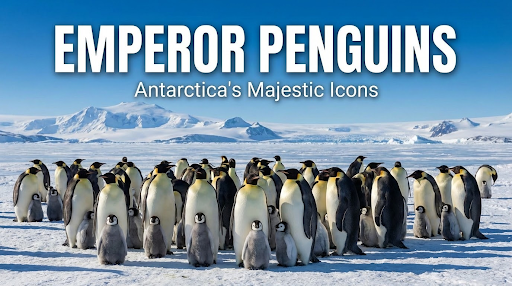
The Emperor Penguin is the tallest and heaviest penguin species, endemic to Antarctica. They are famous for breeding during the frigid winter, where males huddle to protect eggs from extreme cold while females hunt, showcasing remarkable endurance and social cooperation. 
Description

Why In News?

The International Union for Conservation of Nature (IUCN) updated the status of the Emperor Penguin from 'Near Threatened' to 'Endangered'.

About Emperor Penguin 

Key Biological Facts

  • Scientific Name: Aptenodytes forsteri.
  • Physicality: The tallest and heaviest of all living penguin species; they can reach heights of 122 cm (48 in).
  • Habitat: They are endemic to Antarctica and are the only penguin species that breeds during the harsh Antarctic winter.
  • Deep Divers: They can dive to depths of over 500 metres and stay submerged for nearly 20 minutes.

Unique Breeding Cycle

  • Fast Ice Dependency: Emperor Penguins breed on "fast ice"—sea ice that is attached to the coastline. 
    • If this ice breaks up too early in the season (before chicks grow their waterproof feathers), the chicks drown or freeze.
  • The Winter Breeders: They lay a single egg in May/June. The male incubates the egg on his feet for about 65 days during the lightless winter while the female goes to sea to hunt. 

Conservation Status & Major Threats

  • IUCN Red List: Endangered 
  • The Primary Threat: Climate Change:
    • Sea Ice Loss: Warming oceans and changing wind patterns are reducing the extent and stability of fast ice.
    • Projected Extinction: Experts warn that 90% of colonies could be "quasi-extinct" by 2100 if current global warming trends continue.
  • Secondary Threats:
    • Food Scarcity: Overfishing of Krill (their primary food source) for omega-3 supplements and fishmeal.
    • Disease: Increased temperatures facilitate the spread of avian diseases (like H5N1) to isolated Antarctic populations.

Protection Mechanisms

  • Antarctic Treaty System (1959): Provides general protection for Antarctic wildlife. Emperor Penguins are designated as "Specially Protected Species" under the Protocol on Environmental Protection to the Antarctic Treaty.
  • CCAMLR (Commission for the Conservation of Antarctic Marine Living Resources): Works to regulate krill fishing to ensure food availability for penguins.
  • US Endangered Species Act (ESA): Also lists the species as threatened, acknowledging that climate change is the primary driver of their decline. 

The "Indicator Species"  

The Emperor Penguin serves as a "Bio-indicator." Its decline is not an isolated biological event but a signal of the rapid destabilization of the Southern Ocean’s cryosphere. 

Source: THEHINDU

PRACTICE QUESTION

Q. Which of the following statements about Emperor Penguins is correct?

  1. They are endemic to the Arctic Circle.
  2. They are the only penguin species that breeds during the Antarctic winter.
  3. Their IUCN status was recently updated to 'Endangered'.

Select the correct answer:

A) 1 and 2 only

B) 2 and 3 only

C) 1 and 3 only

D) 1, 2, and 3

Answer: B

Explanation:

Statement 1 is incorrect: Emperor penguins are endemic to Antarctica (Southern Hemisphere), not the Arctic Circle (Northern Hemisphere).

Statement 2 is correct: They are the only penguin species that breeds during the coldest, darkest winter months in Antarctica.

Statement 3 is correct: In April 2026, the International Union for Conservation of Nature (IUCN) updated the status of the Emperor Penguin from "near threatened" to "endangered" due to the loss of sea ice.

Frequently Asked Questions (FAQs)

Emperor Penguins act as an early warning system for the health of the Southern Ocean. Their population decline signals the rapid melting of Antarctic sea ice and broader cryosphere destabilization, which directly impacts global sea levels and weather patterns.

Antarctic ice melt contributes significantly to global sea-level rise, threatening India's 7,500 km coastline. Anomalous changes in Antarctic sea surface temperatures can alter the Indian Ocean Dipole (IOD), which heavily influences the strength, timing, and predictability of the Indian Summer Monsoon.

Fast ice is sea ice that is securely attached to the coastline. It provides the stable physical platform required for Emperor Penguins to breed and rear their chicks during the harsh Antarctic winter. Premature breakup of fast ice leads to catastrophic reproductive failures, as chicks drown or freeze.

Free access to e-paper and WhatsApp updates

Let's Get In Touch!