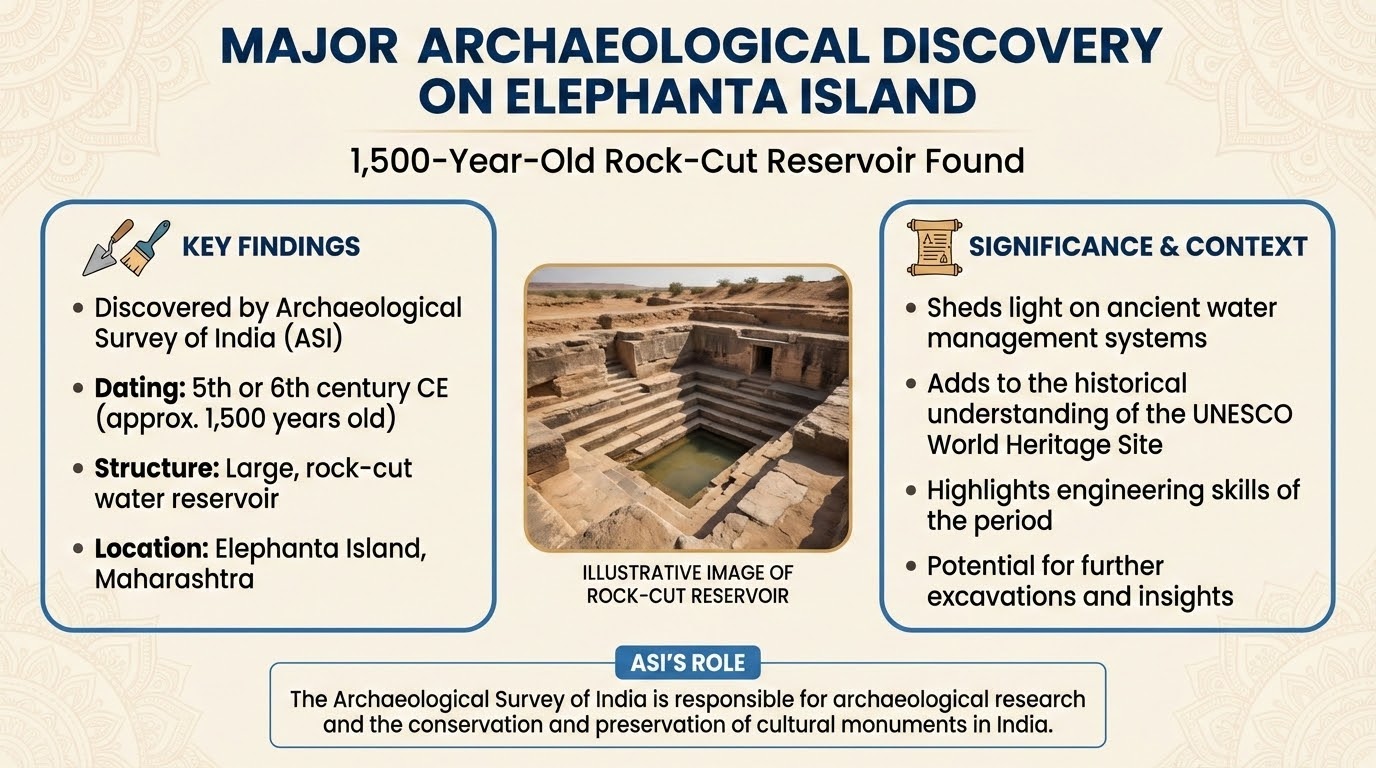
The ASI recently unearthed a 1,500-year-old stepped reservoir on Elephanta Island, revealing advanced ancient water management. Discoveries of Kalachuri King Krishnaraja’s coins (6th century CE) and Roman amphorae confirm the island was a major maritime trade and architectural hub.
Why In News?
Archaeologists from the Archaeological Survey of India (ASI) have discovered a 1,500-year-old, rock-cut reservoir on Elephanta Island, dating back to the 5th or 6th century CE.
Elephanta Island, historically known as Gharapuri ("City of Caves"), is a UNESCO World Heritage site famous for its rock-cut cave temples situated in the Mumbai Harbour.
Geography & Location
Location: The island is located about 10 km east of Mumbai and covers an area of approximately 10 to 16 sq km depending on the tide.
Geology: It is composed of volcanic rock from the Deccan Traps, formed during the Cretaceous or early Paleocene period.
Terrain: The island consists of two hillocks separated by a narrow valley, with the caves located on the western hill.
History & Etymology
Naming: The local name is Gharapuri; the name "Elephanta" was given by Portuguese explorers in the 16th century after they found a colossal stone elephant statue near the landing place.
Patronage: The main caves are attributed to the Kalachuris of Mahishmati (6th century CE), evidenced by the discovery of coins of King Krishnaraja.
Early Occupation: Archaeological remains, such as buried stupas, indicate occupation on the island as early as the 2nd century BC.
Elephanta Caves (UNESCO World Heritage Site)
Inscription: The caves were inscribed as a World Heritage Site in 1987, representing a masterpiece of human creative genius and a unique testimony to a cultural tradition.
Architecture: The complex consists of seven caves, with Cave 1 being the most significant—a pillared hall dedicated to Lord Shiva featuring the famous 7-meter-high Trimurti (Sadashiva) sculpture representing the three aspects of Shiva: Creator, Preserver, and Destroyer.
Preservation: The site is protected and managed by the Archaeological Survey of India under the Ancient Monuments and Archaeological Sites and Remains Act, 1958.
The Reservoir
Design: It is a T-shaped stepped reservoir measuring approximately 14.7 meters in length.
Dimensions: The width varies between 6.7 meters and 10.8 meters, with excavations reaching a depth of 5 meters to expose 20 well-aligned steps.
Engineering: Unlike the rock-cut caves, this structure was built using stone blocks transported from the mainland, indicating sophisticated logistical planning to manage water on the rocky, water-scarce island.
Evidence of Global Maritime Trade
Roman & Mesopotamian Links: Excavators found approximately 3,000 sherds of Amphorae (Mediterranean origin) and Torpedo jars (West Asian/Mesopotamian origin).
Usage: These vessels were historically used to store wine, oil, and fish sauce, confirming the island was an active port engaged in long-distance trade with Rome and the Persian Gulf.
The Kalachuri Patronage
Numismatic Discovery: The team recovered 60 coins made of copper, lead, and silver.
King Krishnaraja: Several copper coins bear the motif of a seated bull and the legend of King Krishnaraja (6th Century CE) of the Kalachuri dynasty.
Significance: Provides the first solid archaeological evidence linking the Kalachuri dynasty as the direct patrons of the main Elephanta Caves, a theory previously based only on stylistic comparisons.
Industrial Activity
Dyeing Vat: A brick structure resembling a dyeing vat was found, suggesting the island hosted textile manufacturing or dyeing industries.
Ornaments: Discoveries of carnelian and quartz beads, along with glass and stone bangles, point to local craftsmanship and habitation beyond just monastic communities.
Source: THE HINDU
|
PRACTICE QUESTION Q. Consider the following statements regarding the Elephanta Caves: 1. The caves are hewn from solid granite rock. 2. The architectural layout of the main cave follows a mandala pattern. 3. The site contains evidence of Buddhist occupation dating back to the 2nd century BCE. Which of the statements given above is/are correct? A) 1 and 2 only B) 2 and 3 only C) 1 and 3 only D) 1, 2, and 3 Answer: B Explanation: Statement 1 is Incorrect: The Elephanta Caves are hewn from solid basalt (volcanic) rock, not granite. Basalt is the common geological material for most rock-cut architecture in western Maharashtra, including Ajanta and Ellora. Statement 2 is Correct: The architectural layout of the main cave (Cave 1) is designed following a mandala pattern. This geometric layout reflects the metaphysical plan of a Hindu temple, emphasizing symmetry and spiritual order. Statement 3 is Correct: While famous for its 5th-century Shaivite shrines, the site contains evidence of Buddhist occupation dating back to the 2nd century BCE. This earlier period is represented by Buddhist stupa mounds and caves with water tanks located on the island. |
The caves are situated on Elephanta Island, also known as Gharapuri (literally "City of Caves"), in Mumbai Harbour, Maharashtra. The island is approximately 10 km east of Mumbai city.
The origins are debated, but contemporary scholars and the Archaeological Survey of India (ASI) generally attribute the main work to King Krishnaraja of the Kalachuri dynasty in the mid-6th century CE. Later contributions were also made by the Rashtrakutas.
The name was given by Portuguese explorers in the 16th century after they discovered a massive stone elephant statue near the landing area. This statue was later moved and is now located at Jijamata Udyaan (Byculla Zoo) in Mumbai.




© 2026 iasgyan. All right reserved