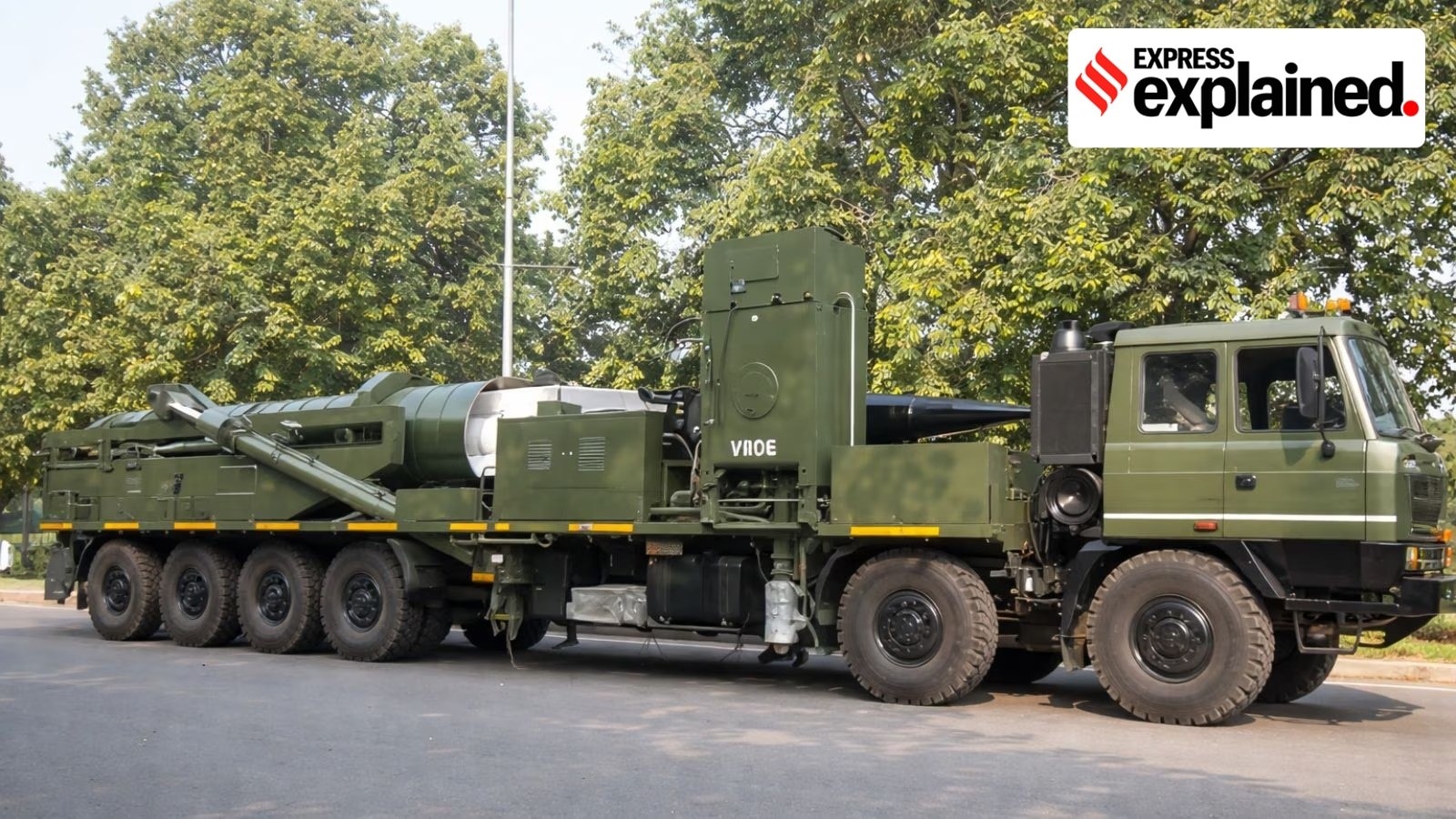
DRDO showcases Hypersonic Glide Missile at Republic Day Parade

DRDO showcased the Long-Range Anti-Ship Hypersonic Missile (LR-AShM) at the Republic Day Parade, marking a major advancement in India’s indigenous defence technology. This hypersonic glide missile, capable of travelling over Mach 5 and striking targets up to 1,500 km away, combines high speed, manoeuvrability, and a low-altitude flight path to evade missile defence systems. Designed primarily for coastal defence and sea-denial operations, it significantly enhances the Indian Navy’s ability to deter and neutralise high-value enemy warships in the Indian Ocean Region, positioning India among the leading nations developing advanced hypersonic weapon systems.
Description

Copyright infringement not intended

Picture Courtesy: Indian Express

Context:

India showcased a major leap in next-generation missile technology at the 77th Republic Day Parade with the first public display of the Long-Range Anti-Ship Hypersonic Missile (LR-AShM) developed by the Defence Research and Development Organisation (DRDO).

Must Read: Basics of Missiles | HYPERSONIC MISSILE | GPI Programme |

What is the LR-AShM Hypersonic Missile?

The LR-AShM (Long Range Anti-Ship Missile) is a hypersonic glide vehicle (HGV)-based missile system capable of striking both static and moving naval targets at ranges of around 1,500 km. It is designed for coastal battery deployment, allowing India to target hostile warships far from its shores.

Unlike traditional cruise missiles, this system combines ballistic missile boost with a hypersonic glide phase, making it extremely difficult to intercept.

Key features of LR-AShM:
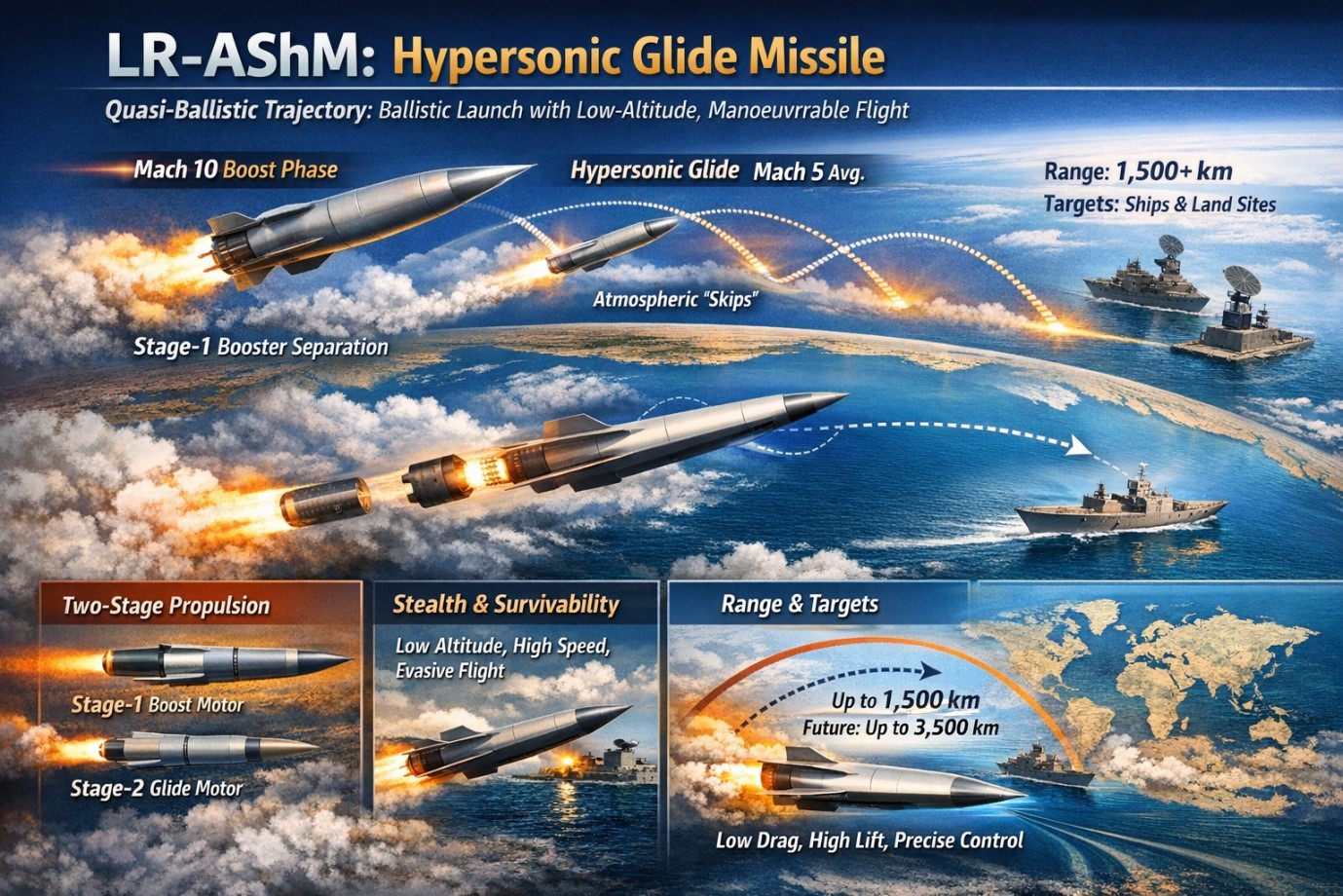
  • Hypersonic speed: The LR-AShM achieves hypersonic velocity, reaching speeds of around Mach 10 during its boost phase and sustaining an average speed of about Mach 5 during its glide phase, enabling it to cover a distance of nearly 1,500 km in approximately 15 minutes and significantly reducing the enemy’s reaction and interception window.
  • Quasi-ballistic trajectory: Unlike conventional ballistic missiles that follow a predictable high-arc path, the LR-AShM adopts a low-altitude, manoeuvrable quasi-ballistic trajectory, which allows it to evade missile defence systems, minimise radar detection time, and alter its course mid-flight to avoid interception.
  • Hypersonic glide phase: After being accelerated by its two-stage solid rocket booster, the missile transitions into an unpowered hypersonic glide phase within the atmosphere, during which it executes sharp manoeuvres and multiple atmospheric skips, making its path highly unpredictable and difficult to intercept.
  • High aerodynamic efficiency: The glide vehicle is engineered with advanced heat-resistant materials and precision control systems, ensuring high aerodynamic efficiency that reduces drag while maintaining lift, thereby enabling longer glide distances, superior manoeuvrability, and improved strike accuracy.
  • Multi-payload capability: The LR-AShM is designed with the flexibility to carry different types of payloads, allowing it to adapt to varied mission requirements, particularly for engaging high-value naval targets in complex maritime operational environments.

Strategic Significance of LR-AShM Hypersonic Missile:

  • Strengthening sea-denial capability: The LR-AShM significantly enhances India’s sea-denial capability by enabling the Indian Navy to prevent adversaries from operating freely in critical maritime zones, especially across the strategically vital Indian Ocean Region (IOR).
  • Deterrence against carrier battle groups: With its long range, hypersonic speed, and high manoeuvrability, the missile poses a serious threat to aircraft carriers and heavily defended warships, thereby strengthening India’s deterrence against powerful naval task forces.
  • Reduced enemy reaction time: Because the missile travels at hypersonic speeds along a low and unpredictable flight path, it drastically reduces the time available for enemy radar detection, tracking, and interception, increasing the probability of a successful strike.
  • Force multiplier for coastal defence: Designed for coastal battery deployment, the LR-AShM acts as a powerful force multiplier by allowing India to strike hostile naval assets far from its coastline without deploying its own fleet into contested waters.
  • Tri-service potential: Future variants of the missile are being considered for land-based, air-launched, and ship-launched roles, which would extend its utility across the Army, Air Force, and Navy, thereby enhancing joint-force operational flexibility.
  • Entry into the hypersonic weapons domain: The development of LR-AShM marks India’s entry into the elite group of nations possessing operational hypersonic weapon systems, boosting its strategic stature and strengthening long-term deterrence in an era of advanced missile defence technologies.

Conclusion:

The induction of the LR-AShM hypersonic glide missile represents a major leap in India’s indigenous defence capability, combining extreme speed, manoeuvrability, and long-range precision to strengthen maritime deterrence, enhance sea-denial power in the Indian Ocean Region, and firmly position India among the leading nations in advanced hypersonic weapons technology.

Source: Indian Express

Practice Question

Q. What are hypersonic glide missiles? How does the LR-AShM enhance India’s sea-denial capability in the Indian Ocean Region? (150 words)

Frequently Asked Questions (FAQs)

The LR-AShM is designed to engage both static and moving maritime targets, including high-value enemy warships operating at long distances from India’s coastline.

A hypersonic glide vehicle (HGV) is a payload that is first launched by a rocket and then glides through the atmosphere at hypersonic speeds, performing manoeuvres to evade detection and interception.

Their extreme speed, low-altitude flight path, and ability to change direction mid-course make tracking and predicting their trajectory very difficult for existing missile defence systems.


Free access to e-paper and WhatsApp updates

Let's Get In Touch!