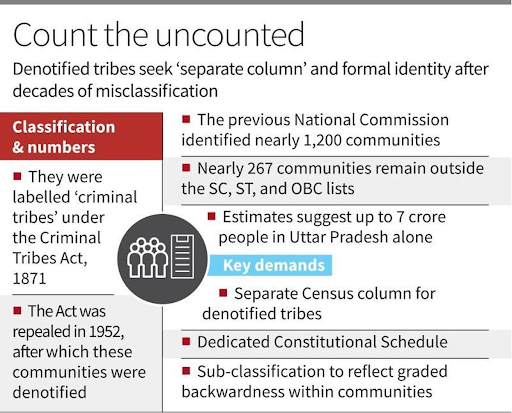
The demand for a separate Census 2027 category and Constitutional Schedule for Denotified, Nomadic, and Semi-Nomadic Tribes highlights historical injustice and persistent stigma. Data gaps cause political misclassification and welfare exclusion. Implementing Renke and Idate Commission recommendations and ensuring accurate enumeration remain vital for achieving social justice and inclusive development

Copyright infringement not intended
Picture Courtesy: THEHINDU
Context
The Ministry of Social Justice and Empowerment recommended enumerating Denotified, Nomadic, and Semi-Nomadic Tribes (DNTs) as a distinct category in the upcoming Census 2027.
|
Read all about: CLASSIFYING DENOTIFIED TRIBES l DENOTIFIED, NOMADIC, SEMI-NOMADIC TRIBES l WELFARE OF DENOTIFIED AND NOMADIC GROUPS l DENOTIFIED TRIBES (DNT) |
Who are the Denotified, Nomadic, and Semi-Nomadic Tribes (DNTs)?
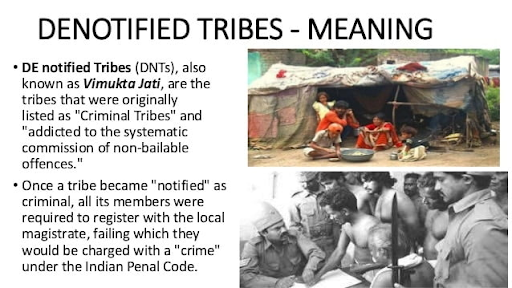
Denotified, Nomadic, and Semi-Nomadic Tribes (DNTs) are among the most marginalized communities in India, representing roughly 10% of India's population.
Denotified Tribes (DNTs): Also known as Vimukta Jati, these are communities that were "notified" as "born criminals" under the colonial Criminal Tribes Act of 1871.
Nomadic Tribes (NTs): Groups that maintain constant geographical mobility for their livelihood, traditionally moving between places rather than living in fixed settlements.
Semi-Nomadic Tribes (SNTs): Communities that follow a hybrid lifestyle; they engage in seasonal migration but return to fixed habitations at certain times of the year.
These communities are demanding a separate column in the Census and a dedicated Constitutional Schedule to rectify historical injustice and address socio-economic marginalization.
Why is a Separate Census Column and Schedule Necessary?
Crisis of Political Misclassification
DNTs are currently scattered across different constitutional categories—Scheduled Castes (SC), Scheduled Tribes (ST), and Other Backward Classes (OBC). This fragmentation dilutes their political voice and prevents targeted welfare.
Problem of Data Deficit ("Ghost Citizens")
Lack of official data on the DNT population, cripples policymaking. Without accurate enumeration, these communities remain statistically invisible.
Demand for "Graded Backwardness"
Following the Supreme Court's judgment in State of Punjab vs Davinder Singh (August 2024), which permitted sub-classification within SCs/STs, DNT leaders are arguing for constitutional recognition of their unique and severe marginalization.
A separate Schedule would allow for sub-quotas to ensure benefits reach the most vulnerable nomadic groups.
What are the Socio-Economic Challenges Facing DNTs?
Continued Stigmatization
The stigma of the Criminal Tribes Act persists through the Habitual Offenders Act, 1952, which continues to criminalize these communities.
Failure of Welfare Schemes
Scheme for Economic Empowerment of DNTs (SEED) has been poorly implemented, primarily due to bureaucratic hurdles.
Loss of Traditional Livelihoods
Laws like the Wildlife Protection Act, 1972, and forest conservation acts have criminalized the traditional occupations of many DNTs, such as snake charmers, pastoralists, and performers.
|
Key Committee Recommendations on (DNT/NT/SNT) Renke Commission (2008): Proposed a 10% separate reservation for DNTs even if it exceeded the 50% legal limit. It also recommended extending the Prevention of Atrocities Act to these tribes. Idate Commission (2018): Called for a Permanent Constitutional Commission for DNTs, adding them as a "third category" after SCs and STs. It also suggested that communities not currently in any list (SC/ST/OBC) be assigned to the OBC category. NITI Aayog & DWBDNC: Following NITI Aayog’s 2019 recommendations, the Development and Welfare Board for De-notified, Nomadic and Semi-Nomadic Communities (DWBDNC) was established in 2019.
|
Way Forward
The inclusion of DNTs in the 2027 Census is a crucial step toward rectifying historical injustices and ensuring their constitutional rights.
Constitutional Recognition: Introduce a Third Schedule for DNTs or implement the Idate Commission's recommendation for a sub-quota within existing categories.
Repeal Draconian Laws: The Habitual Offenders Act, 1952, must be repealed to end the institutionalized harassment and stigma faced by these communities.
Simplify Certificate Issuance: The Centre should mandate a uniform and simplified process for issuing DNT certificates to ensure access to welfare schemes.
Ensure Census Visibility: The Registrar General of India must ensure the 2027 Census accurately captures the population and socio-economic status of DNTs.
Conclusion
India can only realize the vision of Antyodaya—the elevation of the most marginalized—by acknowledging the unique challenges of the uncounted and ensuring their inclusion.
Source: THEHINDU
|
PRACTICE QUESTION Q. Consider the following statements about the history of Denotified Tribes (DNTs) in India: 1. The Criminal Tribes Act was enacted by the British colonial administration. 2. The Ayyangar Committee recommended the repeal of the Criminal Tribes Act. Which of the statements given above is/are correct? a) 1 only b) 2 only c) Both 1 and 2 d) Neither 1 nor 2 Answer: c Explanation: Statement 1 is correct: The Criminal Tribes Act was first enacted in 1871 by the British colonial administration. This law branded entire communities as "born criminals," subjecting them to continuous surveillance, forced registration, and movement restrictions. Statement 2 is correct: The Ananthasayanam Ayyangar Committee (1949) was established to review these laws. Based on its recommendations, the discriminatory Criminal Tribes Act was repealed in 1952, and the affected communities were "denotified" from their criminal status. |
Denotified Tribes are communities that were legally branded as "born criminals" under the colonial Criminal Tribes Act, 1871. They were "de-notified" in 1952 when the Act was repealed. However, they continue to face social stigma and economic marginalization.
The Scheme for Economic Empowerment of DNTs (SEED) is a central government initiative designed to provide free coaching, health insurance, housing assistance, and livelihood support to DNT families. However, its implementation has been hampered by difficulties in obtaining caste certificates.
The Idate Commission (2018) was constituted to identify DNT communities and recommend measures for their development. It notably recommended setting up a Permanent Constitutional Commission for DNTs and ensuring they do not overlap with existing SC/ST/OBC lists to prevent "political misclassification.


© 2026 iasgyan. All right reserved