The 2026 Amendment Bill replaces gender self-identification with mandatory medical certification, sparking debate. While the government aims to prevent fraud, activists argue it violates the NALSA judgment. Critics fear medical gatekeeping will further marginalize the community, urging rights-based autonomy.
Copyright infringement not intended
Picture Courtesy: INDIANEXPRESS
Context
The Union Government introduced the Transgender Persons (Protection of Rights) Amendment Bill 2026 to amend the 2019 Act.
What are the Key Provisions of the 2026 Bill
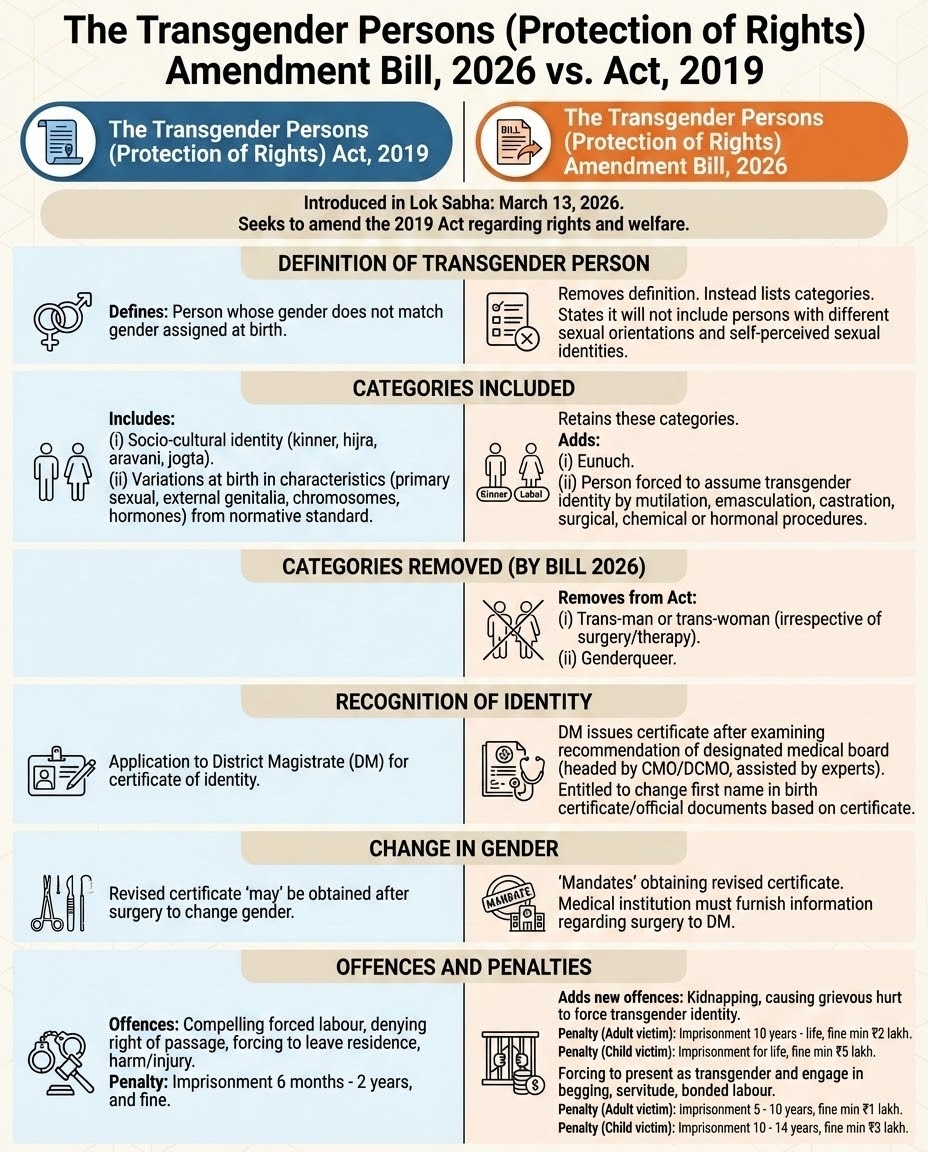
Narrower Definition of Transgender: The Bill introduces a more restrictive definition, recognizing only:
Abolition of Self-Identification
It completely removes Section 4(2) of the 2019 Act, which previously guaranteed an individual's right to a self-perceived gender identity.
Mandatory Medical Board
A Medical Board, led by a Chief Medical Officer (CMO), will clinically examine applicants, and recommend the District Magistrate for issuing a transgender identity certificate.
Mandatory Surgery Notification
After undergoing gender-affirming surgery, a person must get a revised certificate. The medical institution that performed the surgery is now required to report the details directly to the District Magistrate.
Stringent Penal Provisions: To combat exploitation, the Bill introduces harsh punishments.
Government's Rationale for the Amendments
Targeted Welfare Delivery
The 2019 act definition was "vague," making it difficult to identify "genuine oppressed" individuals. The new law aims to protect those facing social exclusion due to "biological reasons for no fault of their own".
Preventing Fraud and Legal Ambiguity
Self-identification created challenges in civil and personal laws. The amendment aims to prevent fraudulent claims for welfare benefits and quotas by setting rigid biological criteria.
Combating Organized Crime
The strict life imprisonment clauses are designed to dismantle human trafficking and begging syndicates that exploit and mutilate abducted children and adults.
What are the Concerns raised about the amendment?
Contradiction with Supreme Court Precedents
The Bill is in direct opposition to landmark Supreme Court judgments that have established gender identity as a fundamental right.
|
|
Core Principle Upheld |
How the 2026 Bill Contradicts It |
|
NALSA vs Union of India (2014) |
The right to self-identification of gender is integral to personal autonomy and dignity under Article 21 (Right to Life). |
The Bill removes self-identification and imposes a medical board for certification, shifting power from the individual to the state. |
|
K.S. Puttaswamy vs Union of India (2017) |
Gender identity is an intrinsic part of the Right to Privacy, also under Article 21. |
By mandating clinical examinations and state certification, the Bill infringes upon an individual's private and autonomous decisions regarding their identity. |
Institutionalization of Medical Gatekeeping
Requiring a Medical Board's approval pathologizes transgender identity, subjecting individuals to humiliating scrutiny and creating barriers, particularly in rural areas with limited access to sensitized medical professionals.
Exclusion of Modern Transitions
The Bill focuses on traditional socio-cultural systems and excludes individuals who transition in modern urban settings to avoid potential exploitation within traditional structures.
Worsening Undercounting and Welfare Exclusion
The 2011 Census recorded 4.87 lakh transgender individuals,a narrower legal definition will further exclude genuine beneficiaries from welfare schemes like SMILE (Support for Marginalized Individuals for Livelihood and Enterprise), which provides skill training stipends and shelter homes (Garima Greh).
Way Forward
Adopt a Self-Declaration Model
The government should abandon the mandatory medical board and adopt a robust administrative verification process based on self-declaration, similar to the model used in Malta.
Focus on Implementation, Not Gatekeeping
The focus should be on the effective and inclusive implementation of existing welfare schemes rather than creating new barriers to access them.
Replicate Successful State Initiatives
A positive example is the Delhi Government's 2026 initiative to provide transgender persons with Ayushman Bharat TG Plus health coverage under the SMILE scheme. Such administrative actions that widen access should be replicated nationwide.
Conclusion
The 2026 Amendment Bill, while intended to curb fraud, risks eroding fundamental rights by imposing a rigid, medicalized gender definition, necessitating a balance between welfare integrity and individual dignity.
|
PRACTICE QUESTION Q. Consider the following statements about the Transgender Persons (Protection of Rights) Amendment Bill, 2026: 1. It abolishes the legal right to self-perceived gender identity. 2. It mandates the creation of a Medical Board for gender certification. 3. It expands the definition of transgender to explicitly include 'genderqueer' individuals. Which of the statements given above is/are correct? (a) 1 and 2 only (b) 2 and 3 only (c) 1 and 3 only (d) 1, 2, and 3 Answer: a) Explanation: Statement 1 is correct: The Amendment Bill proposes to delete Section 4(2) of the 2019 Act, which currently recognizes a person's right to self-perceived gender identity. Statement 2 is correct: The Bill mandates that the District Magistrate will issue a certificate of identity only after examining the recommendation of a designated Medical Board. Statement 3 is incorrect: The 2026 Amendment narrows the definition of transgender, moving away from a broad interpretation. It removes 'genderqueer' and 'trans-men/trans-women' from the definition, focusing instead on socio-cultural identities (eunuch, hijra, etc.) and intersex variations. |
The most significant change is the removal of the right to self-identification of gender. The Bill abolishes the administrative process of self-declaration and introduces a mandatory Medical Board certification to officially determine an individual's transgender identity.
The Bill replaces the previous open-ended definition with a highly restrictive one. It recognizes only individuals with specific congenital biological variations, traditional socio-cultural identities (like kinner or hijra), or those forced into a transgender identity. It excludes 'trans-men', 'trans-women', and identities based purely on self-perception or sexual orientation.
The 2014 NALSA judgement declared that the self-identification of gender is a fundamental right integral to personal autonomy under Article 21. By mandating a Medical Board and clinical scrutiny, the 2026 Bill places the burden of proof on the individual, which activists argue directly contradicts the constitutional autonomy upheld in the NALSA ruling.



© 2026 iasgyan. All right reserved