The discovery of Drawida vazhania underscores the critical role of soil biodiversity in ecosystem health. To protect these "ecosystem engineers" from habitat loss and chemicals, India must adopt agroecological farming and strictly enforce Gadgil Committee recommendations for Western Ghats conservation.
Copyright infringement not intended
Picture Courtesy: THEHINDU
Context
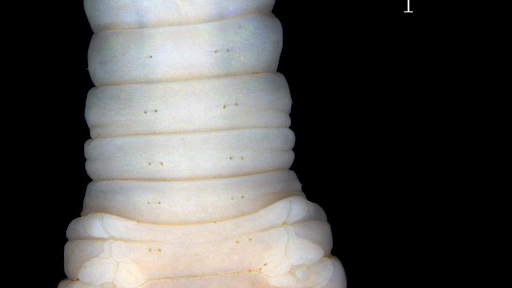
Researchers have identified a new earthworm species, Drawida vazhania, in the Vazhani dam area of the Peechi-Vazhani Wildlife Sanctuary in Thrissur, Kerala.
What is Drawida vazhania?
Discovery: New species of earthworm identified in the Vazhani dam area within the Peechi-Vazhani Wildlife Sanctuary in Kerala.
Taxonomy: Belongs to the genus Drawida and family Moniligastridae.
Characteristics: Part of the Barwelli species group, identified by a distinct grooved male genital field and kidney-shaped prostate.
Significance: It is the 83rd Drawida species in India and the 55th in the Western Ghats, highlighting the region's rich biodiversity.
Western Ghats: A Hub for Earthworm Endemism
Geographical Isolation
The complex terrain and varied microclimates create distinct ecological niches, promoting the evolution of unique species.
High Species Concentration
The Western Ghats and the adjacent west coast plains account for approximately 58.4% of all known earthworm species in India. (Source: The Hindu)
Kerala's Richness
Kerala hosts the highest number of Drawida species among the Western Ghats states, with 31 recorded species, 16 of which are endemic to the state's geography. (Source: Centre for Animal Taxonomy and Ecology)
Adaptive Evolution
Species like Drawida vazhania belong to the ancient Moniligastridae family and have evolved distinct features (e.g., a grooved genital field and kidney-shaped prostate) to thrive in specific local soil conditions.
Source: THEHINDU
|
PRACTICE QUESTION Q. With reference to the recently discovered earthworm species Drawida vazhania, consider the following statements: 1. It was discovered in the Vazhani dam area of Kerala. 2. It belongs to a genus where the vast majority of species are completely endemic to India. Which of the statements given above is/are correct? a) 1 only b) 2 only c) Both 1 and 2 d) Neither 1 nor 2 Answer: c Explanation: Statement 1 is correct: Drawida vazhania was discovered in the Vazhani dam area of the Peechi-Vazhani Wildlife Sanctuary in the Thrissur district of Kerala. Statement 2 is correct: Drawida vazhania belongs to the genus Drawida (family Moniligastridae). While the genus itself is distributed across South, Southeast, and East Asia, the vast majority of Drawida species are endemic to India, with the highest concentration and endemism found in the Western Ghats of Kerala. |
Drawida vazhania is a newly discovered species of earthworm found in the Peechi-Vazhani Wildlife Sanctuary in Kerala. It highlights the rich soil endemism and unique microclimates of the Western Ghats.
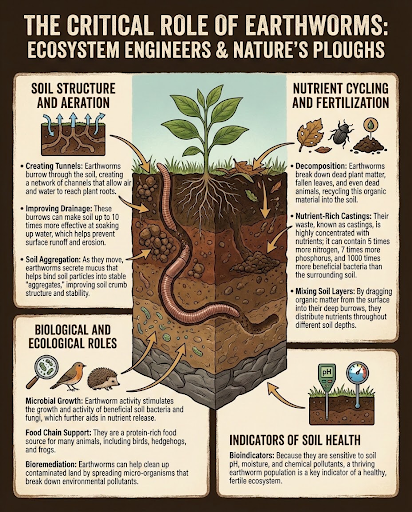
Earthworms physically restructure the soil by burrowing. This activity creates macropores that improve soil aeration, water infiltration, and root growth, while also accelerating nutrient cycling and preventing soil erosion.
Through a process called bioturbation, earthworms help lock organic carbon deep within the soil matrix. Healthy soil ecosystems can store more carbon than the atmosphere and terrestrial vegetation combined.



© 2026 iasgyan. All right reserved