Symbolic decolonization replaces colonial names, laws, and insignia with indigenous markers under the Panch Pran vision. Steps like Kartavya Path, new criminal codes, and cultural symbols aim to reclaim identity, though critics caution against tokenism and urge parallel focus on substantive governance reforms.
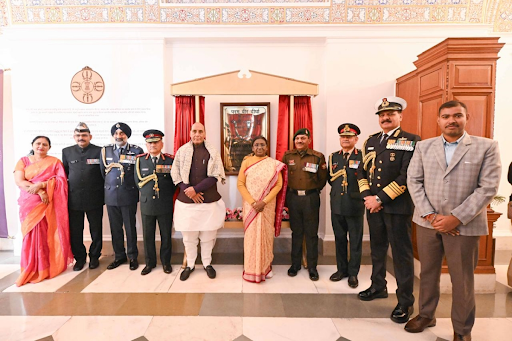
Copyright infringement not intended
Picture Courtesy: ddnews
India has recently made a concerted effort to decolonize various aspects of its national life, from legal frameworks and urban landscapes to military insignia and official attire.
Decolonizing symbols requires a critical look at, and subsequent removal or re-evaluation of, the emblems associated with a former colonial regime.
It is a process of reclaiming cultural identity, correcting historical narratives, and dismantling lingering colonial structures in governance, law, and public consciousness.
Colonial symbols are icons, objects, and structures that represent the authority, culture, and influence of a metropolitan power over a colony.
Place Names: Cities, streets, and public squares named after colonial administrators or monarchs (e.g., Connaught Place in Delhi, Victoria Memorial in Kolkata).
Institutions: Educational and administrative bodies founded on colonial principles and retaining their original names and ethos.
Legal & Administrative Frameworks: Laws and bureaucratic procedures inherited from the colonial era that may not align with modern democratic values.
Public Narratives & Education: Curricula and historical accounts that prioritize a Eurocentric worldview and downplay or misrepresent indigenous history and resistance.
Architectural Landscape: Buildings and city plans designed to project imperial power and authority, such as Lutyens' Delhi.
Rising Global Consciousness
Movements like 'Black Lives Matter' in the USA and 'Rhodes Must Fall' in South Africa have ignited a global conversation about historical injustices and the legacy of colonialism and slavery.
Reclaiming National Identity
Modern decolonization projects aim to revitalize native intellectual and cultural legacies, such as promoting regional languages and literature, to help citizens feel anchored in their own historical settings.
Decolonizing the Mind
Intellectual movements argue colonialism involved intellectual domination. Reclaiming local history and traditions is key to building "cultural confidence."
Youth-Led Activism
New generation is questioning inherited narratives and demanding that public spaces reflect the values of equality, liberty, and justice for all citizens.
Correcting Historical Records
Growing demand to acknowledge and celebrate indigenous heroes, freedom fighters, and cultural achievements that were suppressed during colonial rule.
Symbolic Policy Changes
Governments employ symbolic acts like renaming colonial laws and cities to show that imperial structures no longer guide their future.
|
Approach |
Details |
Example |
|
Removal / Replacement |
Removal of offensive symbols and their replacement with ones that represent national values and heroes. |
The installation of the statue of Netaji Subhas Chandra Bose at India Gate, replacing a vacant canopy that once housed a statue of King George V. |
|
Renaming |
Changing the names of places, streets, and institutions to honour indigenous history, language, and leaders. |
The renaming of Rajpath to 'Kartavya Path' in New Delhi, symbolizes a shift from a ruling to a serving mindset. |
|
Re-contextualization |
Keeping a symbol but adding new information to provide a critical perspective on its historical context and legacy. |
Many museums in the West are now adding context to colonial-era artifacts, explaining how they were acquired and their significance to their original cultures. |
|
Legal & Institutional Reform |
Modernizing colonial-era laws and administrative frameworks to ensure they are consistent with the national constitution and contemporary needs. |
Replacement of the Indian Penal Code (IPC), Code of Criminal Procedure (CrPC), and the Indian Evidence Act with the Bharatiya Nyaya Sanhita, Bharatiya Nagarik Suraksha Sanhita, and Bharatiya Sakshya Adhiniyam respectively. |
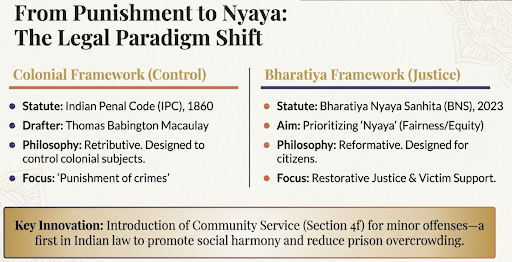
Symbolism vs Substance
Critics argue that symbolic focus can distract from addressing deeper, structural colonial legacies like economic inequality, poverty, and social discrimination, emphasizing that symbolic changes must be paired with substantive policy action.
Erasing History vs Truth-Telling
The debate over removing statues or renaming places revolves around whether it erases history or redefines whom society chooses to honour by presenting a more complete and truthful version of the past.
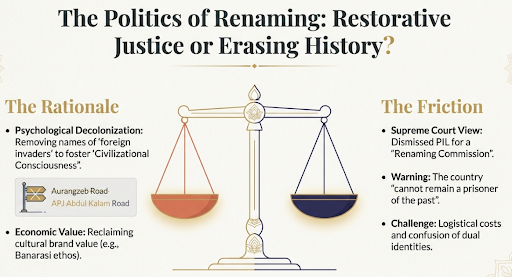
"Cancel Culture" vs Accountability
The debate polarizes around "cancel culture" versus historical revisionism. A balanced approach necessitates democratic dialogue among historians, communities, and policymakers to create a transparent, legitimate decision-making process.
Decolonizing symbols is not an act of erasing the past but an essential process of shaping an inclusive and just future.
The process must be democratic, inclusive, and seen as a crucial component of a larger project: building a self-reliant (Atmanirbhar) nation that is confident in its own heritage and clear about its future path.
Source: INDIANEXPRESS
|
PRACTICE QUESTION Q. While the intent to 'Indianise' colonial-era institutions and laws is laudable, what are the potential challenges and socio-political implications of this process? Discuss. 150 words |
Symbolic decolonization is the process of replacing colonial-era names, statues, laws, and symbols (like the St. George's Cross on the naval ensign) with ones that reflect India's own indigenous history, culture, and values.
Prominent examples include renaming Rajpath to Kartavya Path, replacing the IPC with the Bharatiya Nyaya Sanhita (BNS), unveiling a new naval ensign inspired by Chhatrapati Shivaji Maharaj's seal, and installing the 'Sengol' in the new Parliament building.
Critics argue that it is a form of 'tokenism' that distracts from issues like poverty and unemployment. They also point to financial costs of these changes, raise accusations of political motivation to rewrite history, and warn against erasing a part of India's past, however oppressive.




© 2026 iasgyan. All right reserved