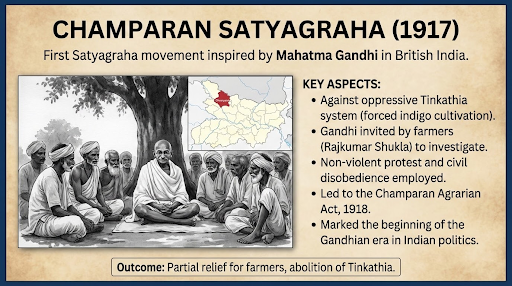
Mahatma Gandhi launched the 1917 Champaran Satyagraha in Bihar to support peasants against the exploitative British Tinkathia system. This first civil disobedience movement successfully abolished forced indigo cultivation and secured a partial refund of illegal dues for the farmers.
The Vice-President addressed the convocation at Mahatma Gandhi Central University in Motihari, honoring the city as the birthplace of the 1917 Champaran Satyagraha.
The Champaran Satyagraha of 1917 was not just an agrarian protest; it was the laboratory where Mahatma Gandhi tested the weapon of Satyagraha (Truth-Force) on Indian soil for the first time.
The event marks the transition of the Indian National Movement from elite petitioning to mass-based resistance.
Historical Background
The unrest in the Champaran district of Bihar was rooted in the exploitative indigo plantation system introduced by European planters.
The Tinkathia System: Under this, tenant farmers (ryots) were legally forced to cultivate indigo on 3/20th (three kathas per bigha) of their landholdings.
Economic Impact of German Dyes: By the early 20th century, the invention of synthetic German dyes had rendered natural indigo unviable.
The Trigger: The farmers were trapped—forced to grow an unprofitable crop or pay extortionate sums to stop. This led to widespread peasant unrest in the region.
Timeline of Events
The Invitation (1916): At the Lucknow Session of the Congress, a local agriculturist named Raj Kumar Shukla persistently requested Gandhi to witness the plight of the farmers.
Arrival and Defiance (April 1917): Gandhi arrived in Motihari, the district headquarters.
The Inquiry: Facing massive public support, the government withdrew the case and allowed Gandhi to investigate.
Champaran Agrarian Committee
Instead of an immediate agitation, Gandhi insisted on a thorough, data-driven inquiry. The government was eventually forced to constitute the Champaran Agrarian Enquiry Committee, with Gandhi as a member.
The Compromise: The committee found the planters guilty of exploitation.
Legislative Outcome: The recommendations led to the passing of the Champaran Agrarian Act, 1918, which formally abolished the Tinkathia system.
First Civil Disobedience: It was the first successful execution of Civil Disobedience (refusing to obey an unjust law) in India.
Emergence of Mass Politics: It shifted the freedom struggle from the conference rooms of lawyers to the fields of peasants. For the first time, the "masses" were integrated into the national movement.
Psychological Victory: The partial refund broke the myth of the British planters' invincibility and taught the peasantry that they had rights.
Leadership Development: It created a cadre of leaders like Rajendra Prasad and Anugrah Narayan Sinha who would lead Bihar and India in later years.
Source: DDNEWS
|
PRACTICE QUESTION Q. Which of the following was a direct outcome of the Champaran Satyagraha? A) Total refund of all illegal dues collected by the planters. B) The immediate withdrawal of the British from Bihar. C) The agreement by planters to refund 25% of the money they had taken illegally. D) The introduction of the Ryotwari system in the region. Answer: C Explanation During the Champaran Satyagraha of 1917, Mahatma Gandhi joined the official Champaran Agrarian Committee to investigate the exploitative practices of British indigo planters. The committee found the planters guilty of extracting illegal dues (known as tawan). As a settlement, Gandhi agreed to a 25% refund of the money. Gandhi accepted this 25% refund—even though he initially asked for 50%—because he believed the loss of the planters' prestige was more important than the actual amount of money returned. |
The Champaran Satyagraha of 1917 was India's first civil disobedience movement led by Mahatma Gandhi. It was launched in the Champaran district of Bihar to protest the oppressive conditions faced by local peasant farmers who were forced to grow indigo by British planters.
The Tinkathia system was an exploitative agricultural practice in Champaran where British planters legally coerced local tenant farmers to cultivate indigo on 3/20th (three kathas per bigha) of their land, severely impacting local food security and farmer incomes.
The movement led to the constitution of the Champaran Agrarian Enquiry Committee (with Gandhi as an official member). This resulted in a 25% refund of the illegally extracted money and culminated in the enactment of the Champaran Agrarian Act of 1918, which legally and permanently abolished the Tinkathia system.



© 2026 iasgyan. All right reserved