Researchers recently identified Calamaria garoensis, a new species of non-venomous burrowing reed snake in Meghalaya's West Garo Hills. It features unique longitudinal stripes and 13 rows of smooth scales.
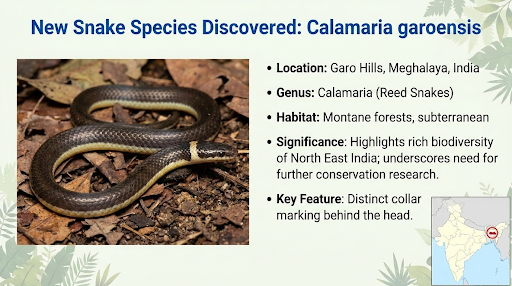
Calamaria garoensis, a new species of fossorial reed snake, has been discovered in the Garo Hills of Meghalaya
Researchers discovered a new species of burrowing reed snake, Calamaria garoensis, in the West Garo Hills district of Meghalaya.
Key Characteristics of Calamaria garoensis
This species is distinct from other reed snakes due to specific morphological and genetic traits:
Habitat and Distribution
Source: TIMESOFINDIA
|
PRACTICE QUESTION Q. In which Indian state was the new snake species Calamaria garoensis discovered? A) Assam B) Mizoram C) Meghalaya D) Arunachal Pradesh Answer: C Explanation Researchers recently identified Calamaria garoensis, a new species of non-venomous burrowing reed snake in Meghalaya's West Garo Hills. |
It is a newly discovered species of fossorial (burrowing) reed snake found in the West Garo Hills district of Meghalaya. It lives underground or under decaying logs and feeds on soft-bodied invertebrates like earthworms.
Its discovery highlights the immense, undocumented biodiversity of the Indo-Burma Hotspot. Furthermore, its presence serves as an important bio-indicator of undisturbed, moisture-rich soil and a healthy, functioning forest floor ecosystem.
PES is a conservation model where landowners or indigenous communities receive direct financial incentives for preserving natural habitats. In Meghalaya, a state and World Bank-backed PES program is successfully used to encourage the protection of forests and micro-ecosystems like Living Root Bridges.





© 2026 iasgyan. All right reserved