Description
Disclaimer: Copyright infringement not intended.
Context:
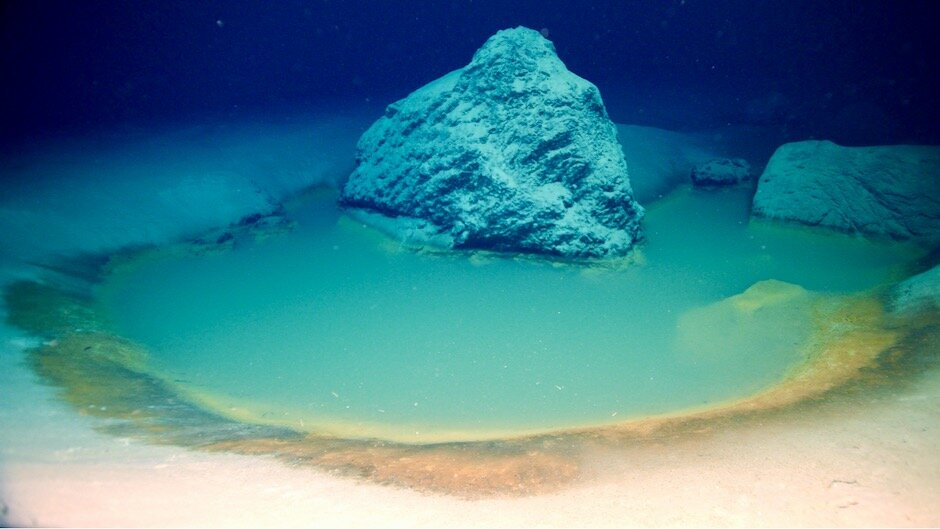
- Scientists recently made a discovery beneath the Red Sea. It is brine pools, which are extremely dangerous for marine life.
- These pools have high salinity and lack oxygen. And this makes them lethal for most sea creatures that enter them.
What Are Brine Pools?
- Brine pools are bodies of water found on the ocean floor. These pools are:
-
- Hypersaline: They have a salt content much higher than regular seawater.
- Anoxic: They lack oxygen and create an environment where most marine life cannot survive.
- Due to their high salt content, brine pools are denser than the surrounding ocean water, which prevents them from mixing with it.
- This results in a distinct "lake-like" appearance under the sea.
Why Does Dense Water Not Mix With Less Dense Water?
It happens because of differences in their buoyancy:
●Density Difference: Dense water has more mass in the same volume compared to less dense water. This makes it heavier.
●Buoyancy: Buoyancy is the force that causes less dense (lighter) substances to float on denser (heavier) ones. When you have dense water at the bottom and less dense water on top, the less dense water naturally floats above the denser water.
●Separation: Since the dense water is heavier, it doesn't want to rise to the top, and the less dense water doesn't want to sink to the bottom. So, the two layers stay separate, preventing them from mixing easily.
In nature, mixing happens more when water is disturbed (like through currents or wind), but in calm, stable conditions, dense and less dense water stay separated.
|
Key Facts About Brine Pools
- Formation: It forms in depressions on the seafloor where salt and other minerals accumulate. It creates water so salty that it can't mix with the surrounding seawater.
- The deepest known brine pool is in the Orca Basin in the Gulf of Mexico. It is about 2,200 meters below sea level.
- This brine pool covers an area of 7 x 21 km and contains water that is roughly 8 times saltier than the surrounding Gulf water.
- Toxicity: These extreme conditions make these pools toxic to most marine life. However, certain specialized organisms, like chemosynthetic bacteria, have adapted to survive in these harsh conditions and thrive around the brine pools.
About the Red Sea

- The Red Sea is a narrow inlet of the Indian Ocean, located between Africa and Asia.
- It is the northernmost tropical sea in the world and is one of the busiest shipping routes.
- The Red Sea connects to the Arabian Sea and the Indian Ocean through the Gulf of Aden and the narrow Bab el Mandeb strait.
- The northern part of the Red Sea is divided by the Sinai Peninsula into two gulfs: the Gulf of Aqaba and the Gulf of Suez.
- The Gulf of Suez is linked to the Mediterranean Sea by the Suez Canal.
- The Red Sea covers about 438,000 square kilometers and stretches for around 2,250 km in length.
- Bordering Countries:
- To the east: Yemen and Saudi Arabia.
- To the north and west:
- To the west: Sudan, Eritrea, and Djibouti.
- The Red Sea is one of the warmest seas in the world.
- Its water is also among the hottest and saltiest.
- The name "Red Sea" comes from the occasional reddish-brown color caused by algae blooms. Normally, the sea is a blue-green color.
- Islands: Notable islands in the Red Sea include Tiran Island, located near the Gulf of Aqaba, and Shadwan Island, located at the entrance of the Gulf of Suez.
What is a Strait?

A strait is a narrow waterway that connects two larger bodies of water and is surrounded by land on both sides. Examples include:
- The Bering Strait, which connects the Arctic Ocean with the Bering Sea, and separates Asia and North America.
- The Strait of Gibraltar, between Spain and Africa, connecting the Mediterranean Sea with the Atlantic Ocean.
|
PRACTICE QUESTION
Q.Why do brine pools remain separated from the surrounding seawater?
a) Due to differences in temperature
b) Due to the chemical composition of the water
c) Due to differences in the density of water
d) Due to the presence of marine life
Answer: c)
Explanation:
●Brine pools are denser than the surrounding ocean water due to their high salt content.
●The density difference causes the denser water to stay at the bottom while the less dense water stays on top.
●This phenomenon prevents the two waters from mixing, resulting in the separation of the brine pools from the surrounding seawater.
● This behavior is due to buoyancy, where lighter substances float above heavier ones.
|