Bengal played a pioneering role in the Indian National Movement by shaping its ideological foundations, organisational structure, and methods of struggle. From the Bengal Renaissance and Swadeshi Movement to revolutionary activism, mass mobilisation, and cultural nationalism, the region acted as the vanguard of anti-colonial resistance. Bengal’s leaders, institutions, and movements profoundly influenced the direction and character of India’s freedom struggle.
Copyright infringement not intended
Picture Courtesy: The Hindu
Context:
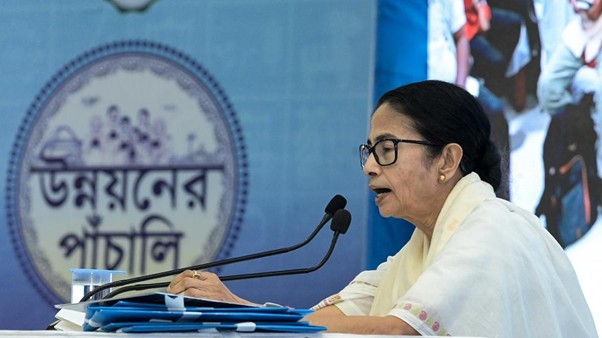
West Bengal Chief Minister Mamata Banerjee welcomed a discussion on 150 years of Vande Mataram in the Lok Sabha but added that central government were not aware of the contribution of Bengal in the freedom struggle.
|
Must Read: Socio-Religious movement | LORD CURZON | |
What are the contributions that Bengal made towards Indian National movements?
Ideological Leadership:
Bengal spearheaded the ideological awakening of nationalism in India. The Bengal Renaissance fostered modern political thought, rationalism, social reform, and anti-colonial consciousness. Thinkers and leaders such as Raja Ram Mohan Roy, Bankim Chandra Chattopadhyay, Rabindranath Tagore, and Swami Vivekananda shaped ideas of national identity, self-respect, and cultural revival, laying the philosophical foundation of Indian nationalism.
Birthplace of organised nationalism:
Modern Indian nationalism first took organised political shape in Bengal. The formation of the Indian National Congress (1885) was preceded by political associations in Bengal such as the Indian Association (Surendranath Banerjee), which mobilised educated Indians and popularised constitutional agitation.
Role in the Swadeshi and Anti-Partition Movement (1905):
The Partition of Bengal (1905) marked a decisive turning point in the freedom struggle. Bengal became the epicentre of the Swadeshi and Boycott Movement, introducing:
This movement transformed nationalism from elite politics to mass participation.
Literary Resistance:
Bengal used literature, art, music, and theatre as instruments of resistance.
Organisational foundations of nationalism:
Bengal pioneered the creation of early political organisations that laid the groundwork for all-India nationalism.
Role of trade unions and labour organisations:
Calcutta emerged as an early centre of labour organisation.
Agrarian movements:
Bengal’s contribution included strong peasant mobilisation through organised movements.
How British responded to the National Movement in Bengal?
Partition of Bengal (1905): The Partition of Bengal by Lord Curzon was a political strategy to divide and weaken nationalist unity by exploiting communal and regional differences. Though justified on administrative grounds, it was widely perceived as a punitive response to Bengal’s rising political consciousness and mass mobilisation.
Press censorship
To suppress nationalist journalism emerging from Bengal, the British enacted stringent press controls:
Papers like Amrita Bazar Patrika and Bande Mataram were frequently censored, fined, or forced to shut down, reflecting fear of public opinion mobilisation.
Preventive detention and emergency powers
To counter revolutionary organisations, the British enacted extraordinary laws:
Suppression of revolutionary organisations
Secret societies such as Anushilan Samiti and Jugantar were targeted through mass arrests, deportation to the Andaman Cellular Jail, police surveillance and informant networks. The execution of revolutionaries like Khudiram Bose and trials such as the Alipore Bomb Case exemplified the state’s hardline response.
Conclusion:
Bengal made a foundational and multidimensional contribution to the Indian National Movement by shaping its ideas, organisations, leadership, and methods of struggle. From intellectual awakening and cultural nationalism to mass mobilisation, revolutionary activism, and institution-building, Bengal acted as the vanguard of Indian nationalism. Its initiatives not only challenged colonial authority but also set the tone, strategy, and direction of the freedom struggle across India, leaving a lasting imprint on the nation’s path to independence.
Source: The Hindu
|
Practice Question “Bengal was not merely a participant but a pioneer of the Indian National Movement.” With reference to the Brahmo Samaj, consider the following statements: 1. It was founded by Raja Ram Mohan Roy in Calcutta in 1828. 2. The Brahmo Samaj supported idol worship and traditional priestly rituals. 3. It played an important role in promoting women’s education and social reform. 4. Leaders like Debendranath Tagore and Keshab Chandra Sen were associated with its later development. Which of the statements given above are correct? A. 1 and 2 only Answer: B Explanation
|
Bengal witnessed the earliest political awakening through social reform, modern education, nationalist literature, and organised political associations, making it the first region to articulate a coherent nationalist ideology.
Bengal was the epicentre of the Swadeshi and Boycott Movement (1905) following the Partition of Bengal, introducing mass mobilisation, economic nationalism, and cultural resistance to colonial rule.
Bengal produced several revolutionary organisations such as Anushilan Samiti and Jugantar, and revolutionaries like Khudiram Bose, Bagha Jatin, and Surya Sen, who challenged British authority through militant action.






© 2026 iasgyan. All right reserved