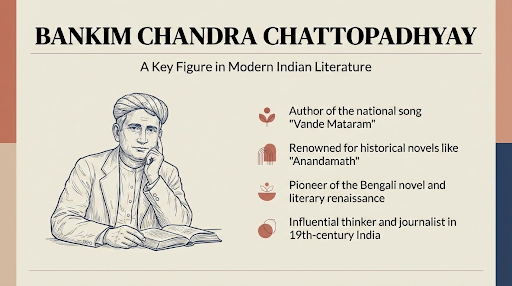
Bankim Chandra Chattopadhyay bridged colonial service with nationalist fervor, immortalizing the Indian soul through "Vande Mataram." His literary genius, notably in Anandamath, catalyzed the Bengal Renaissance and provided a spiritual foundation for the freedom struggle against British imperial rule.
The Union Home Minister, Shri Amit Shah pays tribute to the great patriot and nationalist writer Bankim Chandra Chattopadhyay on his death anniversary (April 8).
Bankim Chandra Chattopadhyay (1838–1894) was an important personality in the 19th-century Bengal Renaissance.
He was a novelist, poet, and journalist, famously known as the composer of Vande Mataram, which became the slogan of the Indian independence movement.
On his birth anniversary (June 27) and death anniversary (April 8), he is remembered as the "Sahitya Samrat" (Emperor of Literature) who infused a sense of pride and cultural identity into a colonized nation.
|
Key Facts First Graduate: He was one of the first two graduates of the University of Calcutta in 1858. Professional Career: He served as a Deputy Magistrate and Deputy Collector under the British Government for over 30 years. |
Literary Contributions & Nationalism
Anandamath (1882) and Vande Mataram
Bangadarshan (1872): Bankim launched this monthly literary magazine to promote a Bengali "public sphere," promoting historical research, scientific temper, and a unified identity.
Durgeshnandini (1865): His first Bengali novel and the first major modern novel in Indian literature.
Rajmohan's Wife (1864): His first and only novel written in English, making it the first Indian novel in English.
Kapalkundala (1866): Considered one of the finest romantic novels in Bengali literature.
Devi Chaudhurani (1884): Portrayed a powerful woman protagonist as a rebel leader, reinforcing the theme of "Shakti".
Philosophical and Social Views
Religious Thought: In Dharmatattva and Krishna Charitra, he re-interpreted Hinduism by portraying Lord Krishna as an ideal man, politician, and social reformer to inspire the youth.
Samya (Equality): He wrote an essay titled Samya where he discussed egalitarianism and criticized social inequalities, influenced by Western thinkers like John Stuart Mill.
Role in the Freedom Struggle
Cultural Nationalism: Bankim’s work moved away from "mendicancy" (begging the British for reforms) toward Atmashakti (Self-reliance). He used the image of Mother India to unify a diverse population.
Inspiration for Revolutionaries: His call for sacrifice in Anandamath deeply influenced secret societies and revolutionaries like Aurobindo Ghosh and the Anushilan Samiti.
Language as a Tool: He proved that Indian vernacular languages were capable of expressing complex modern ideas, thus challenging the hegemony of the English language.
Bankim Chandra Chattopadhyay balanced a professional colonial career with a literary legacy that championed the Indian soul, most notably through "Vande Mataram," which became the immortal anthem of India’s struggle for independence.
Source: PIB
|
PRACTICE QUESTION Q. With reference to Bankim Chandra Chattopadhyay, consider the following statements: 1. He was the first Indian to be appointed as a Deputy Magistrate in the British administration. 2. His first published novel, Rajmohan’s Wife, was written in English. 3. He was among the first graduates of the University of Calcutta. Which of the statements given above are correct? A) 1 and 2 only B) 2 and 3 only C) 1 and 3 only D) 1, 2, and 3 Answer: B Explanation: Statement 1 is incorrect. Bankim Chandra Chattopadhyay was appointed as a Deputy Magistrate in 1858, but he was not the first Indian to hold this post. His own father, Yadav Chandra Chattopadhyay, served as a Deputy Collector (a position often combined with Deputy Magistrate in the Subordinate Executive Service) before him. Statement 2 is correct. His first published novel, Rajmohan's Wife, was written in English and serialized in 1864. Statement 3 is correct. He was indeed among the first graduates of the University of Calcutta. He and Jadunath Bose passed the B.A. examination in 1858, becoming the university's first two graduates. |
Bankim Chandra Chattopadhyay is revered as the "Sahitya Samrat" (Emperor of Literature) for his unparalleled contribution to modern Indian literature and cultural nationalism during the colonial era.
Although he passed away before the Swadeshi Movement (1905), his hymn *Vande Mataram* became its mass battle cry. His writings conceptualized the nation as a "Mother Goddess," directly inspiring revolutionaries like Aurobindo Ghosh and secret societies like the Anushilan Samiti.
Bankim Chandra strongly advocated for knowledge dissemination and literary creation in the mother tongue to build national consciousness. This directly mirrors NEP 2020's emphasis on using regional languages as the medium of instruction to enhance cognitive development and cultural rootedness.


© 2026 iasgyan. All right reserved